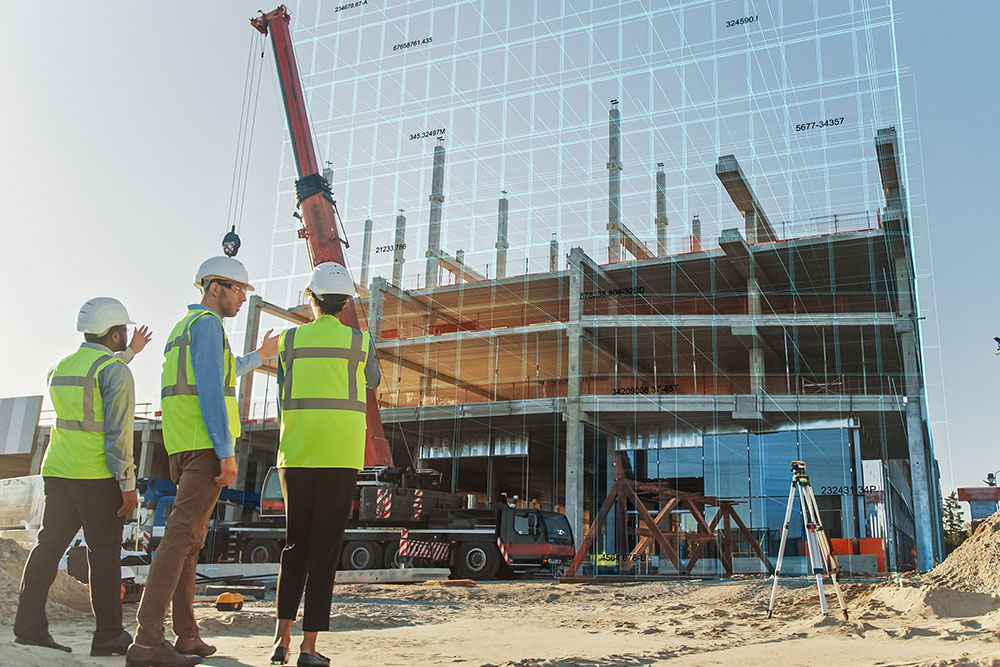

Data and its implementation are now commonplace. Every company is working on it. Of course, some more than others, but it is almost impossible to exclude yourself from it. In the construction industry, it is overwhelmingly a requirement to keep up with the times.
Ultimately, an efficient approach to a construction project offers significant benefits. Especially in terms of sustainability, efficiency and cost-effectiveness.
BIM
Originally an abbreviation for Building Information Modelling. Better known in the Netherlands as a building information model. BIM is a digital model that brings together all aspects of a construction project and is used by all parties involved. For example, the model contains information on the materials to be used, the positioning of (for instance, a wall) within a floor, which electrical installations are incorporated into that wall, and much more besides. Consider, for example, how the ventilation system is connected throughout the project, or where the sanitary facilities are to be installed. All this information ‘communicates’ with one another, ensuring that the logistics surrounding the project can run seamlessly. This efficiency helps to minimise, for example, failure costs, which in the construction industry amount to between 5 per cent and 15 per cent.
Reality
Of course, different types of 'Reality' have made their appearance in construction. Through virtual reality (VR) and augmented reality (AR), projects can become visible well before construction has started. Whereas with VR you are in a fully digital environment, AR offers the possibility of showing a combination of the real environment and the digital one. Especially very useful within renovation projects as you can see how the planned fits within the existing environment.
DigiBuild
Developments are happening at lightning speed and it is especially important that all stakeholders are well informed. There is a lot of information out there, but often specialised and in one specific area. A new initiative by Jaarbeurs brings it all together. On 20 and 21 November, there will be DigiBouw. This new event should be the meeting place where construction and installation professionals get tools to accelerate digitalisation within their company.
Improve adoption
With its knowledge and experience, the Netherlands is one of the leaders in Europe in digitalisation in the construction and installation sector. Jeroen van Hooff, CEO Royal Jaarbeurs: "In recent years, we see that under the influence of sustainability and energy transition, the construction and installation sector is facing a major challenge. Legislation has also tightened up with the addition of the Building Quality Assurance Act (Wkb). However, we see that the adoption of digitalisation among construction and installation professionals can be improved. I am proud that from now on, in cooperation with digiGO, we can also offer a platform for the Dutch builder who wants to know all about digitalisation of his construction business." Pieter van Teeffelen, director Direction & Organisation, digiGO: "We are going to set the pack in motion towards more digital collaboration and that is why we are collaborating with Jaarbeurs on this new event."
Sharing knowledge
During DigiBouw, frontrunners from the market share how they have digitised their business processes. Pieter Beuker, Management Member Sales & Customer Success at Pro4all and one of the frontrunners: "The construction industry is facing big challenges: newspapers are full of nitrogen, the WKB and the housing shortage. But you never actually hear anything about work pressure, because the tough men and women of construction are used to it. While research by Berenschot recently showed that one in four UTA workers suffer from excessive work pressure. By deploying software to make construction processes run more smoothly, you reduce that workload and make room to tackle other major challenges. As a software supplier, we are happy to contribute to that."
Find out more about DigiBouw at DigiBouw.nl.