Battery pays off, but returns are uncertain
The power supply of companies is becoming more versatile. Business owners used to get all their power from the grid. Now, more and more SMEs generate their own power with solar panels. Storing power in a large battery is the next step. Such a battery can generate so much revenue that the power supply no longer costs money, but makes money. However, the returns are uncertain due to choices yet to be made in the climate agreement. Batteries are therefore not yet a standard solution, as solar panels already are. Companies that want to make their power supply more sustainable will therefore go with solar panels rather than batteries, the Economic Research Bureau calculated in a recently published report.
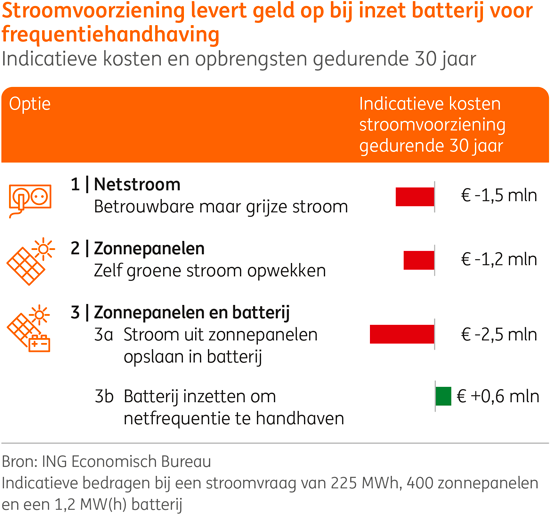
Power supply makes money when using battery to maintain grid frequency
Indicative revenues and costs over 30 years
Battery can make power supply make money instead of costing money
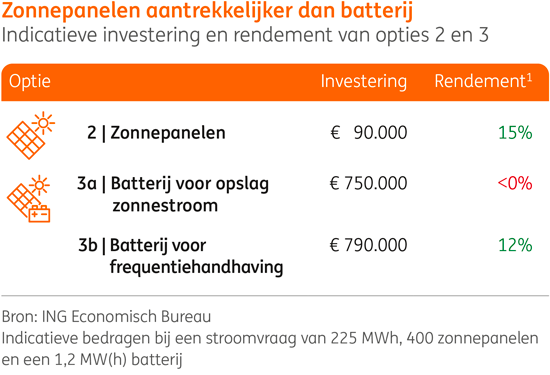
A battery can generate so much revenue that power supply no longer costs money, but makes money. An "average SME" pays around €1.5 million for grid power over a 30-year period. With solar panels and a battery, the power supply can generate as much as €620,000. The battery must then be fully deployed to keep the grid frequency at 50 Hertz. Then the entrepreneur can achieve a return on equity of around 12%. The battery is currently too expensive to be used only for storing self-generated solar power.
Solar panels more attractive than battery
Indicative investment and return of options 2 and 3
Battery not yet suitable for many entrepreneurs
An investment in large-scale battery storage can now generate a return on equity of around 12%, but the risks are high. The climate agreement is strongly committed to making the power market more flexible to accommodate the increase in solar and wind energy. Batteries can contribute to this, but returns depend on choices yet to be made in the climate agreement. In addition, a lot of knowledge of the electricity market is needed for entrepreneurs to make money from a battery. Batteries are not something you 'just do on the side' as an entrepreneur. Solar panels are, require a lower investment and the return on equity of around 15% is more attractive.
"Batteries, unlike solar panels, are not yet a standard solution for SMEs. Entrepreneurs who want to make their power supply more sustainable will therefore mainly go with solar panels. Those who do want to store power in batteries would be wise to first rent a battery and gain experience," says Martijn Stevens: sustainability programme manager for large businesses at ING.
Battery investment not always financially driven
Besides these financial arguments, companies can also invest in batteries from other motives. For instance, batteries can also replace polluting generators and help companies make their emergency power supply more sustainable or reduce nitrogen emissions on construction sites.
Copyright: ING Economics Department. Images: ING and Getty Images
Full article on ING.nl