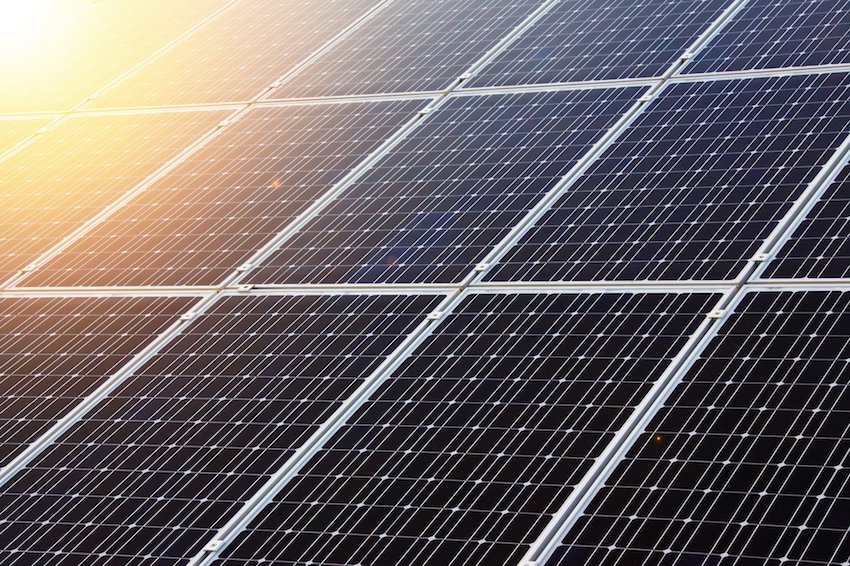

A new electrolyser is capable of producing green hydrogen using solar energy generated by the device itself. It is a completely stand-alone unit, integrating all the necessary components.
The electrolyser was developed by the Fraunhofer Institute as part of the Neo-PEC research project. The German applied scientific research organisation sees an important role for hydrogen in reducing our climate impact. "A fuel that burns without emitting CO2 should be produced without any CO2 footprint if possible," states the Fraunhofer Institute.
Green hydrogen
Specifically, the institute is referring to green hydrogen. An electrolyser converts water into hydrogen and oxygen using electricity. If it uses sustainable energy sources for electricity, it is green hydrogen. Does it involve non-renewable energy sources? Then we call this grey hydrogen.
It has long been possible to generate green hydrogen. However, in practice, the electrolysers required for this are bulky, complex, costly and maintenance-intensive. In addition, the devices are difficult to obtain in practice, partly due to the high demand for renewable energy sources.
Photo electrochemical cells
The Fraunhofer Institute is setting up photoelectrochemical cells (photoelectrochemical cell / PEC). This is a solar cell that converts light into electrical energy through photoelectrochemistry. Within the Neo-PEC research project, researchers from three Fraunhofer Institutes are collaborating on a modular solution in this field: Fraunhofer Institute for Ceramic Technologies and Systems (IKTS), Fraunhofer Institute for Surface Engineering and Thin Films (IST) and Fraunhofer Center for Silicon Photovoltaics (CSP).
One concrete development by the team is the so-called tandem PEC module. This is similar in many ways to a traditional PEC module. Characteristically, however, both solar energy production and the electrolysis process take place in the same unit. This is in contrast to traditional PECs, where solar power generation and the electrolysis process take place in different places.
"The entire process takes place in one and the same unit. Caution is needed here: since the process results in hydrogen and oxygen, the structure must be designed to maintain strict separation between the two elements during generation and beyond," report the researchers.
Glass plate with conductive material on both sides
Tandem cell features a glass plate coated with conductive materials on both sides. If sunlight hits the glass, one side of the module absorbs short-wave radiation. The long-wave radiation passes right through this glass, and is absorbed by the coating on the other side. The module then releases hydrogen on one side (acting as a cathode) and oxygen on the other side (acting as an anode).
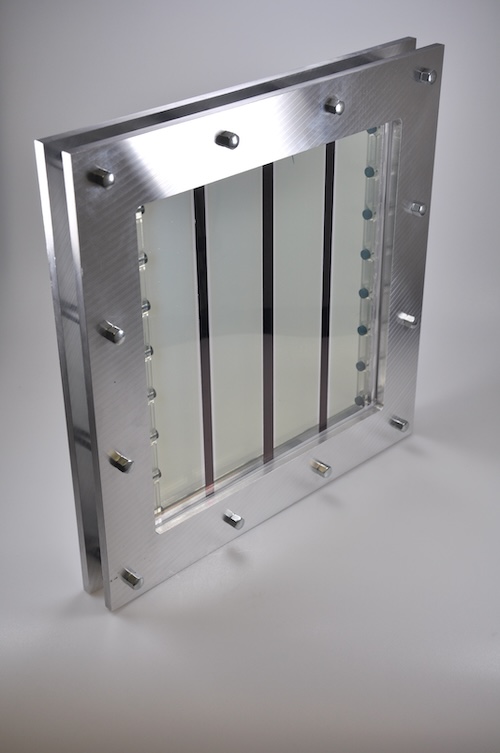
The researchers have succeeded in developing a very pure conductive material, which helps increase the yield of the electrolysis process. "We use the vapour phase to form layers just nanometres thick on the glass. The structures we create in the process have a huge impact on reactor operations in addition to the actual material properties, which we have also optimised," explains Dr Arno Görne, group manager of Functional Materials for Hybrid Systems at the Fraunhofer Institute for Ceramic Technologies and Systems IKTS.
Good for range of 20,000 kilometres per year
The result is a reactor with an active area of half a square metre. Produced hydrogen can be directly collected and quantified. Currently, a single module exposed to sunlight under European conditions can generate over 30 kilograms of hydrogen per year from an area of 100 square metres. With this yield, a hydrogen car can travel 15,000 to 20,000 kilometres, for example, the researchers report.
"In terms of the dimensions of the tandem cell, we are limited by the fact that our module splits water directly, but this also requires electricity to go from one side to the other. As the module area increases, the increasing resistance has an adverse effect on the system. As things stand, the existing format has proved optimal. It is stable, robust and significantly larger than any comparable solution," states Görne. The compact elements can be connected as needed without negative side effects, from a single module to large areas. The researchers call this a key advantage of their solution.
Author: Wouter Hoeffnagel
Image: PublicDomainPictures via Pixabay











