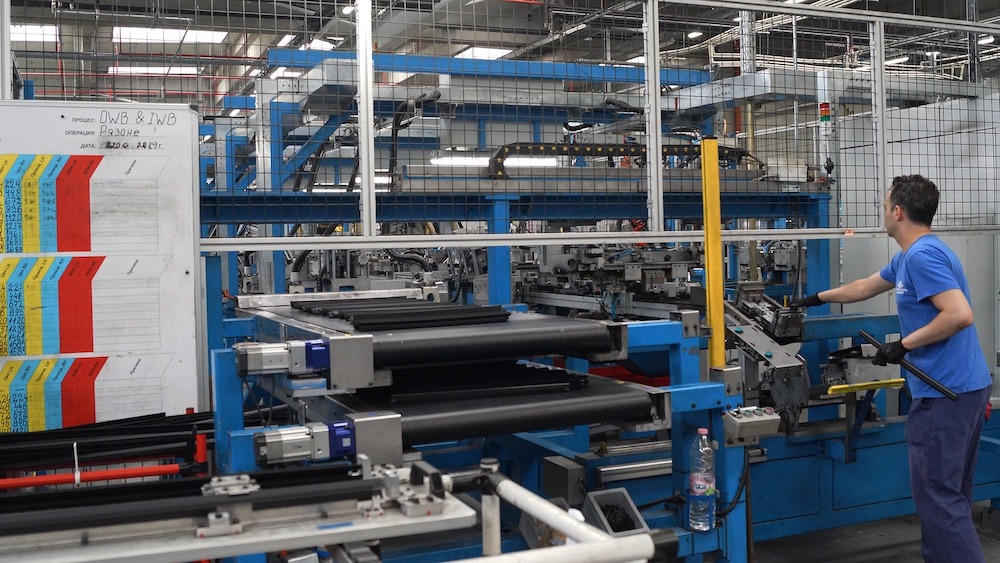

Breakdowns can quickly run into costs for companies. A new system based on artificial intelligence (AI) should provide relief.
Failures come in all shapes and sizes. Think of a bank's app that does not function or a website that is inaccessible, but also an entrance gate or door that will not open or a part of a production line that breaks down. The damage can quickly add up for companies. For example, because production comes to a standstill and deliveries have to be postponed.
Preventing by predicting
The University of Twente, Saxion University of Applied Sciences, TNO-ESI and VU University Amsterdam are working on the new system within the project ZORRO. ZORRO stands for Engineering for Zero Downtime in Cyber-Physical Systems via Intelligent Diagnostics. The parties want to use AI to better predict failures, which should help prevent them. The project will receive a research grant of three million euros.
The kick-off of the project took place last week. Within the ZORRO project, the parties involved are working on diagnostic methods for high-tech systems. These include MRI scanners and printers.
Monitoring equipment behaviour
The researchers deploy sensors to monitor equipment behaviour. Algorithm can then detect anomalous patterns in the collected data, and correlate them to possible causes. This enables companies to take timely action. For example, by preventively replacing or repairing components. They thus prevent unexpected failures and can schedule downtime if unavoidable.
"Intelligent diagnostics is an active research area; where several research projects are ongoing ZORRO is unique because we focus on the system as a whole, rather than individual components," explains Mariëlle Stoelinga, professor of Risk Management for High-tech system at the University of Twente.
Complex interactions and dependencies
"This makes it complex: within a system, components have all kinds of complex interactions and dependencies. To develop diagnostics for that, that's the challenge. For example, we want to develop efficient monitoring systems through smart combinations of sensors. Another work package in the project focuses on linking domain knowledge to data-driven algorithms. For this, we develop new diagnostic models and integrate them into the development process for high-tech systems."
Vice-project leader Carmen Bratosin of TNO-ESI: "This multi-company programme gives us confidence in wide applicability. It enables us to accelerate our efforts to realise ESI's diagnostics roadmap for the high-tech industry."
National investment programme KIC
The three million euro grant made available for the project comes from the call 'Next Generation Hightech Equipment: cyber-physical systems'. This call is part of the Knowledge and Innovation Covenant (KIC) research programme. This programme is aimed at realising ground-breaking innovative solutions with social and economic impact. Companies, knowledge institutions and governments all invest together in the business application of knowledge. The aim is to tackle major societal challenges using smart technologies.
The project is being pulled by UT professor Marielle Stoelinga and co-project leader Carmen Bratosin of TNO-ESI. ASML, Canon Production Printers, ITEC, Philips, and Thermo Fisher Scientific are involved from the industry side.
Author: Wouter Hoeffnagel
Photo: X3 via Pixabay











