The TU Delft Solar Boat Team became world champion solar boat racing on the open sea at the Solar & Energy Boat Challenge 2019 last weekend. It was the first time the university competed offshore with its own designed and manufactured solar boat.
That the team became champion in Monaco is pretty handsome. It faced a number of setbacks, including a broken part during the final test and a problem with the electrical system around the solar panels. The TU Delft Solar Boat Team, made up entirely of students, wanted to show by participating in the reace that solar energy can also defy the open sea. Team manager Kristian de Ruiter says in a press release, "After all the setbacks, I wouldn't have dared to dream that we eventually became world champions. I am immensely proud of the team for persevering despite everything and that this has finally been rewarded with this fantastic result."
The race days were a huge emotional rollercoaster for the team. On Friday, the first race took place between Monaco and Ventimiglia(IT) and covered a distance of 30 km. De Ruiter says: "Due to excellent conditions, a team that worked very well together and perfectly functioning boat, we were able to achieve very high speeds and even set a speed record for the boat with a speed 35 km/h."
Damage to electronic system
After successfully sailing out of the endurance race on Friday, the team discovered damage to the electrical system around the solar panels. Olmar van Beurden, chief electronics, explained: "The damage was caused by internal heat. Unfortunately, this damage could no longer be fully repaired before the next race on Saturday. To ensure no more damage to the boat, and to ensure the safety of the pilots, we decided to remove the solar panels from our boat and sail Saturday's race on the energy stored in the batteries."
The long-distance 60km race that took place on Saturday was therefore quite a challenge. "The solar panels were no longer on the deck and so we had to make do with the energy already stored in the batteries. This resulted in slower speeds and a big strategic challenge to match consumption and battery capacity. Nevertheless, I am immensely proud of our team that by sailing efficiently and going all out, we became world champions," says De Ruiter. The team crossed the finish line almost twice as fast as its competitors, who had to recharge along the way.
The boat
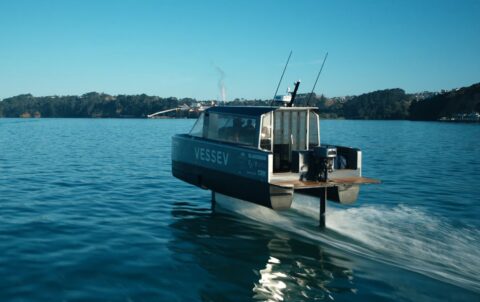
The solar boat the students worked on for the past year consists of a main hull and two smaller side hulls. These are designed to provide the necessary stability. "These hulls are produced by the team and are mainly made of carbon fibre, ideal for strong and lightweight structures. In total, they weigh only 90 kg, just above the average human weight," the website reads." The solar array is 28 square metres in size, comparable to nine double beds together. The array, consisting of nearly 1,100 cells, can generate 5.4 kW of power and is 30% more efficient than the average rooftop solar panel. The team has also designed its own Maximum Power Point Trackers (MPPTs) to make optimal use of all the captured energy.

The team
The TU Delft Solar Boat Team consists of 28 students from ten different faculties at TU Delft. In one year, the team's students go through the process of designing, producing, testing and finally racing a solar boat. Since its establishment in 2005, the TU Delft Solar Boat Team has been trying to inspire the maritime sector to sail with fewer emissions. Until last year, the students did this by participating in races for solar boats on inland waterways. In doing so, they showed what a student team can achieve by using solar energy. This is the first year the team will take on the offshore challenge. De Ruiter: "This is how we demonstrate to the maritime industry that sailing on the open sea with fewer emissions is also possible."
Source: TU Delft.
Photos/infographic: TU Delft Solar Boat Team