
Quality control plays a crucial role in the agri-food sector. Think of assessing and sorting food products by colour, shape and size. A new scanner developed by Wageningen University & Research (WUR) automates and speeds up this process.
Traditionally, many quality checks in the agri-food sector have been carried out by hand. However, the number of suitable staff for this important task is rapidly shrinking. Automation can offer a solution. By assessing and sorting fruit, vegetables and processed food for such things as colour and size, work can be automated. As a result, fewer people are needed and the shrinking availability of professionals can be met.
However, using automation also offers other benefits. For instance, automation can speed up quality controls by allowing them to be operational 24/7. However, also think about achieving higher accuracy and speed.
From harvest to sale
According to WUR, the tool is suitable for all parts of the production chain, from harvest to final sale. Among others, farmers, traders, packaging companies and transporters can use the robot to analyse the quality of their products.
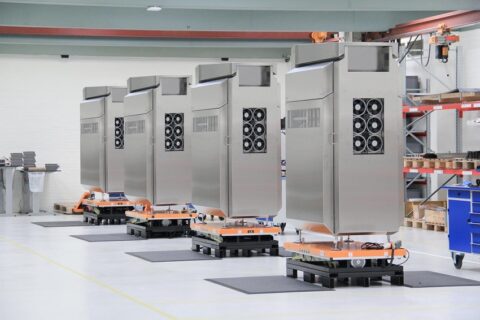
A striking feature of the scanner is its design. At first glance, the scanner resembles an MRI or CT scanner. The device features a 360-degree ring for scanning objects. This increases the speed at which the scanner scans objects; WUR reports a top speed of about 20 km/h. This speed enables the application of quality control to entire batches rather than just samples.
At least three cameras
This 'scan ring' contains at least three cameras for scanning objects. However, if required, there can also be more. These are specifically so-called linescan cameras, which scan passing objects.
Software analyses the scans and offers various applications. For example, the software can be used to measure the length and diameter of objects. Or for checking volume. However, think also of detecting specific spots on products. Both the hardware and software of the scanner can be adapted to the specific needs of users.
The video below shows how the system works.
Author: Wouter Hoeffnagel
Image by S. Hermann & F. Richter via Pixabay