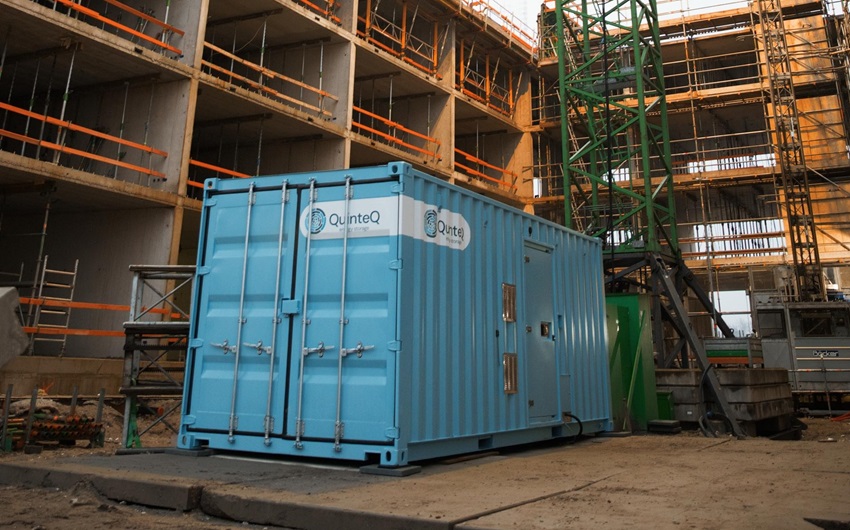

BAM Materieel and QuinteQ Energy are starting a trial of a flywheel as a sustainable, kinetic battery on a construction site in Amsterdam. Using a flywheel as a peakshaver can prevent grid congestion at times when, for example, a high-power tower crane is running. The flywheel will be placed in a container at the project in the Sluisbuurt neighbourhood in Amsterdam, where BAM Wonen is building 767 student houses.
A flywheel stores energy in motion and delivers that energy back to the construction site tremendously fast when needed. QuinteQ Energy uses an electric motor-generator to set the flywheel in motion. By spinning the rotor harder and harder, the kinetic battery recharges. By braking the flywheel with the motor-generator, the motion is converted back to electricity. No chemical processes and harmful substances are involved in this mechanical technique. This improves fire safety. In addition, the flywheel is fully recyclable. This makes it a more sustainable alternative.
World's most advanced flywheel
The QuinteQ flywheel was originally developed by Boeing for a space application. It is widely recognised as the most advanced flywheel in the world. The flywheel rotates within a patented housing. This ensures the safety of people and equipment, without the need to install it underground, as is usually the case. Thanks to this housing and its compact design, the flywheel can be housed in containers and deployed for both temporary and permanent applications.
Long lifespan
The flywheel installed on BAM's construction site is light, compact and transportable. The rotor rotates at high speeds in a vacuum and without friction thanks to a unique, magnetic bearing system that allows energy to be stored and released most efficiently. This ensures that the system has extremely many discharge cycles and a long service life. The trial will start in winter to experience how the flywheel functions in cold conditions.
Widely applicable flywheel
The flywheel now deployed is a prototype. QuinteQ Energy plans to use the results of the trial for further product development. The prototype will be placed in a 20ft container, but a10ft container will be used for the final product to take up as little space as possible on a construction site. BAM Materieel wants to gather insight into what sustainable solutions are possible to make construction sites more sustainable and energy efficient. And with this trial, it is making a contribution to BAM's 'Building a sustainable future' strategy, with sustainability, digitisation and industrialisation as key spearheads.
Measurement data
Equipment rental company Van der Spek Vianen is participating in the trial by providing additional measurement data on the tower crane that can be used to carry out analyses and simulations. As a tower crane lessor, Van der Spek Vianen is involved in its customers' challenges and interested in grid congestion solutions.