To make ships and submarines smoother, the US Navy’s research centre is sponsoring the development of a so-called omniphobic coating that repels not only water but also other substances such as oil, alcohol and even peanut butter! The transparent and durable coating is being developed in collaboration with the University of Michigan to reduce hull drag. This would make ships more energy-efficient and harder to track. Other applications are within reach, such as a dirt- and grease-repellent layer for mobile phone screens, shop counters or camera lenses.
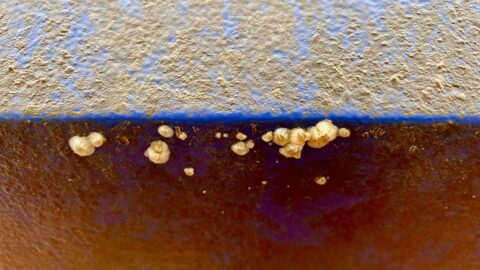
You may be familiar with the image of a ship moving through the water. At first glance, it looks as if the hull is skimming through the water almost without resistance. Nothing could be further from the truth. Because the water makes the hull wet, it sticks to the hull skin, creating friction and thus resistance. When the hull skin is then also covered in barnacles and coral, the problem only gets worse.
A substantial part of a ship's fuel consumption (80% at low speeds and 40-50% at higher speeds) is needed to maintain speed and overcome the ship's drag. By drastically reducing frictional resistance, ships would use less fuel or consume less electrical energy and thus be able to travel longer distances. Reducing friction not only increases efficiency but also makes the ship less trackable. This is because friction and drag produce turbulence and thus noise that can be picked up by a sonar. A smooth, frictionless hull skin ideally cannot be heard, allowing ships and submarines to reach higher speeds and be less likely to be recognised.
One possible method for this is to use a special coating that repels water and other liquids. Such coatings have been around for some time and are used under for sauce bottles and exterior walls. In particular, the challenge now lies in developing a coating with a wide range of phobic properties. As a result, the coating not only repels water but also other liquids, such as oil and grease. The coating must also be practical and therefore durable.
It is precisely this combination of durability and repellency that makes the combination difficult. Yet the researchers have succeeded. To do this, the research team used a computer database of chemicals and then modelled and combined them with the computer to then predict their behaviour. The end result is a clear, rubbery substance that can be sprayed on, adheres to many surfaces and still resists scratches, bumps and other damage.
According to the researchers, the coating can also be used for applications other than ship hulls. This could include protecting sensors, radar units and antennas from weather effects.
A video testing the repellent coating can be seen below.