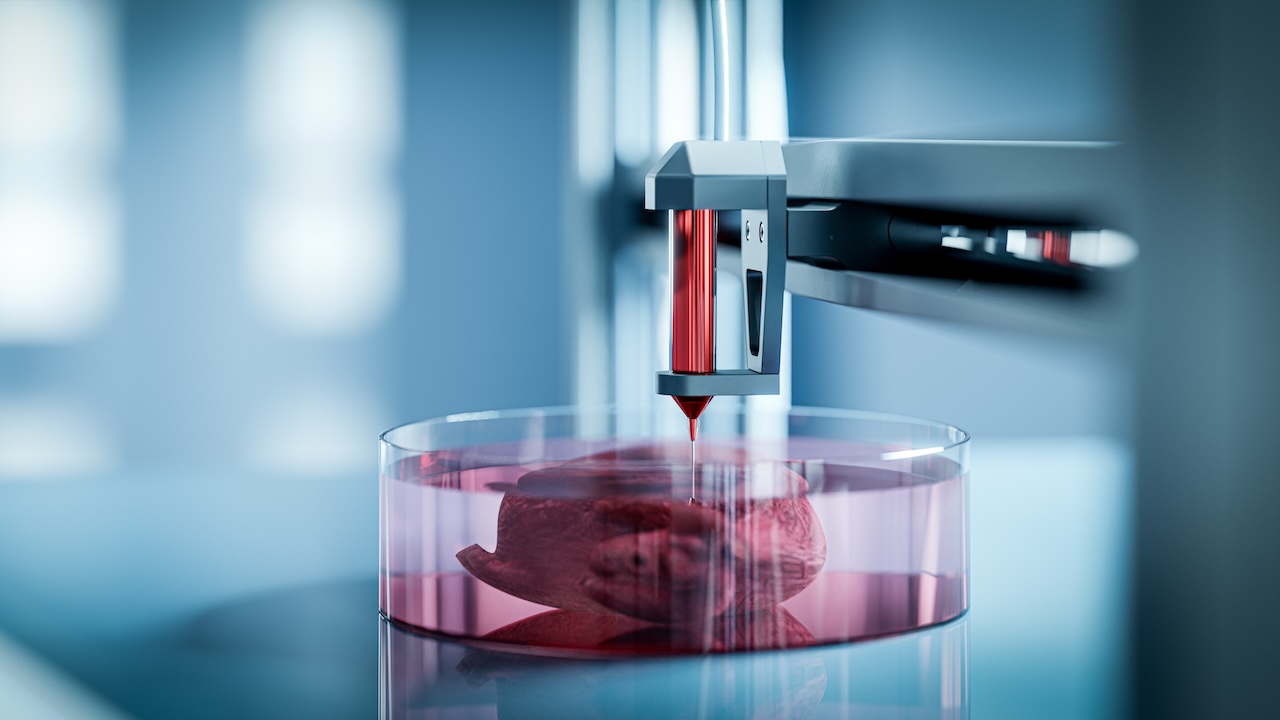

3D printing of organs could provide a solution to the shortage of organ donors. In practice, tissue printing, also known as bioprinting, is very complex and challenging. A new kind of 3D bioprinter that looks and thinks along offers a solution.
The printer was developed by Riccardo Levato's team at UMC Utrecht and Utrecht University. They deploy computer vision supported by artificial intelligence (AI). As a result, the 3D bioprinter watches the print and, based on its findings, adjusts the design where necessary.
Volumetric printing
The 3D printer uses a technique called volumetric printing. This prints a structure in one go using a light-sensitive gel, which cures under the influence of laser light. A key advantage of 3D printing technology is the speed at which it can be printed and the fact that the printing process is more 'friendly' to the cells present in the bioprints.
"To make an object, we focus a series of light projections on a rotating tube containing cells embedded in a light-sensitive gel. At the places where the light converges, the material hardens," Riccardo explains. "This creates a complete 3D object in one go, without us having to touch the cells."
Printing functional blood vessels
A key challenge in 3D bioprinting is printing functional blood vessels. Blood vessels ensure that cells receive oxygen and nutrients. They therefore need to be printed accurately to create living tissues. In current printing methods, a 3D design is created without knowing where the cells are located in the light-sensitive gel, making it unclear where the blood vessels should be printed.
A new technology called GRACE, which stands for Generative, Adaptive, Context-Aware 3D printing. GRACE offers a solution. GRACE was developed by Sammy Florczak, PhD student in Levato's lab. The technology allows 3D printers to see where cells are located and, based on this, produce a network of blood vessels around those cells within seconds.
What is in the printing material?
"To make a good print, you need to understand what is in the print material so that the printed tissue is as optimally put together as possible," he says. The new technology, called GRACE, makes this possible. It opens up new possibilities in bioprinting functional tissues. And is thus a step towards repairing injuries, testing drugs and even replacing entire organs," the team writes on the UMC Utrecht website.
The printer uses a special bio-ink developed by the team at Levato. This ink is specifically aimed at 3D printing functioning bio-tissues, which presents challenges. For instance, living cells are fragile and cannot survive in a normal 3D printer. The bio-ink therefore consists of a combination of nutritious gels and cells that protect the cells during the printing process.
Thinking about the design
"Previously, the printing process always depended on the designer of the blueprint. GRACE also thinks along with the design itself," says Florczak. "The printer 'sees' which cells are in the print material and where they are located. The printer then uses this information and, using AI tools, creates an appropriate design for the object to be printed. This new 3D bioprinter has its own eyes and brain, so to speak. This customisation produces tissues that survive and function better."
The technology can also automatically align multiple printing steps. As an example, the researchers cite a printed piece of bone tissue, to which a layer of cartilage needs to be added at a later stage. This process is normally cumbersome and requires a lot of manual work. GRACE simplifies this process by scanning the existing tissue and, based on this, designing a second layer that fits perfectly onto the existing tissue.
'Just the beginning'
Levato: "This initial work on GRACE is just the beginning. We are now working on increasing the number of cells that can be printed, so that other tissues such as heart and liver can also be printed. Moreover, we want to make this technique openly accessible to other labs so they can apply it to their own printing methods."










