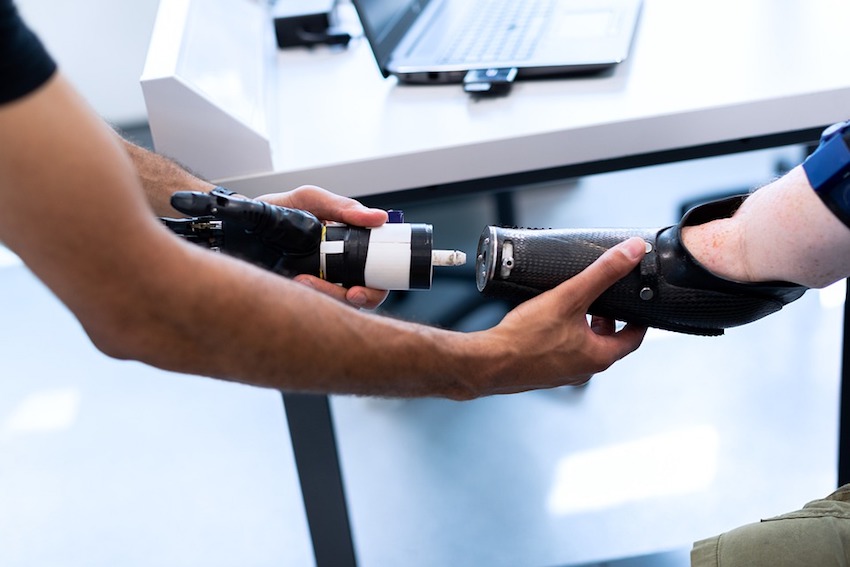

A new biometric arm gives upper arm amputation patients feeling back in their arm. Thanks to sensors, users can experience movements and touch. Among other things, this allows for more natural movements.
The biometric arm has been developed by a research team led by the Cleveland Clinic. They want to use prosthetics to make patients with an upper arm amputation more able to think, act and function like a person without an amputation. To this end, the neurorobotic prosthetic arm combines three functions: intuitive motor control, touch and 'grip kinetics'. The latter term describes the intuitive sensation of opening or closing the hand.
Move more intuitively
Paul Marasco, MD and associate professor at Cleveland Clinic Lerner Research Institute's Department of Biomedical Engineering, leads the research team. Researchers from the University of Alberta and the University of New Brunswick are also involved. "We adapted a standard prosthesis with this complex bionic system that allows wearers to move their arm prosthesis more intuitively while sensing touch or movement," Marasco explains.
University associate professor talks a major step towards providing full restoration of natural arm function for people with amputations.
Neural-machine interface
The system uses a neural-machine interface, which controls the various functions and controls of the prosthesis. This interface is connected to the nerves of the amputated arm. It allows the patient to send nerve impulses from the brain to the arm prosthesis. This enables operation and movement of the prosthesis. The prosthesis can also receive physical information from their environment through the interface and feed it back to the brain via the nervous system.
The researchers point to the bidirectional feedback and control provided by the neurorobotic prosthesis. This allows patients to perform tasks with an accuracy similar to that of people without amputation. "What we are perhaps most excited about is that participants make judgements and decisions, calculate movements and correct errors comparable to a person without amputation," says Dr Marasco.
Major differences
"With the new bionic limb, people behave as if they have a natural hand. Normally, there are big differences between the brain behaviour of people with and without an upper limb prosthesis." These differences arise, for example, from the lack of sensation in limbs. This requires patients to constantly look at their prosthesis during routine movements.
The prosthesis was tested on two upper arm amputation patients who previously underwent 'targeted sensory and motor reinnervation'. These are procedures in which a neural-machine interface is set up by connecting amputated nerves to remaining skin and muscle. If the patient thinks of moving a limb, these nerves communicate with a prosthesis prepared for the purpose, which can then move in the same way. Small robots simultaneously create vibrations in receptors in the same 'reinnervated muscles'. This gives the patient the sensation that the hand and arm are moving.
In the video below, the researchers explain the prosthesis.
Author: Wouter Hoeffnagel










