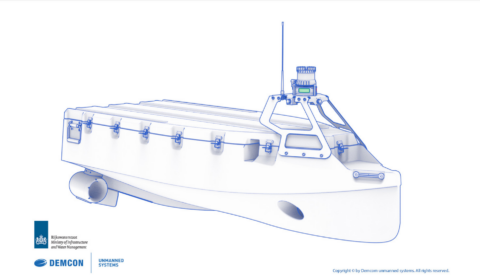
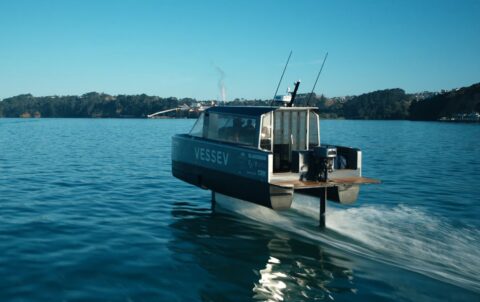
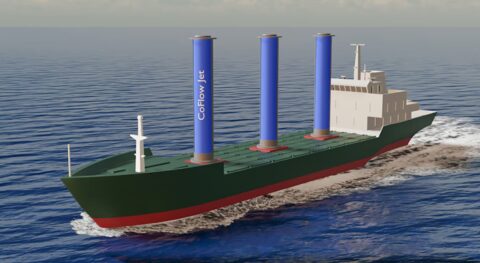
A consortium of Dutch companies are embarking on a large-scale research into the technical possibilities of autonomous sailing at sea. Nearly 20 parties are participating.
During the Smart Shipping Challenge 2017, it was announced that a Dutch consortium of almost 20 parties started a project this month to research and demonstrate the technical possibilities for autonomous sailing at sea: "Autonomous Shipping". The applications of autonomous shipping at sea help reduce operational costs and increase safety and sustainability.
Working together
This project will build knowledge on integrating existing technical solutions for autonomous sailing. The solutions will be demonstrated in simulators and in practice. Autonomous sailing is an end goal, but the intermediate steps in the project are already providing useful results for the participants. This development is part of the trend of far-reaching digitalisation in shipping, also referred to as "Smart Shipping".
'The mooring lines are loose! It is very nice that together we managed to start this project, even in economically difficult times for many companies in our sector,' says Marnix Krikke of Netherlands Maritime Technology. 'TU Delft, MARIN and TNO are each working on this practical research for autonomously sailing seagoing vessels from their own specialism. They are doing this together with industrial partners, the Ministry of Infrastructure and Water Management, the Ministry of Defence, a class agency, the Pilotage Service and universities of applied sciences the Maritime Institute Willem Barentsz and Rotterdam Mainport Institute.'
Simulation and demonstrations
In the Joint Industry Project "Autonomous Shipping", a Dutch consortium of maritime companies, knowledge and educational institutions, service providers and governments are working together on a two-year practical research project. The research starts with an exploration and analysis of possible applications. It will then investigate how safe navigation is possible for the ship in an environment with shipping. The autonomous ship must also be able to make the right decisions in case of malfunctions and busy shipping. It will then be investigated whether we are able to control or remedy these malfunctions or failures from shore using existing techniques. This will be tested through simulation and various demonstrations, both from the office environment and physically on board. The project should lead to a roadmap for introducing autonomy in shipping.
Maurits Huisman, business development manager at TNO Maritime & Offshore: 'It is great that we can give the Smart Shipping Challenge 2017 a concrete follow-up with this project. With TNO, we are building on the knowledge and experience available in areas such as autonomous driving and cyber security. This allows us to take quick steps and help the maritime industry become more sustainable, safer and more profitable in the best possible way.'
Source: TNO