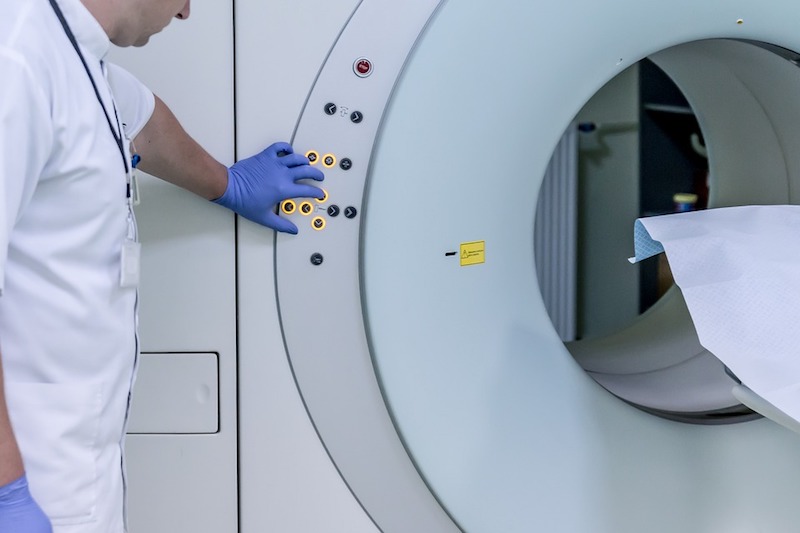

Soteria Medical, Tesla Dynamic Coils and the Radboudumc will receive over a million euros grant from the European Regional Development Fund (ERDF-East). The grant is for the project MI-Robot - 'Metabolic imaging for magnetic resonance (MR) guided robotic interventions'. Within this project, the parties are investigating new forms of imaging that provide insight into specific metabolic processes in the body. The resulting insight will help perform robot-guided biopsies more accurately.
With the population getting older, the number of people getting cancer is expected to continue to rise for the foreseeable future. For optimal treatment of individual patients with cancer, timely detection and proper tumour characterisation play a crucial role. Tumour characterisation involves determining the exact characteristics. For example, is a tumour aggressive or not? And are they about to metastasise? This is a complex process.
For now, the best results are achieved with a combination of histopathology (the detection of disease processes in tissue) combined with genetic analysis. This analysis is performed on a biopsy, in which a small piece of tissue is taken from the body. Tom Scheenen, researcher at Radboudumc, says: "Combined, both innovations create new high-value activity in Gelderland and better care for patients with cancer."
Local or metastatic tumour
Among other things, research on a biopsy reveals whether it is a local non- metastatic tumour, or just a metastatic tumour. Scheenen: "That determines the difference between local treatment of the tumour or more extensive, systemic treatment. Especially at an early stage of metastasis, a metastatic tumour is still small, hard to find and difficult to biopsy. Where exactly is the metastasis located? Is it possible to take a good biopsy of it? After all, without such a biopsy, characterisation is not possible. So there is a big clinical need there. It would be wonderful if we could predict and detect the presence of metastatic disease in a non-invasive way. With new powerful MRI techniques, we are going to try that."
Merely detecting and localising a tumour is not enough. The MI-Robot project therefore goes further. Metabolic MRI (Magnetic Resonance Imaging) can already characterise the local tumour in a non-invasive way as well. This process takes place on the basis of metabolic processes characteristic of tumours. This method also makes it more predictable whether a disease is about to spread or not. The Zaltbommel-based Tesla Dynamic Coils makes this process technically possible.
Tesla Dynamic Coils focuses on developing innovative, fast and versatile MRI technology. With this, the company aims to improve diagnostics and therapy. Using modern technology, the company aims to accelerate scientific research. The company also provides services that support research and product development on a global scale.
More accurate biopsy
To determine the most appropriate treatment, accurate biopsy of any metastases is essential. This ensures that a piece of the suspected tissue has actually been punctured. Scheenen: "In such a situation, we may also be able to remove the metastasis directly with minimally invasive treatment or by focal therapy, such as targeted local radiotherapy, lasering or freezing."
Controlling a needle with an MRI-compatible robot based on real-time imaging enables highly accurate biopsy. Soteria Medical, a spin-off from Radboudumc, has extensive experience in this process. The Arnhem-based company is developing a new way of taking prostate biopsies. With this, the company aims to improve the accuracy, duration, cost and reliability of existing procedures. Shortening the duration of the biopsy increases patient comfort on the one hand and minimises patient movements on the other. The latter is important in terms of scan quality.
Viewing recordings in real time
Soteria Medical is using a robot for this purpose that is equipped with components that do not interfere with the magnetic field generated by an MRI scanner. In practice, this means that the robot can do its work while the MRI delivers images in real time.
Scheenen: "The combination of both companies offers the possibility to take biopsies from potential tumours, deep inside the human body, in a minimally-invasive way, guided by metabolic information. Radboudumc will design the optimal metabolic scans and set up a demonstration study to demonstrate the success of metabolism-driven biopsy in patients with prostate cancer."
The project, which will cost almost 3 million euros in total, will run for 2.5 years.
Author: Wouter Hoeffnagel










