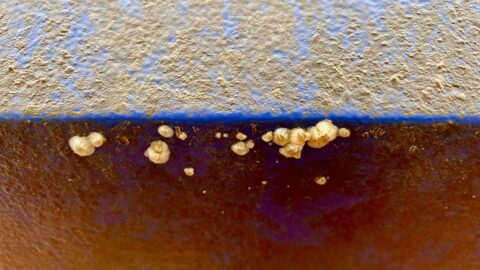
Every serious sailor is unfortunately familiar with it: biofouling. These biological fouling of barnacles and other marine organisms on a ship's hull reduce a ship's efficiency. For tankers, the loss of efficiency is even more disturbing. More engine power is needed, engines have to work harder and thus emit more CO2. A new ship paint changes this - after painting, the biofouling can be wiped off the hull with a sponge.
Although there are similar paints on the market, many of these work by regularly secreting a toxic substance that kills the barnacles, mussels and other fouling. However, these substances also end up in the ocean, harming the environment. The paint developed by the University of Kiel and spin-off Phi-Stone works differently.
The eco-friendly marine paint is made of a polymer composition based on polythiourethane (PTU) and specially formed ceramic particles that have an unprecedented smooth surface. Marine organisms cannot adhere to it and those that do manage to do so are easily removed without damaging the paint.
In a field test, the paint was applied to the hull of a ship regularly sailing between Belgium and Gabon in central Africa. Even after two years, a noticeable reduction in biofouling was visible. The organisms present could be easily removed with a sponge. Phi-Stone is now working on a spraying technique to apply the paint to large areas as well.