
Too low or too high oxygen saturation in the blood can cause permanent physical damage or even death. Therefore, patients' oxygen concentration is continuously monitored in intensive care and trauma units. However, the pulse oximeters commonly used for this purpose can be unreliable. Researchers at the Fraunhofer Institute for Physical Measurement Techniques IPM have developed a fluorescence-based sensor. This measures the oxygen content of people's breath directly and in real time in an effort to provide accurate figures in the future.
The human body needs sufficient oxygen to function properly. A healthy body regulates oxygen concentration in the blood through the respiratory system. If a patient's values are too low or too high, it means that something has gone wrong with breathing. Therefore, reliable measurements of blood oxygen concentration are especially crucial when caring for patients with respiratory problems who are receiving artificial ventilation. Currently, the most common method of determining hypoxia - when oxygen levels are too low - is a non-invasive method known as pulse oximetry.
Pulse oximeter
A small device - a pulse oximeter - is clipped to the patient's finger to display the O2 concentration in the blood. The problem is that the measurements are not accurate. The only way to get more reliable values is to take a blood sample and then perform a blood gas analysis. This is an unpleasant and sometimes even painful procedure for the patient. Fraunhofer IPM in Freiburg has developed a non-invasive sensor in an attempt to enable painless yet ultra-accurate measurements in the future. The sensor attaches to a breathing mask or breathing tube. The innovation will surpass the current state of technological advances in terms of accuracy and cost-effectiveness, according to researchers. And it will replace existing measurement systems.
Oxygen content in the blood
"Our sensor measures the oxygen content in people's breath. This allows us to extrapolate to the oxygen concentration in the blood," says Mahmoud El-Safoury, project manager at Fraunhofer IPM. "We use the quenching effect for the O2 sensor we developed." In this method, a fluorescent coating on an aluminium substrate is exposed to short-wave light. This causes the coating to glow. The emitted light has a longer wavelength than the light "generated" by the fluorescent substance. That means it has a lower energy. When oxygen molecules then come into contact with the coating, the fluorescent light is markedly weakened. The weaker the light, the higher the oxygen concentration. "Our measurement method is so fast and accurate that we can measure oxygen concentrations down to the level of individual breaths," El-Safoury explains.
A new method in medical technology
To develop the fluorophore coating, Fraunhofer IPM researchers studied different fluorescent chemical compounds with optimal properties in terms of response time, signal intensity and long-term stability. In the end, they chose a type of pyrene. To make the layer, the fluorophore had to be embedded in a suitable matrix, which is a complex process. "Quenching is already used to determine the concentration of dissolved oxygen in liquids in industries such as the food industry and at water and wastewater treatment plants. However, it is a new method in medical technology," says Dr Benedikt Bierer, group manager at Fraunhofer IPM.
Continuous measurement of oxygen content
Another advantage of this principle is that the sensor allows continuous measurement of oxygen concentrations throughout an entire day. In contrast, invasive arterial blood sampling is performed only once a day or, for critical intensive care patients, several times a day. This means that in the intervening time there is no data on any changes in the patient's health status.
Miniature sensor
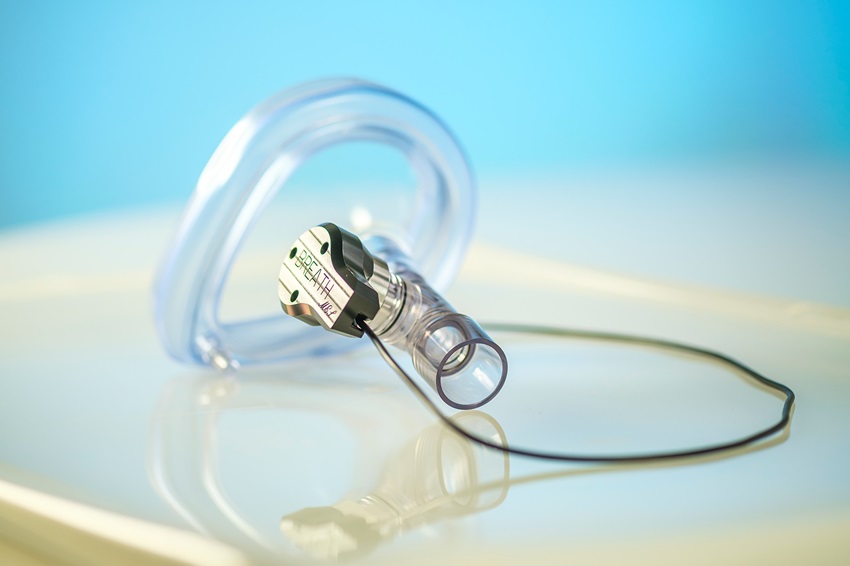
The miniature sensor measures just 26 mm in diameter. It can be connected to any T-connector, a standardised adapter that is then connected to a ventilation mask or breathing tube. The sensor head with integrated optics contains an LED light source, a detector, two sapphire lenses and a sample with the fluorophore coating. This component will need to be replaced regularly by hospital staff. The sample must be kept sterile and gas-tight, just like bandages.
Sensitivities
Researchers are currently investigating whether there are cross sensitivities to other gases such as CO2 that could affect the oxygen measurement signal from the sensor. The influence of parameters such as humidity and temperature on the signal is also being studied, along with the long-term stability of the system and different sterile storage options. "There is a wide range of potential future applications. The tiny sensor can be used by paramedics, in hospital settings and even at home by patients with lung diseases," El-Safoury said.
Featured image: The non-invasive miniature sensor can be integrated into existing ventilation equipment via a T-connector (photo: Fraunhofer IPM)
See also: Developer of autonomous blood-collection devices raises $20 million










