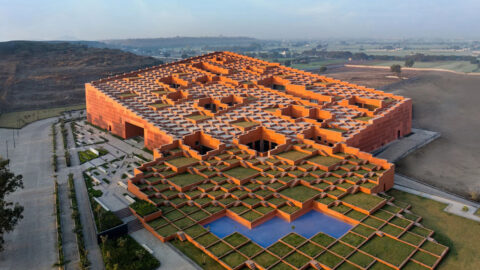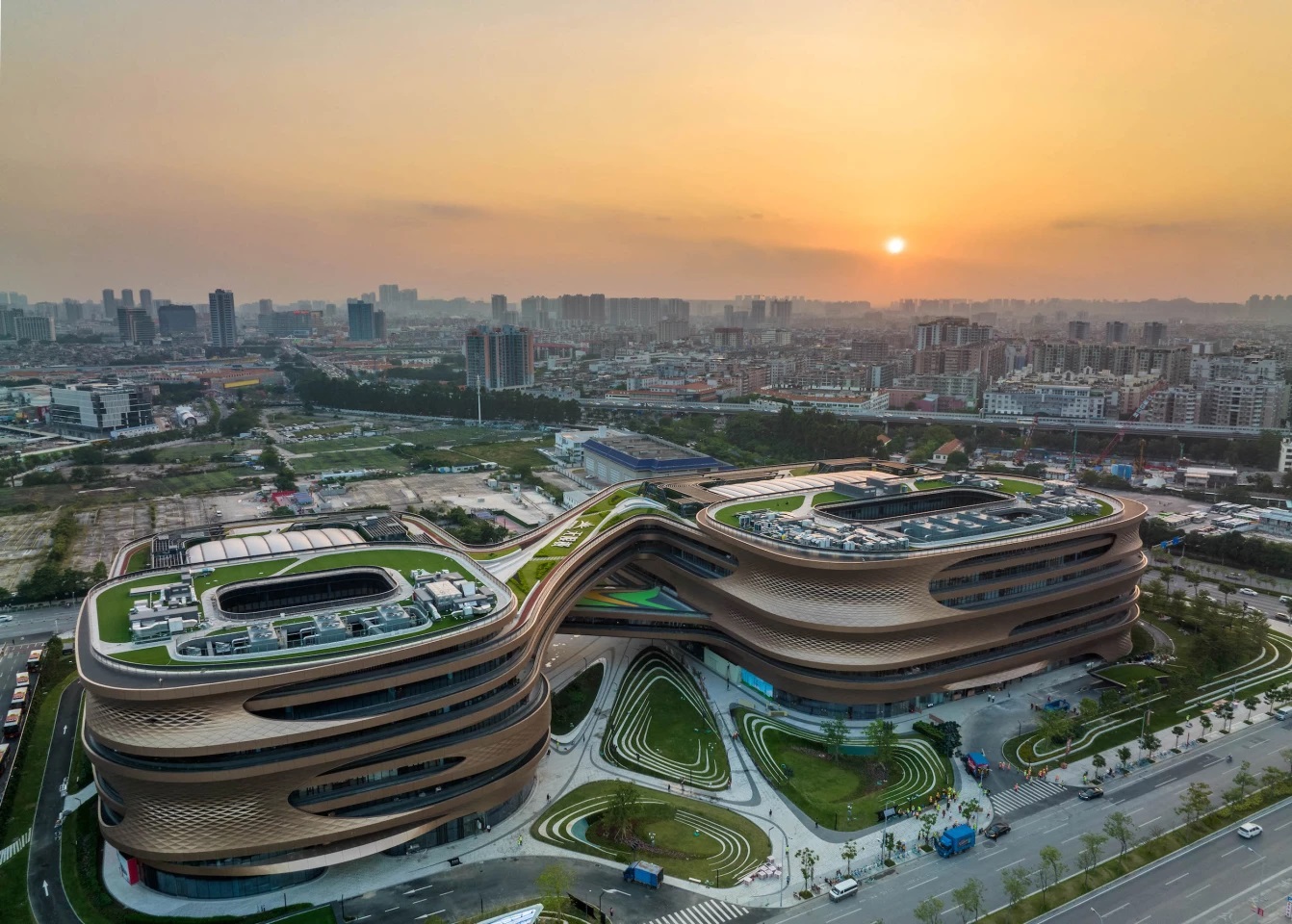

Zaha Hadid Architects has completed one of its most eye-catching designs of recent times with the Infinitus Plaza. The recently opened building in Guangzhou, China, consists of two interconnected office buildings that stand out for their sustainability. It is characterised by a design in the shape of the symbol for infinity.
Infinitus Plaza serves as the new headquarters for traditional Chinese health products supplier Infinitus. The building is located on either side of an underground metro tunnel. Building directly on top of the tunnel would have been problematic, so the architecture firm connected the two buildings with several bridges.
Community spirit
The building has multiple central atriums and courtyards based on the symbol for infinity '∞'. This creates different indoor and outdoor spaces that emphasise the strong sense of community Infinitus is known for. The connecting bridges house flexible communal spaces for employees. These include gym and exercise areas, recreation and relaxation zones, a restaurant and a café.
Multipurpose
The eight-storey towers are mainly for office space, but there are also some retail and dining areas, plus several courtyards and relaxation areas. And LEED Gold, the office complex is also highly sustainable. For instance, the amount of concrete used during the construction process was minimised as much as possible. In addition, around 28,000 tonnes of recycled materials were used during construction, including steel, copper, glass, aluminium, plaster and wood. Computer analyses of the expected efficiency of solar heat determined the width of the outdoor terraces. This allows the interior of the building to take full advantage of shade, aided by the external copper-coloured perforated aluminium shading panels.
These measures are combined with solar panels to reduce grid consumption and a smart management system that controls everything - from indoor temperature and lighting to air quality. In addition, sprinklers spray rainwater on the roof above each atrium to dissipate heat through evaporative cooling. Finally, rooftop water heaters are heated by solar energy which further reduces energy requirements.