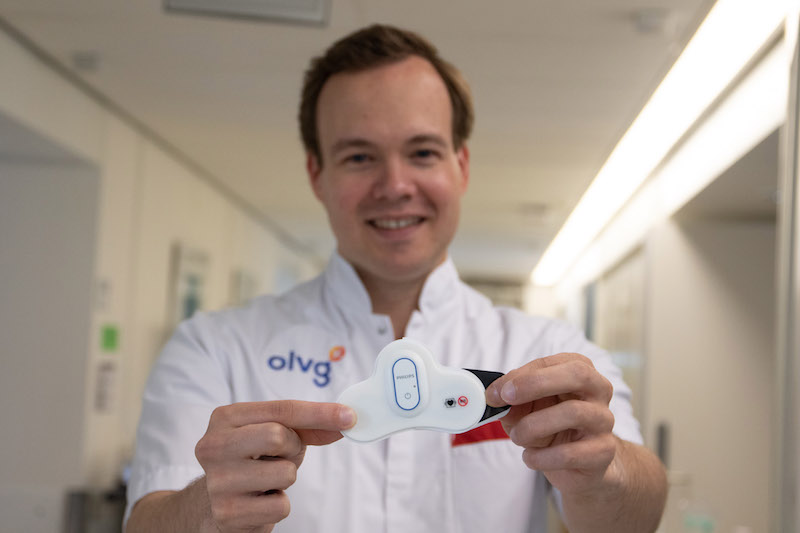

The Philips biosensor BX100 receives FDA 510(k) approval and CE marking for use as an aid in monitoring patients with COVID-19 in hospitals. The OLVG is the first in the Netherlands to deploy the sensor for monitoring COVID-19 patients.
The BX100 is a new wireless and portable biosensor that signals deterioration in patients' health. The solution detects when a patient is at increased risk. This allows doctors to intervene more quickly, improving patient care. Remote monitoring can also improve the safety of both patients and carers by reducing carers' exposure to the virus.
Measuring vital signs
With the new biosensor, Philips is targeting a new way of measuring patients' vital signs. This measurement method supports the monitoring of high-risk patients transferred from intensive care to less intensive care units within a hospital.
The sensor is intended for single use and can be used for five days. Collected values are transmitted by the sensor to a scalable hub, which can be used to monitor multiple patients in different rooms. Philips reports that the tool can be incorporated into existing clinical workflows for mobile display and notifications. Because the sensor is a single-use device, no cleaning or charging is required.
Respiratory rate and heart rate
Specifically, the sensor is intended for use by healthcare professionals in patients aged 18 years and older. The sensor can be inconspicuously stuck to the chest. This allows it to detect two key signals that predict deteriorating health: respiratory rate and heart rate. Both are measured, recorded, stored and transmitted every minute. Other contextual parameters such as posture, activity level and mobility are also recorded.
The OLVG is the first party in the Netherlands to deploy the BX100 sensors. The hospitals remotely monitors patients with established or suspected COVID-19 staying in an isolation room during the current corona crisis. To still monitor properly, the OLVG is deploying the biosensors. Early signals detected using these sensors are recorded in the IntelliVue GuardianSoftware analysis software. EarlyVue VS30 patient monitors are also used.
Reducing exposure
"In these unprecedented times of COVID-19, the rapidly deployable Philips Biosensor BX100 for remote monitoring can reduce the risk of exposure of caregivers to the virus when patients' vital signs need to be taken regularly. It also reduces the need for personal protective equipment," says Peter Ziese, general manager of monitoring and analytics at Philips. "The biosensor is an integral part of our solution for signalling deterioration in a patient's condition; it helps identify the subtle signs of deterioration in the patient at the point of care, hours before a potential deterioration would occur."
"Using this new biosensor, we can remotely monitor patients' condition constantly. This is extra important on COVID wards," says Florian van der Hunnik, Chief Nursing Information Officer and team leader of the COVID ward at the OLVG in Amsterdam. "Now that we can't just walk in and out of the patient's room without protective equipment, this innovation is very welcome as it allows us to do our job better."
Author: Wouter Hoeffnagel