
A new electronic artificial skin reacts to pain stimuli just like humans do. In doing so, the skin responds with the same speed as the human body.
The electronic skin has been developed by Melbourne-based RMIT University in Australia. Researchers at the university have developed a prototype device that electronically replicates the way human skin registers pain. In doing so, the device mimics the almost immediate response of the human body. Among other things, this could help prevent damage to prosthetics.
'Big step forward'
Professor and lead researcher Madhu Bhaskaran sees the development as an important step towards the next generation of biomedical technologies and intelligent robots. The skin is our body's largest sensory organ, with complex functions designed to send warning signals at lightning speed if something hurts us," Bhaskaran explains.
"We continuously feel things through our skin, but the pain response only kicks in at a certain moment. For example, if we touch something hot or sharp." The artificial skin reacts immediately if pressure, heat or cold exceeds a certain lower value. "It is a critical step forward in the development of advanced feedback systems that we need to develop really smart prosthetics and intelligent robotics."
Registering temperature and pressure
Besides an artificial skin that registers pain, a number of other prototypes of the skin have also been developed. These include a version that responds to changes in temperature and a version that registers changes in pressure. With the prototypes, the researchers aim to make important sensory functions of the skin available in electronic form.
In time, the researchers hope that their invention could also be an alternative to skin transplants. In particular, they foresee applications here if conventional skin transplants are not possible or do not prove to work. "Further development is needed to integrate this technology into biomedical applications, but the fundamentals - biocompatibility and skin-like extensibility - are available," says Bhaskaran.
Three components
The prototypes consist of three components:
- stretchable electronics in the form of transparent, unbreakable and wearable electronics with the thickness of a sticker.
- Temperature-reactive coatings: customisable coatings a thousand times thinner than a human hair based on a material that reacts to heat.
- Memory that mimics the brain: electronic memory cells that mimic the way the brain uses long-term memory to store and retrieve information.
Ataur Rahman, one of the researchers involved in the project, explains that memory cells are used to trigger a particular response if the pressure, heat or pain exceeds a certain limit. "We have basically created the first electronic somatosensors (ed: cells that register temperature, pain or touch), replicating key functions of the complex system of neurons, neural pathways and receptors that drive our perception of nerve stimuli."
"While some existing technologies use electrical signals to stimulate different levels of pain, these new devices can respond to real mechanical pressure, temperature and pain, delivering the appropriate electronic response," Rahman said. "This means that our artificial skin knows the difference between gently touching a pin with the finger or accidentally pricking yourself with this pin - a critical distinction that has not been made electronically before."
Not the first prosthesis with feeling
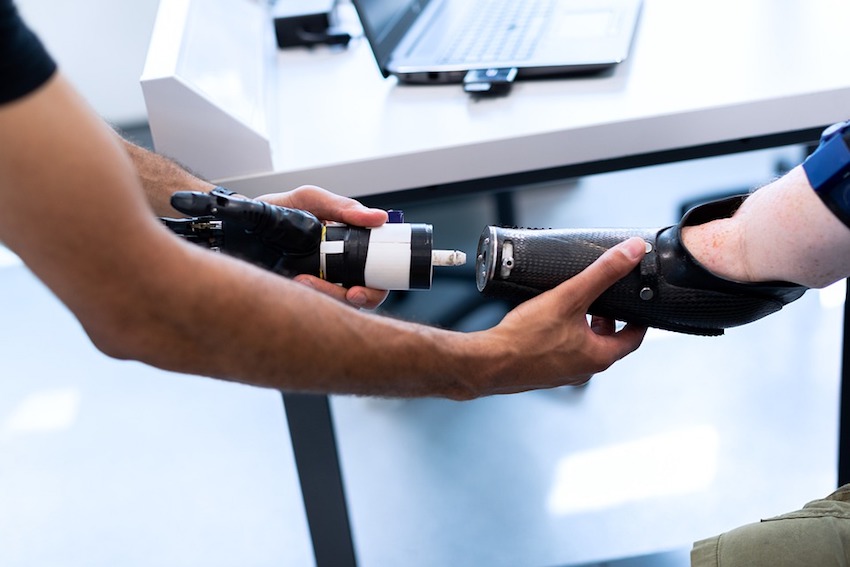
One of the applications envisaged by the researchers is to realise smart prosthetics that give their users sensation. There are more developments in this field. One example is a project by Chalmers University of Technology led by professor Max Ortiz Catalan. Within this project, a trio of Swedes were assigned an artificial arm connected to their nerves, muscles and skeleton. The sensation that users have in their prosthesis allows them to control it much more precisely than a conventional prosthesis.
In addition, the John Hopkins School of Medicine previously developed a similar electronic skin, which also has 'feeling'. This skin was developed for the fingertips of a hand prosthesis. The skin consists of a combination of fabric and rubber, into which sensors are inserted. This allows the artificial skin to give users sensation in their fingertips and also make them feel pain.
More information on RMIT University's research is available here.
Author: Wouter Hoeffnagel










