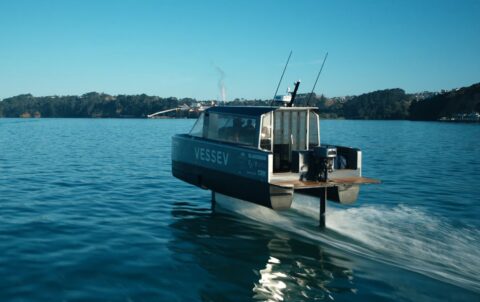
Fitting boats with hydrofoils allows them to be lifted out of the water, so to speak, and makes them much more comfortable and efficient. A hydrofoil designed in France also uses electric propulsion and an automatic self-stabilising system. This ensures clean and quiet waterborne transport.
Taxi is now also creating a furore in America, where it is the first to be deployed in Miami. The Bubble Taxi has five seats, making it much like a car flying over water.
The Bubble Taxi prototype has two propellers on a 20 kW (27 hp) electric drive. Once a speed of about 13 km/h is reached, the hydrofoils develop enough buoyancy to raise it out of the water. Thus, a top speed of 28 km/h can be achieved. In the process, the taxe hovers about 40 cm above the water.
Because the hull of the boat is out of the water, resistance is about 40 per cent lower and the 21.5 kWh battery allows for longer cruising. The battery is good for two hours of use or 40 km; charging time is five hours. And because the hydrofoils also reduce contact with the water surface, travelling with the Bubble Taxi is also comfortable. These figures apply to the prototype, according to manufacturer Seabubbles. The final versions are expected to be faster and - with larger batteries - also have a longer range and a charging time of only 35 minutes.
Do you feel that such a hydrofoil looks a bit unstable with three of the hydrofoils anyway? The Bubble Taxi uses gyroscopic and altitude sensors that constantly measure inclination and roll angles. The steering is adjusted directly to this, so the boat automatically corrects and stabilises itself while sailing.
Although the Bubble Taxi looks like a car, at around $200,000 it is a touch more expensive. This is partly offset by savings on fuel and maintenance. But most importantly, the look remains; it is downright futuristic and trendy.
See what it looks like? The video below will give you an idea.