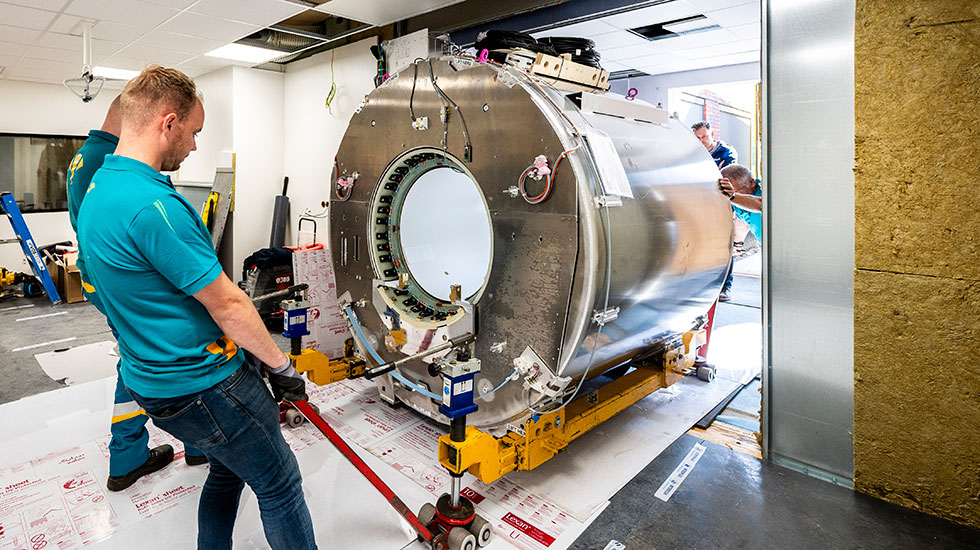

Philips reports having installed the first MR 5300 in the Netherlands. The first models have been installed at Albert Schweitzer hospital in Dordrecht, Het Zonnehuis of QuaRijn in Doorn and a collaboration between MRON and OCON Orthopaedic and Sports Medicine Clinic.
These are 1.5 Tesla scanners from Philips, which the company presented in November 2023. The MR 5300 is designed to reduce pressure in the radiology department. For instance, the scanner uses automated workflows and artificial intelligence (AI). This combination allows routine examinations to be performed in less five minutes, which is up to 50% faster than comparable scans. This increases efficiency in the department and relieves radiologists.
Automated workflows
The automated workflows ensure that patients are ready for an examination within a minute. The scanner also reduces the changeover time between examinations by up to 30%, according to Philips. Another feature is the use of the lightweight Breeze coils, which simplifies operation.
"Our MR 5300, the new coil concept and the BlueSeal magnet make MRI examinations more accessible, as an MRI scanner can be installed more easily and in more places. Moreover, the light coils make it easier to use the scanner," says Paul Wiering, Head of Imaging at Philips Benelux. "AI technology in the MR 5300 also makes a significant contribution to improving MRI examinations and generating insights. For example, our AI SmartSpeed technology allows us to speed up MRI scans and there are several AI applications that support radiologists in image analysis."
Reduce use of liquid helium
The MRI scanners are equipped with a BlueSeal magnet that uses only 7 litres of liquid helium. This is considerably more than traditional MRI scanners, which can use up to 1,500 litres of liquid helium. An MRI scanner uses this material to cool the magnet.
So using the BlueSeal magnet helps reduce the use of liquid helium. Important, as helium is a scarce and expensive resource. In total, with the installation of the three new MR 5300 MRI scanners, 25 of these magnets are now in use in the Netherlands. Philips reports that this has saved a total of 37,000 litres of liquid helium in the Netherlands.
Quick restart after emergency shutdown
The BlueSeal magnets are closed, preventing helium from escaping the system. This offers several advantages. For instance, using the magnet, hospitals can perform helium-free MR surgery, meaning that no helium is lost. In addition, they can quickly reactivate the MRI scanner after an emergency shutdown, as they do not have to wait for the scanner to be refilled with liquid helium. For this purpose, the scanners feature an AI-based functionality called EasySwitch, which allows the magnet to be discharged and recharged with energy without loss of helium.
The magnets are not new; the first one was installed at the Spaarne Gasthuis in Hoofddorp in 2018. In addition to the substantially lower use of liquid helium, the lower weight of the magnet is also an important advantage, including for installation purposes. A BlueSeal magnet is 900kg lighter than a traditional one. In addition, the ventilation ducts required by a traditional magnet with larger amounts of liquid helium are unnecessary with the BlueSeal magnet, simplifying installation.
The Albert Schweitzer hospital now has two MRI scanners with a BlueSeal magnet. "We use several MRI scanners from Philips including now two scanners with a BlueSeal magnet," says Cor Ritmeester, department head of Radiology at the Albert Schweitzer hospital. "It is fortunately very rare but sometimes metal objects end up in an MRI scanner accidentally, for example a stool or a wheelchair. This would mean that in the event of such an emergency, you would have to switch off the scanner where all the helium would be lost and would have to be replenished. If this happens, the scanner is out of operation for a few days. This has a huge impact on continuity of care and is something we want to avoid at all times. With a BlueSeal magnet, we can turn off the scanner without losing helium. This makes the BlueSeal a sustainable solution both for the wallet and the climate."
Author: Wouter Hoeffnagel
Image: Philips










