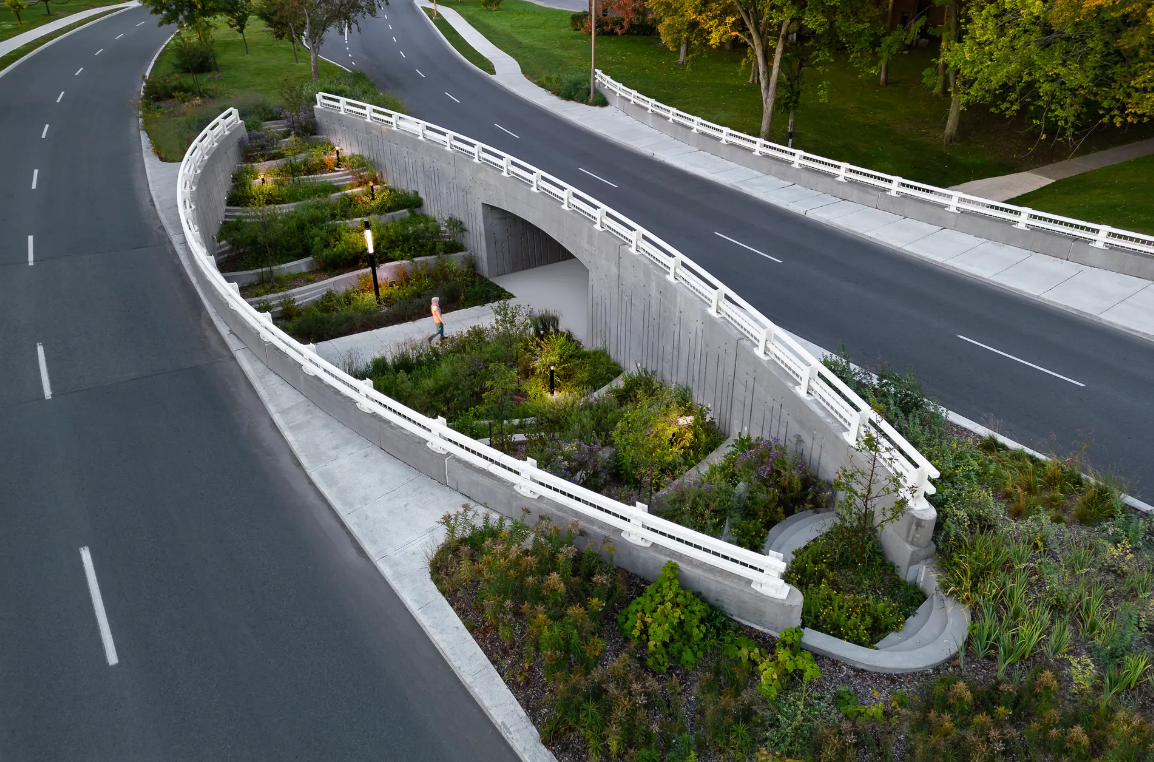

The production of cement used in concrete is a major cause of CO2 emissions worldwide. This is why Provencher Roy architects used a greener alternative for a pair of bridges in Canada. The bridges were built from concrete that incorporated locally recycled glass, significantly reducing greenhouse gas emissions.
The Darwin Bridges are located on Nuns' Island in Montreal and replaced a pair of bridges that had been in use for almost 60 years. The pavements were not narrow enough and water began to collect in the passageway under the bridges.
The new bridges were built with on-site poured concrete, using a mixture of 10% finely ground recycled glass as a binder to replace the cement. According to the architect, this reduces greenhouse gas emissions by as much as 40 tonnes. Incidentally, the idea is not new. Worldwide, there are several (research) teams using glass to make greener concrete.
The pioneering project builds on 17 years of research into the integration of ground glass into civil infrastructures. That research was conducted in collaboration with the Université de Sherbrooke and the Ville de Montréal. The patented invention GGP (ground glass pozzolans) was added as a binder, replacing the cement normally used. The GGP represents 40,000 kilograms of locally recycled glass, equivalent to 70,000 wine bottles.
The slightly curved new bridges - each 37 m long - are a big improvement on their predecessors. They are safer and more accessible for pedestrians and cyclists, with new LED lighting and wider pavements. Moreover, a new, lush green area has been added to enliven the sight concrete.
The new Darwin Bridges have been in use for a while, but have only recently been officially opened. If all goes well, they are expected to remain in use for more than 125 years.











