
Which parkinson's patients benefit from brain surgery, and which ones may be worse off because of it? Artificial intelligence from the automotive industry helps neurologists answer this question.
This is according to research by physician-researcher Victor Geraedts, who recently obtained his PhD on the subject at Leiden University Medical Centre (LUMC). In an interview with De Volkskrant, Geraedts explains that a certain protein accumulates in nerve cells, which consequently break down. In Parkinson's patients, this happens in the part of the brain that controls movements, causing patients to move slower and become stiff. At a later stage, nerve cells related to memory and speech, among other things, can also be affected.
Deep brain stimulation
An operation also known as deep brain stimulation can provide relief and improve patients' movement problems. However, those who already suffer from cognition usually turn out to do worse in that area after surgery. Currently, these patients are identified using a two-and-a-half-hour test, which tests thinking skills, among other things. These include memory, attention and language skills. However, the results are highly correlated with, for example, level of education, culture and ability to concentrate.
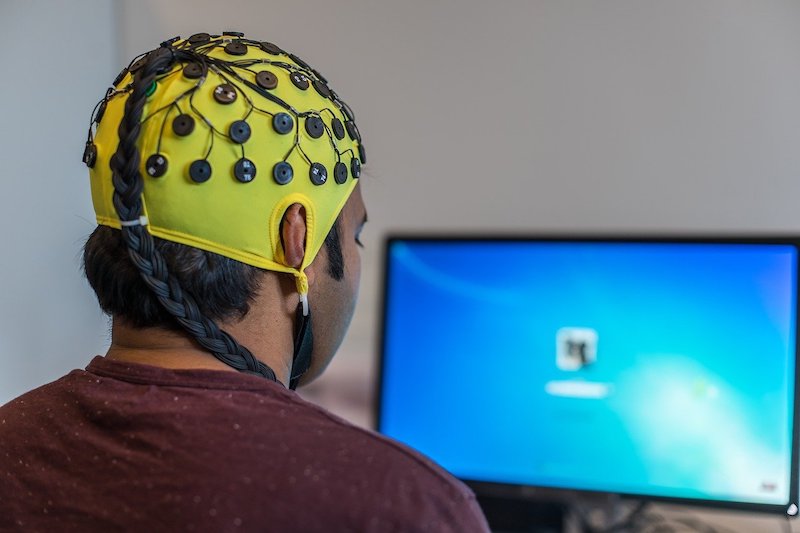
To solve this problem, Geraedts analyses brain images (EEGs) using artificial intelligence. "Actually, we let artificial intelligence loose on an existing technique: a brain movie, or EEG. Nerve cells communicate with each other via electrical impulses. Those electrical impulses can be measured with an EEG. On a computer screen, it looks like a series of waves. If the thinking ability is impaired, as in Parkinson's disease, the waves move more slowly," the doctor-researcher tells de Volkskrant. The results are promising. For instance, the algorithm appears to be able to correctly identify 92% of patients with good and just poor cognition.
Algorithm from the automotive industry
The algorithm deployed by Geraedts comes from researchers in the automotive industry and developed by the Leiden Institute of Advanced Computer Science. This algorithm alerts motorists if they need to go to a garage after a minor accident - such as hitting a bollard. The algorithm does this by analysing data that sensors collect about vibrations in the vehicle. To the algorithm, these vibrations of the car look just like the waves of an EEG, reports Geraedts. The algorithm appears to work well for EEGs of parkinson's patients.
Geraedts points out that the algorithm is not yet deployable in practice. "Not yet, it took the Leiden supercomputer to make the algorithm learn how to detect patterns in the jumble of EEG measurements. We show that it can do it, but it has yet to be built into the EEG software on an ordinary computer in the consulting room. For now, it is still an addition to the existing assessment of cognition. For now, we still assess the EEG waves manually, but soon the software will hopefully give an assessment of the patient's cognition at the touch of a button," the physician-researcher concludes.
Geraedts’ interview with de Volkskrant can be found here.
Author: Wouter Hoeffnagel










