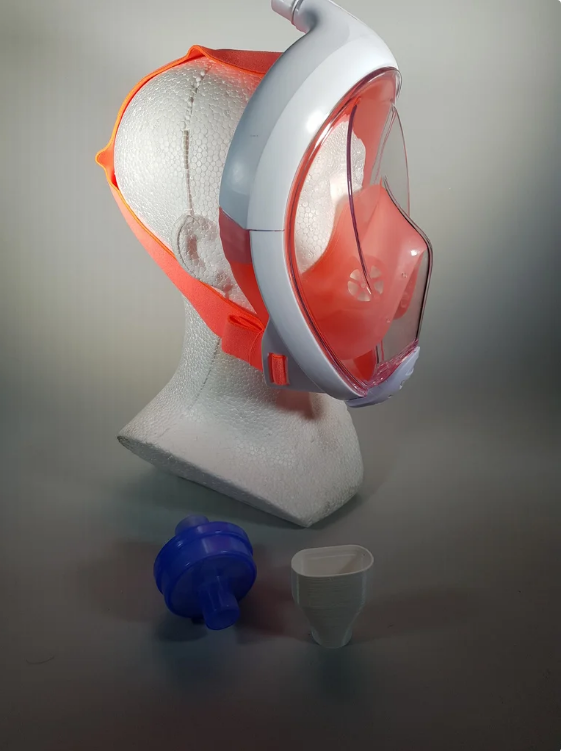
IO researchers, in collaboration with medics and industry, are designing a unique 3D-printed connector to connect an ordinary snorkelling mask to a filtration system. This makes the snorkel mask usable as a protective mask for medical personnel. The design has been made available worldwide on Thingiverse. TU Delft writes in a press release.
There is a global shortage of personal protective equipment for medical professionals due to the COVID-19 pandemic. A team of anaesthetists, universities and a group of companies, all providing non-profit assistance, have developed two new reusable face masks for medical professionals caring for and treating COVID-19 patients.
These designs can help solve the global face mask shortage and improve the safety of medical professionals, especially during intubation and intensive care procedures where the risk of infection is highest. Both masks use a unique 3D-printed connector piece to connect an ordinary snorkel mask to a filter system. The COVID Lifesaver Mask uses a high-efficiency filter from anaesthesia equipment to create a low-cost, easy-to-use system for short-term use. The Air-Wave Protector uses an industrial fan & filter component to create a personal protection device for longer use.
COVID Lifesaver Mask
Combining an ordinary full-face snorkel mask with a high-efficiency filter from anaesthesia machines and respirators enables the development of a reusable full-face mask for medical professionals that is safer than the commonly used FFFP2 mask. The prototype has been subjected to clinical studies to rule out carbon dioxide poisoning. The anaesthetic filter used has already proven that it can block 99.999% of viruses and bacteria. Further research is ongoing here.
Air-Wave Protector
The Air-Wave Protector is a combination of the same snorkel mask coupled with a filter for medical use and an air pump used in the welding industry for personal protection through a specially developed 3D-printed connecting piece. The air pump creates a positive pressure in the mask, reducing the potential leakage of air
is reduced and makes breathing easier. Initial studies show that the solution offers better protection than commonly used FFP2 masks.
Safety and comfort
A team of medical professionals tested the snorkel mask in both solutions and indicated that it works well. There is room to wear glasses inside the mask and communication with patients and colleagues is possible. The reusable mask can be disinfected by medical institutions with cleaning methods already available.
Availability
The designs of the solutions are open source, meaning they can be freely copied to help medical professionals around the world. The design of the 3D-printed connectors created by TU Delft is made available on "thingiverse.com", a global website where designs for 3D printers can be shared.
Although some parts of the solutions are still under development and testing, the group has decided to make their designs and progress available to the general public. Royal Dutch Shell has already started printing the COVID Lifesaver connectors at its Technology Centre in Amsterdam and has given its full cooperation to contribute to the solutions currently being developed.
Collaboration
The non-profit initiative brought together several groups (anaesthetists, universities, companies and volunteers) who had similar ideas on how to help medical professionals in their fight against COVID-19. With overwhelming passion, they partnered to design solutions within a short time frame.
The "COVID Lifesaver Mask" and the "Air-Wave Protector" are being developed by a support network consisting of:
● An independent group of anaesthetists from the Haaglanden Medical Centre (HMC)
● Delft University of Technology
● Royal Dutch Shell
● Air-wave.org, a non-profit group started by Damen Shipyards, Blue Orange Wave, and VFA Solutions with support from a large international group of specialists and innovative companies










