
Nevi Purchasing Managers' Index (PMI) for July comes out at 47.9. This is significantly higher than June's figure. Nevi, the association for purchasing and supply management, calls the increase an indication of a modest deterioration in business conditions in the Netherlands and speaks of significantly less contraction.
Nevi's purchasing managers' index is released every first working day of the month. Due to the COVID-19 pandemic, the Nevi PMI fell to 40.5 in May, the lowest since May 2009 when the global financial crisis was at its height. In June 2020, it rose to 41.3, followed by a rise to 47.9 in July.
Production and number of orders fall less sharply
The smaller contraction is due to better results in production and new orders. Thus, the decline in production in July was the lowest in five months. The number of new orders also fell in July, but the index for this ends almost eight points higher than in June. New export orders also fell less sharply. However, Nevi does point out that the decline here remains significant.
Employment has again fallen significantly, while purchasing activity also continues to decline. The same goes for the quantity of materials purchased. The stock of finished goods remained largely unchanged. Delivery times have increased to the smallest extent since October 2019.
Purchasing and sales prices also fall less sharply
Nevi also reports that purchasing prices fell for the fourth month in a row, while selling prices also fell. However, both fell less sharply than in June. Expectations for future output remain positive; this part of the index also falls higher than in June.
"It seems that the Dutch manufacturing sector is close to bottoming out. Production, new orders and current orders declined further, but the decline was quite small. With manufacturing in Germany and the eurozone as a whole already cautiously picking up, new export orders could increase slightly in August. Production will remain at low levels for the time being. As for 12-month output, business leaders have become even more optimistic. There is good hope for economic recovery in 2021″, said Albert Jan Swart, industry sector economist at ABN AMRO in a note.
Business confidence increases
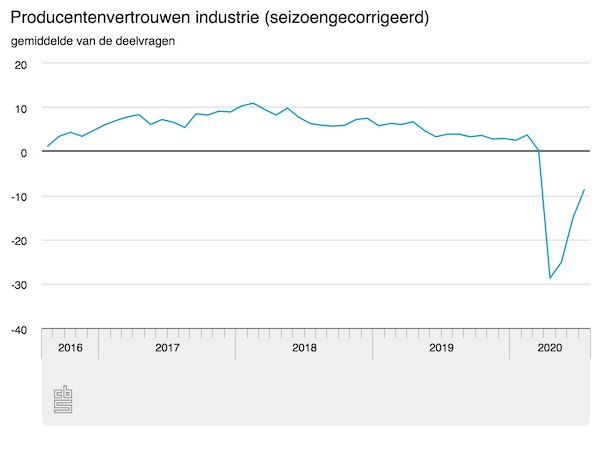
CBS figures also show a cautiously positive picture. For instance, business confidence among industrial entrepreneurs rose again in July, from -15.1 in June to -8.7 in July. By comparison, the average for the past 20 years is 0.5. Business confidence was highest in February 2018 (10.9) and lowest in April 2020 (-28.7). CBS reports that negatively-minded entrepreneurs have prevailed since April 2020.
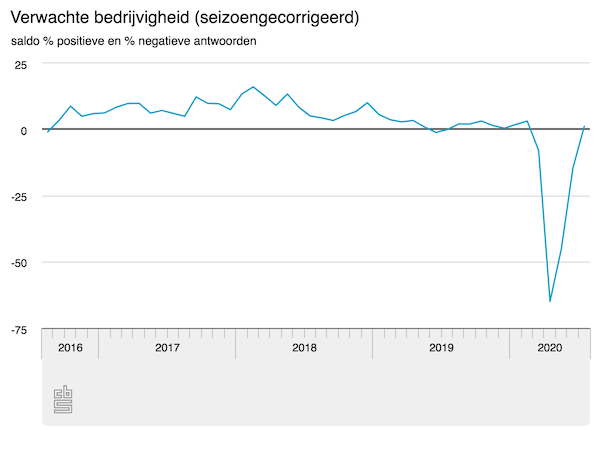
Expected activity improved significantly again. For the first time since February, expected activity is positive again. "The unprecedented deterioration in April has been completely reversed in three months," writes CBS in a press release. The opinion on the order book is also less negative. About stocks of finished products, however, entrepreneurs remain as negative as ever.
It should be noted that expected business activity is the only sub-indicator of producer confidence to turn positive. In practice, this means that more entrepreneurs expect their output to increase in the next three months than those who expect their output to decrease. However, the other two sub-indicators are negative. For instance, the number of entrepreneurs who consider their order book to be small is higher than the number of entrepreneurs who consider their order book to be large. This figure is seasonally adjusted. Also, the number of entrepreneurs who consider the stock of finished goods as too large is larger than the number who consider the stock too small.
Producer confidence up across all sectors
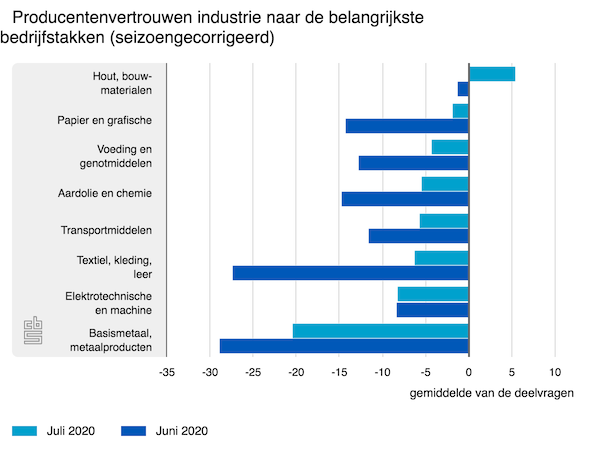
Looking at industries within manufacturing, it is noticeable that producer confidence rose in all sectors, with textiles and clothing leading the way. The most negative are entrepreneurs in the metal industry. Entrepreneurs' confidence in the electronics and machinery industries hardly improved. The confidence figure in the wood and building materials industry is the only one that is now positive again.
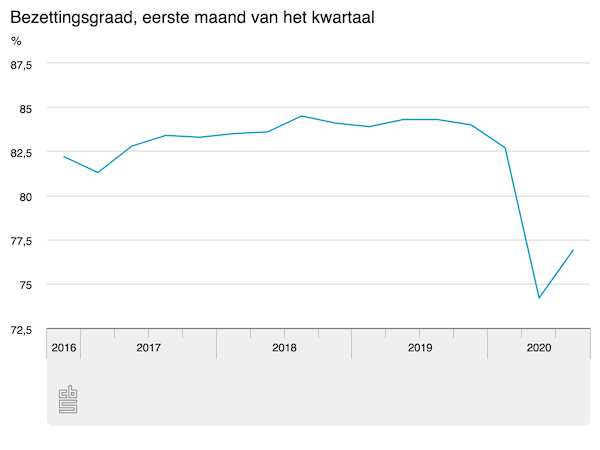
The utilisation rate of machinery and equipment in manufacturing rose slightly from 74.2 per cent in the second quarter to 76.9 per cent at the start of the third quarter. However, CBS points out that the capacity utilisation rate is still the second-lowest in more than seven years. The average daily output of Dutch manufacturing in May was 12.5 per cent lower than in May 2019. This is the biggest drop in over 11 years.
Germany
CBS also looks at Germany, which is a key sales market for Dutch manufacturing. Confidence among German industrial producers was less negative in July than in the previous month for the third month in a row. Both current activity and expectations for the coming months improved. German capacity utilisation increased from 70.4 to 74.9%. Average daily output of German manufacturing shrank by almost 24% in May compared to the same month a year earlier, according to figures from Destatis, the German counterpart of CBS.
Author: Wouter Hoeffnagel











