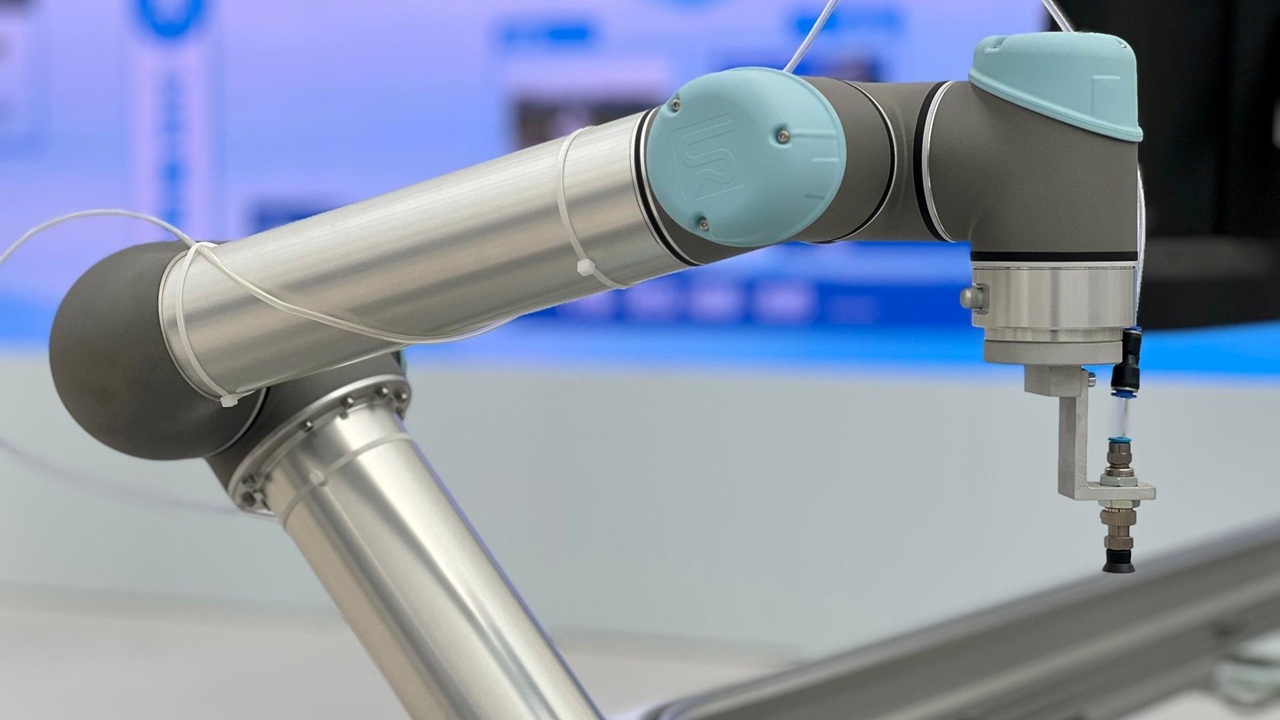

Dutch manufacturing companies are increasingly using industrial robots. According to new figures from the International Federation of Robotics (IFR), the number of new robot installations in the Netherlands rose by 5 per cent to 2,473. Robot density has also increased: the Netherlands now has 310 industrial robots per 10,000 employees. As robots play an ever-greater role in production processes, the importance of precise, fast and safe control is also growing.
The performance of industrial robots depends to a large extent on their control electronics. In the automotive industry, for example, robots must be able to position parts with an accuracy of one-tenth of a millimetre. Fast, controlled movements are also essential in medical technology and logistics.
Sensors
Modern motor control enables more precise and efficient movements. At the same time, sensors continuously collect information about the robot’s movements and its surroundings. Encoders and motion sensors track the robot’s own movements, whilst 3D cameras, LiDAR and force sensors help to detect obstacles, objects and contact forces.
Edge computing
To process this data without any critical delays, real-time control and fast communication between the various components are required. Edge computing also plays an important role here. By processing data directly in or close to the robot, systems can respond more quickly and are less dependent on network connections.
AI offers opportunities, but safety remains a challenge
Artificial intelligence (AI) is also playing a greater role in robot control. It can assist with object recognition and the optimisation of movements, but at the same time presents new challenges. AI systems operate on the basis of probabilities, whereas safety-critical functions must, by contrast, respond in a predictable and reliable manner. Functions such as an emergency stop must therefore continue to rely on proven safety mechanisms.
Specialist knowledge
Furthermore, the development of advanced robots requires specialist knowledge of motor control, sensor technology, software and AI. For manufacturing companies, this means that technical innovation also requires multidisciplinary collaboration and further training for staff.
Start small, improve in a targeted way
For small and medium-sized manufacturing companies, a step-by-step approach is often the most practical. A first step is to analyse existing systems: where do delays occur, which sensors or processors are limiting performance, and where can communication between components be improved?
Pilot project with a single robot cell
A pilot project involving a single robot cell can then provide insight into the technical and financial feasibility of modernisation. In doing so, companies should not only consider the necessary investment, but above all the measurable results, such as fewer production errors, shorter cycle times, greater precision and improved safety.
System architecture
Decisions regarding system architecture also deserve early consideration. For example, companies must determine which processes are to be controlled centrally and which data needs to be processed directly at the robot. This enables them to improve their existing automation in a targeted manner and respond more effectively to future technological developments.
Robotisation from a bird’s-eye view
Malte Janßen, Product Manager for Professional Robotics at reichelt elektronik: “When it comes to robotisation, many companies focus primarily on purchasing new machines, whilst there are also opportunities to improve performance within existing systems. By first identifying where the technical bottlenecks lie and then modernising a single robot cell, companies can determine precisely which investments will actually deliver benefits.”
Source and opening image: reichelt elektronik
Read also: Robot swarms can improve inspections of ageing bridges