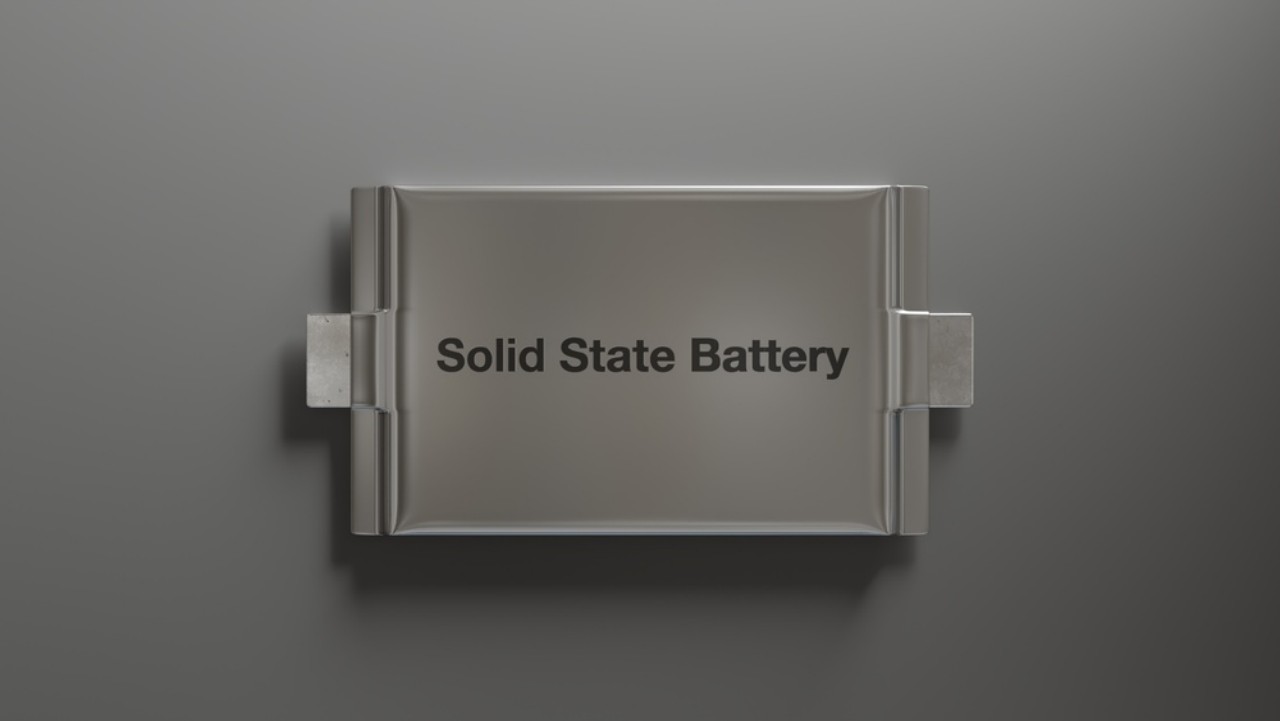

The first solid-state battery factory in France has opened. It is a Saft factory, part of the French company TotalEnergies, in Bordeaux. Saft claims this makes it the first French manufacturer capable of producing solid-state batteries that use both sulphide and polymer electrolytes at room temperature.
Solid-state batteries are regarded as a promising battery technology for various applications, including electric vehicles (EVs). These batteries can store up to fifty per cent more energy and charge more quickly, whilst remaining safe. A key feature of solid-state batteries is the use of a solid electrolyte. A ‘conventional’ lithium-ion battery contains a liquid electrolyte. This allows lithium ions to move between the positive and negative electrodes during both charging and discharging. In a solid-state battery, this liquid electrolyte is replaced by a solid electrolyte.
From aerospace to energy storage
Saft is a French technology company specialising in the design, development and manufacture of both batteries and battery storage systems for industrial and critical applications. The company was founded in 1918 and has been wholly owned by TotalEnergies since 2016. Saft’s technology serves a range of sectors, including aerospace, defence, railways, shipping, industrial facilities and energy storage.
When it comes to solid-state batteries, Saft focuses specifically on those with sulphide and polymer electrolytes. A sulphide electrolyte is an inorganic material based on lithium and sulphur, which in many cases also contains phosphorus. It can conduct lithium ions relatively quickly at room temperature. A polymer electrolyte is a material based on long molecular chains. This material can be flexible and, amongst other things, ensures that different components remain in good contact with one another.
The French company will produce the solid-state batteries at its factory in Bordeaux using a dry-electrode process. This reduces CO₂ emissions from this stage of production by 40 per cent compared with alternative production methods.
Many challenges remain
The factory is significant, amongst other things, for the further development of solid-state batteries in Europe. There are challenges in areas such as production costs, service life and large-scale production. With the new factory, Saft is focusing on industrial-scale production, which could contribute to a wider application of the technology across various sectors.
Saft’s batteries are specifically designed for the aerospace sector. Safety, performance and energy density are key requirements in these sectors, making solid-state batteries particularly relevant. Saft had previously produced ‘semi-solid-state’ battery cells, intended to evaluate the technology for use in electric and hybrid aircraft.
France and Europe as leaders in solid-state batteries
“Solid-state batteries are one of the most promising innovations for meeting the electrification needs of the future. These new production lines represent a significant milestone for Saft, enabling us to translate several years of research into industrial production capacity. This underlines our ambition to position France and Europe as leading players in this strategic technology,” said Cedric Duclkos, Chief Executive Officer (CEO) of Saft.
Saft cites various applications for solid-state technology:
- Storing renewable energy sources such as solar and wind power to better balance the demand for and availability of sustainable energy.
- Powering medical implants and wearable devices, which can thus be made safer and worn for longer periods.
- For use in satellites, drones and other aerospace applications where weight and reliability are of critical importance.
- These batteries can store more energy and charge faster than conventional batteries in EVs, which translates into a longer range and shorter charging times.
- Extending battery life and making consumer electronics such as smartphones, tablets and laptops safer.
Battery storage systems in Orbec and Bois Paillet
Earlier this month, Saft announced that it would be supplying two battery storage systems to Axpo, a Swiss renewable energy producer. Both systems will be installed in France. These comprise a project in Orbec with an energy storage capacity of 92 MWh and a power output of 41 MW, and a project in Bois Paillet with an energy storage capacity of 30 MWh and a power output of 14 MW.