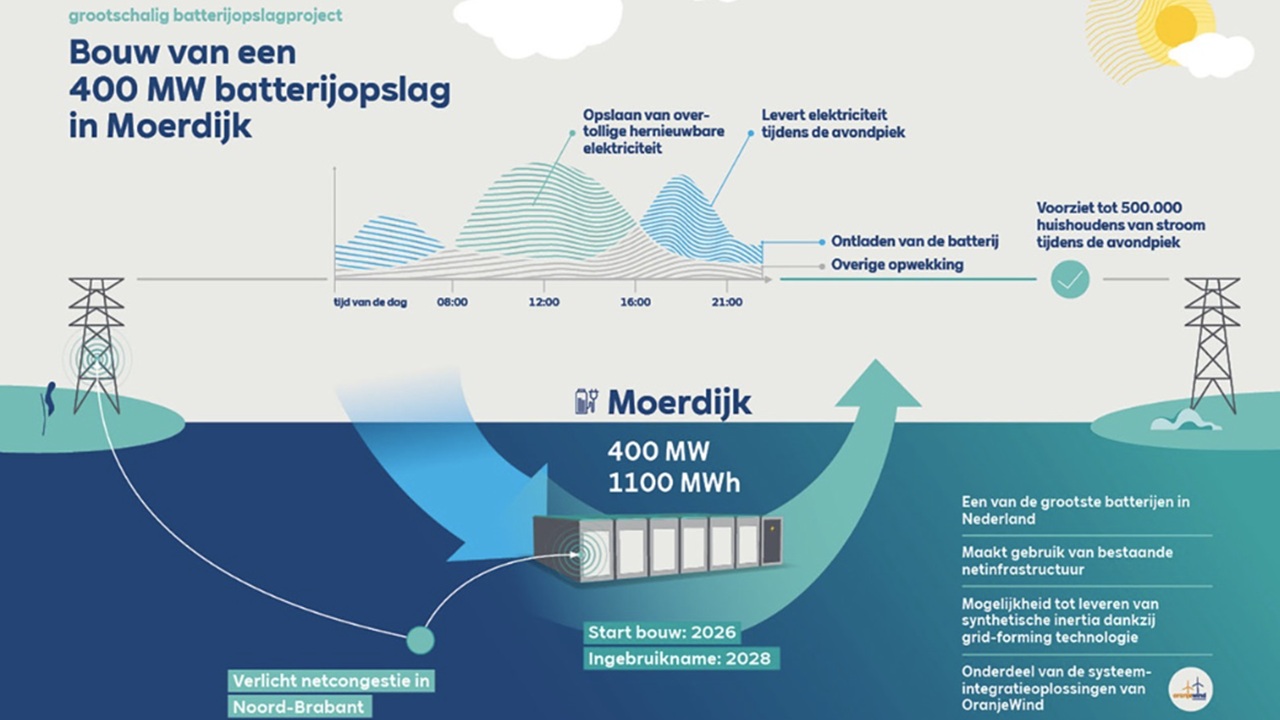

A large-scale battery storage system is to be built on the site of the power station in Moerdijk, the Netherlands. RWE has taken the final investment decision to build a 400 megawatt (MW) and 1,100 megawatt-hour (MWh) battery storage system at this site.
The new battery storage system will consist of 208 containers housing lithium-ion batteries and will be able to deliver its full capacity for almost three hours. Construction is set to begin shortly, with commissioning scheduled for the second quarter of 2028.
Meeting peak demand
Nikolaus Valerius, CEO of RWE Generation SE: “This battery represents a significant milestone for a reliable electricity supply and for relieving pressure on the electricity grid in North Brabant. As one of the largest and most powerful battery systems in the Netherlands, it will be able to meet the peak demand of around 500,000 households during the evening for almost three hours. At the same time, it can absorb surplus electricity from the grid within seconds. Battery storage plays a crucial role in building a resilient energy system that can accommodate a growing share of renewable energy sources.”
Battery storage system cleverly positioned
Mark Lentjes, Regional Director of TenneT South Netherlands: “We are pleased that RWE, in West Brabant, intends to contribute to a more efficient use of the electricity grid with a large-scale battery that acts as a congestion reliever. RWE’s large-scale battery is located close to the 150,000-volt Moerdijk-Noord high-voltage substation and helps to reduce the bottleneck there, which has an impact on congestion across the whole of North Brabant.”
Battery storage system combined with existing infrastructure
The new battery storage system will make optimal use of the existing infrastructure: it will be connected to the national electricity grid via the existing substation at the RWE power station in Moerdijk. Through capacity management agreements with grid operator TenneT, the battery will be used to alleviate congestion in the North Brabant region. This development will free up capacity on the grid for parties on the waiting list who wish to purchase electricity.
Further research
TenneT, together with the regional grid operator Enexis, will be investigating what this means for whom and when over the coming period. The grid operator will take this development, along with other developments in the region, into account in the review of the congestion management study in December 2026. The new battery storage system will be able to provide advanced grid services, such as immediate reserve (inertia). The Moerdijk site is already home to the first synthetic inertia battery connected to the continental European grid, with a capacity of 7.5 MW/11 MWh.
Offshore wind energy
The 795 MW offshore wind project by RWE and TotalEnergies off the Dutch coast is designed to combine offshore wind power generation with onshore flexibility solutions, which help to match renewable energy production to electricity demand.
Fewer fluctuations
In Moerdijk, the battery projects play a key role in this by storing electricity when wind generation is high and feeding it back into the grid when needed. This helps to smooth out fluctuations and optimise the use of renewable energy. Together with technologies such as electrolysis, e-boilers and EV charging, this supports OranjeWind’s ambition to integrate offshore wind energy more effectively into the Dutch energy system.
Battery storage at RWE
As a driving force behind the energy transition, RWE develops, builds and operates battery storage systems in the US, Europe and Australia. In the Netherlands, RWE currently operates two battery storage systems. In addition to the existing inertia battery in Moerdijk, RWE operates a 35 MW/41 MWh battery at the power station in Eemshaven. Globally, RWE currently operates battery storage systems with a total capacity of approximately 1.7 gigawatts (GW), and a further 3 GW is under construction. As an integral part of its growth strategy, RWE plans to significantly expand its battery storage capacity worldwide.
Source and lead image: RWE
See also: Collective collection scheme for industrial batteries on the way