
Almost every (96%) Dutch industrial company is affected by supply chain bottlenecks to a greater or lesser extent. More than a quarter (26%) even report that they face serious disruptions. This is according to reichelt elektronik's latest supply chain report 2025, published for the fifth consecutive year.
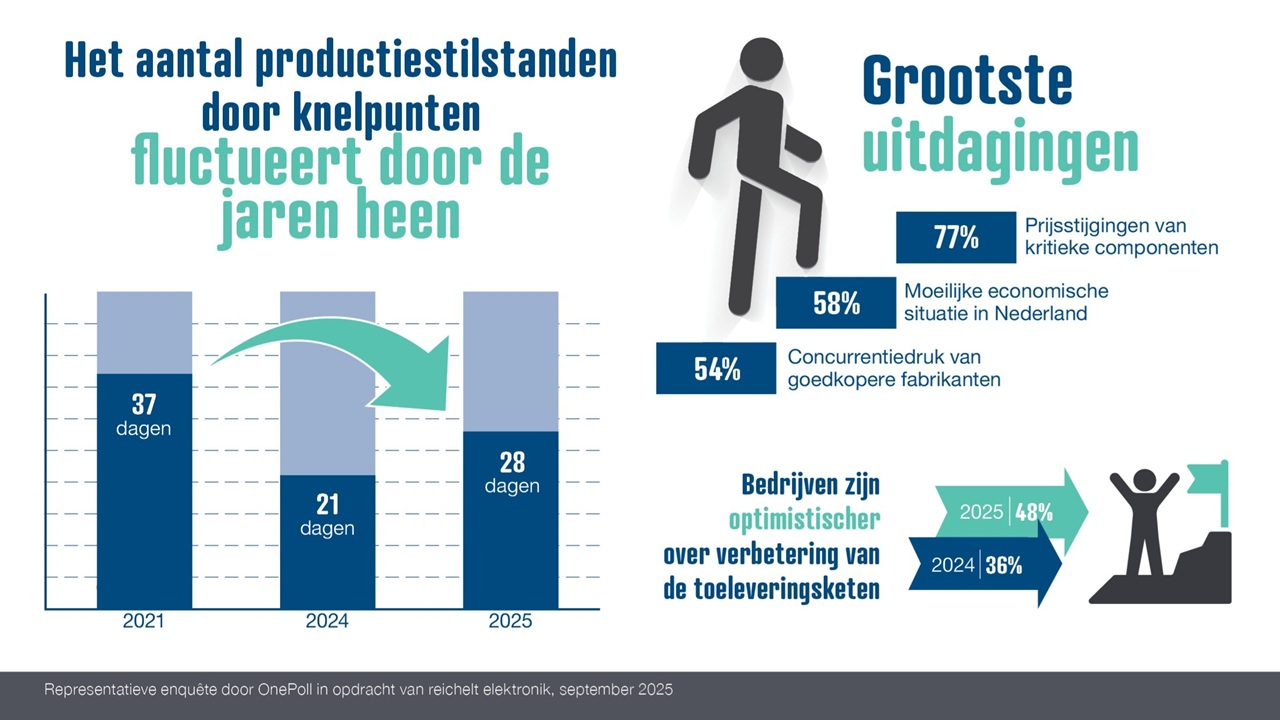
In 2025, Dutch companies are still struggling with their supply chains. The number of days that business operations have to be shut down due to supply chain problems has increased. This year, business is down for an average of 28 days compared to 22 days in 2024, and buying parts was also perceived as slightly more difficult than last year. One in five (21%) respondents reported difficulty in procuring parts or materials, compared with 20% last year.
Batteries and charging technology
The biggest product group affected by supply problems this year is batteries and charging technology (37%), which is five percentage points more than last year. In second place are computer components such as RAM, hard drives and graphics cards (33% vs 30% in 2024) and in third place are sensors (29% vs 40% last year).
Spare parts
When it comes to spare parts for appliances and machines, the situation has improved. In 2024, almost half (45%) of the respondents said they had difficulties with this, while in 2025 it is only 29%.
Optimism about supply chain
Overall, companies are cautiously optimistic. Almost half (48%) expect the situation to improve over the next 12 months, up significantly from 36% last year.
Price increases outweigh supply chain bottlenecks
Outside of sourcing materials, Dutch companies are even more troubled by price increases (77%) for critical components than bottlenecks in the supply chain (64%). This is a significant increase from last year when only 63 per cent complained about high prices. Moreover, more than half (54%) of companies report competitive pressure from cheaper manufacturers. This means that companies are under great financial pressure. The difficult economic situation in the Netherlands (58%) also adds to this pressure.
Other challenges
Other challenges faced by industrial companies include high energy prices (60%), stricter environmental regulations (58%), the shortage of raw materials (53%), competitive pressure from more innovative solutions and products (50%), difficulties in implementing the Supply Chain Due Diligence Act (50%) and digitalisation (47%).
Political tensions
Political events and developments also continue to have a huge impact on companies' economic outlook. The ongoing war in Ukraine (52%) is still seen as the biggest negative factor. The newly imposed US tariffs are also seen as damaging by a third of respondents (34%). However, ongoing tensions and a feared trade war between the EU and China are seen as even more dangerous (43%).
Security closer to home
This is why many companies are turning to Europe: 36 per cent of them have established new trading relationships with companies from northern, western or central Europe in the past 12 months. Although the percentage of trade relationships with partners from eastern and southern Europe is only 30 per cent, 37 per cent say they plan to do so next year. These figures are significantly lower for partners from other continents. For instance, only 23 per cent of companies have entered into new partnerships in the US in recent months. Results for East Asia and Southeast Asia were also low (16 and 19 per cent, respectively).
Resilience
"Our fifth edition of the Supply Chain Report shows that the challenges are complex, but also that Dutch companies are showing resilience," says Christian Reinwald, head of product management and marketing at reichelt elektronik. "By forging new partnerships in Europe and investing in alternative sourcing strategies, entrepreneurs are showing that they are not letting uncertainty paralyse them, but are actively building a more robust future."
Also read: How AI is making supply chains smarter, faster and more resilient
infographic: reichelt
By forging new partnerships in Europe and investing in alternative sourcing strategies, entrepreneurs are showing that they are actively building a more robust future."Christian Reinwald, head of product management and marketing at reichelt elektronik
About the survey
The survey was conducted by OnePoll on behalf of reichelt elektronik and is being published for the fifth consecutive year this year. For this survey, 250 technical decision-makers from different industries were surveyed, including in aerospace, automotive, computer hardware, electronics, engineering, manufacturing, textiles, transport/distribution. They were questioned about the current state of the supply chain.











