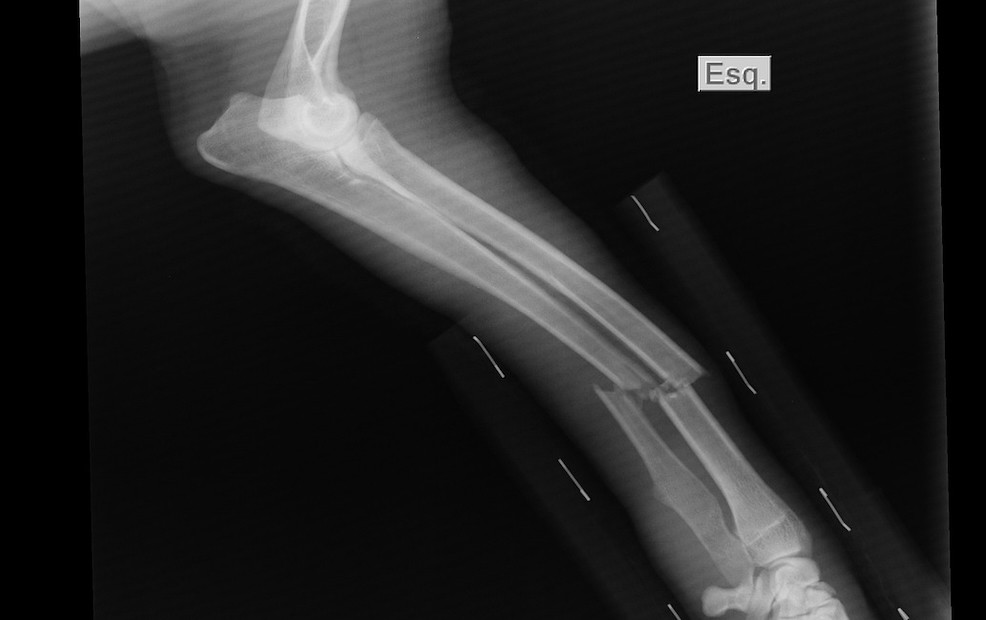

A new biodegradable implant could change the way bone fractures are treated. The scaffold material (scaffold) not only dissolves independently in the human body, but also helps stimulate bone growth.
A bone fracture heals on its own in most cases, while patients wear plaster or a brace to keep the bones stable. In complex fractures, this is not always the case and surgery may be required. In such cases, surgeons may place a scaffold of biocompatible material. In other cases, it is necessary to place metal plates or pins to allow the bones to recover properly.
Combination of magnesium, glutamine and citric acid
A new type of scaffold material developed by a team at US Penn State University could change this. CitraBoneQMg is an implantable and biodegradable implant. "By combining magnesium and glutamine - two small molecules that occur naturally in the body and in food - with citric acid, we found that these molecules work together to promote bone growth by stimulating intracellular energy metabolism," said first author Hui Xu, PhD, a biomedical engineering professor. Xu is supervised in this project by Su Yan, assistant research professor of biomedical engineering.
The combination of magnesium, glutamine and citric acid appears to increase intercellular energy and help regulate two energy pathways essential for bone growth: AMPK and mTORC1. These pathways are similar to management systems in the cell, and ensure that the cell's energy use is balanced for the creation of new bone.
"The molecules simultaneously regulate both energy pathways, which is different from normal - usually they work like a seesaw: one accelerates while the other slows down," Xu said. "The scaffold-like material energises a bone cell, so to speak: both magnesium and glutamine work synergistically with citric acid, giving stem cells more energy to grow and develop into bone cells, leading to better bone regeneration."
Faster bone growth
Animal tests on rats show that the method is effective. For example, after two weeks, thanks to CitraBoneQMg, bone growth was found to be improved by 56% compared to using a citric acid-based implant. Compared to animals with implants made of traditional bone material, this difference is as much as 185%.
"The three molecules act as a healing recipe for bone and open the door to a new view of bone repair," says Yan. "Besides accelerated bone growth, we also saw nerve regeneration and anti-inflammatory properties at the site of the scaffold-like material - two crucial factors for long-term bone repair."
High concentration of nutrients
The researchers stress that delivering the molecules directly to the site of bone fracture via the scaffold material ensures a high concentration of nutrients exactly where they are needed most. This while when taken orally, only a small percentage reaches the bone fracture.
The polymeric scaffold material is also found to possess naturally photoluminescent and photoacoustic properties. This makes it easy to map the material after implantation.
"Thanks to those photoacoustic properties, CitraBoneQMg has great potential for living tissue tracking," Xu adds. "It can even be detected with ultrasound under deep tissue."
Image: Wellington Dinho via Pixabay