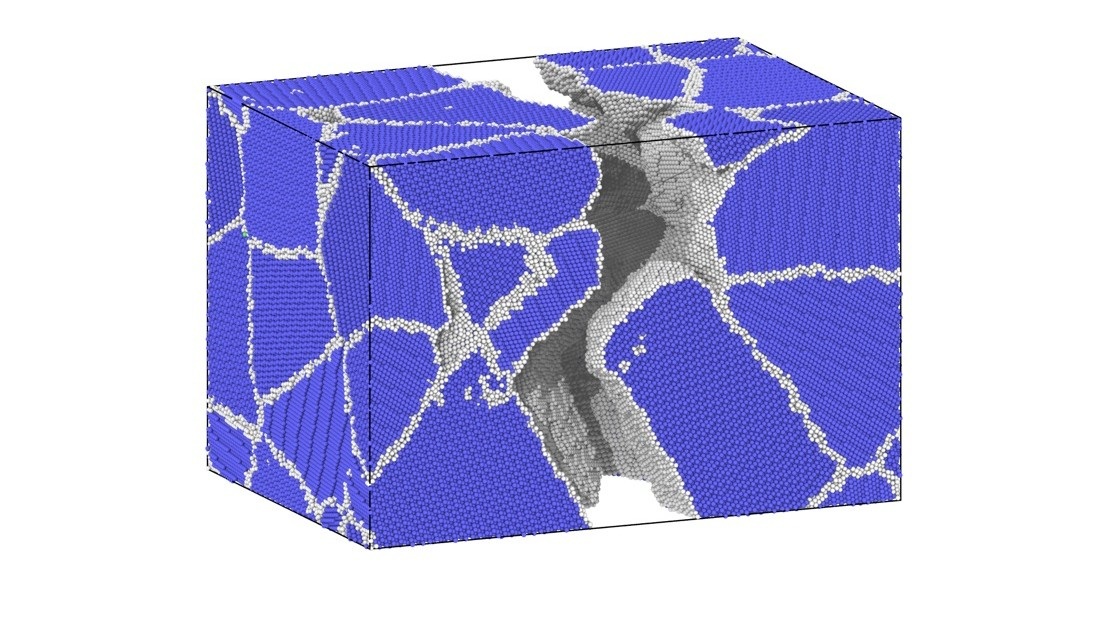

Tiny cracks, fracture lines, or irregularities. These microscopic flaws in metals can have major consequences. Researchers at TU Delft have now developed a clever way to detect and predict those minute defects in metals with machine learning. This new tool could be a huge step forward in designing stronger and safer materials. Their research was recently published in npj Computational Materials.
"Defects are actually always present in metals," explains associate professor Poulumi Dey. "But it is crucial to understand what those defects do to a material's strength and lifespan. Especially when it comes to life-threatening situations due to infrastructure collapse or very expensive repairs."
What is a defect genome?
Normally, you have to do a lot of tests in the lab to find out which defects are in a metal and what exactly they do. That costs a lot of time and money. TU Delft's team takes a different approach. They use computer simulations to see how defects are formed and how they affect the behaviour of the material. "We have developed a new computational model with which we can effectively reconstruct the metal at the atomic level," says Dey.
Machine learning
The machine learning model used is faster and more accurate than existing methods. The result is a kind of 'defect genome' of metals: a systematic framework that allows scientists to investigate how different imperfections affect the mechanical properties of a material. This approach could dramatically improve the way engineers design materials for critical applications.
More durable metals
The applications are wide-ranging. From bridges and aircraft to smartphones and medical devices-almost all modern technologies rely on metals that must withstand heavy loads. "By better understanding how defects affect performance, engineers can design materials that are not only stronger, but also more reliable and durable," adds postdoctoral researcher Fei Shuang.
Tungsten
The team successfully tested their method on tungsten, a metal known for its high strength and melting point. The next step is to apply the machine learning model to more complex materials with multiple components, such as steel and high-entropy alloys. These are widely used in construction, hydrogen technology and other demanding applications.
We have developed a new computational model that can effectively reconstruct the metal at the atomic levelUniversity associate professor Poulumi Dey
The team successfully tested their method on tungsten, a metal known for its high strength and melting point. The next step is to apply the model to more complex materials with multiple components, such as steel and high-entropy alloys, which are widely used in construction, hydrogen technology and other demanding applications.
Source and image: TU Delft
Also read: New 3D printing method combines flexible and hard materials in one print