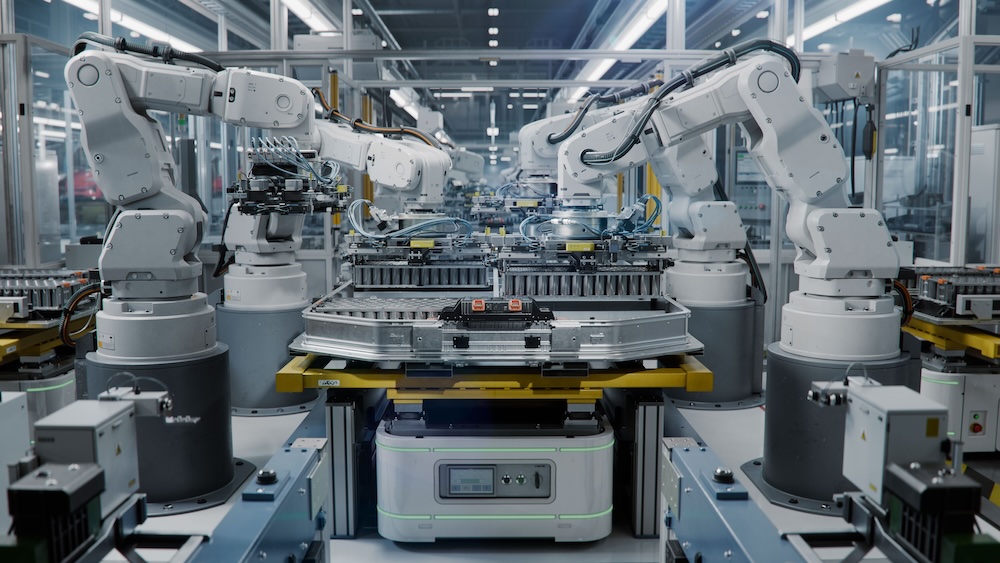

Without structural strengthening of the innovation chain and a strategic vision of the future, the Netherlands risks losing its industrial lead, TNO warns on the basis of an analysis. In a report, the organisation sounds the alarm about the creeping deindustrialisation in our country.
Manufacturing makes a major contribution to the Dutch economy; about 12% of GDP comes from industrial activities. The sector accounts for about a fifth of our country's total export value. The independent research organisation also points to the flywheel effect industry has on innovation in adjacent sectors.
Industry under pressure
Despite this importance, industry is under pressure. For instance, industry is largely dependent on international supply chains. This makes companies vulnerable, partly due to increasing geopolitical tensions. At the same time, TNO points to other factors such as energy transition, labour market tightness and rising raw material costs.
The research organisation warns that the Netherlands must take action to prevent such developments from causing our country to lose ground on other countries that do firmly commit to industrial policy and innovation.
'Innovation chain is cracking'
In the analysis, TNO concludes that the innovation chain is cracking. Much knowledge development is still taking place in the Netherlands, including at universities and knowledge institutions. At the same time, the flow of concrete applications to the market is stagnating.
The Netherlands also has a difficult climate for start-ups. For instance, they encounter high costs and complex regulations. In addition, large companies move R&D abroad in some cases, where there are tax advantages and more attractive ecosystems.
Investment lags behind
TNO stresses the need for robust public and private investments in R&D to remain competitive. It also points out that other countries are pouring billions of euros into their strategic industries, with the Netherlands lagging behind.
The independent research organisation therefore calls for a structural increase in R&D investment in the Netherlands. Currently, the Netherlands puts about 2.23% of GDP into R&D, while the target from the EU is 3%. On an annual basis, this shortfall translates into billions of euros the Netherlands invests less in R&D than other countries. In addition, several countries including Germany and South Korea invest significantly above the European target in R&D.
Strengthen innovation climate
TNO also calls it important to strengthen the innovation climate more broadly. Policies should create space for new players on the one hand, while encouraging existing players to keep their R&D in the Netherlands. The research organisation points out that the R&D Top 30, compiled by TW, TNO and VNO-NCW, has long been headed by established players such as ASML, Philips and NXP. According to TNO, this makes the Netherlands vulnerable; if these players decide to move their R&D abroad, the impact on innovation on Dutch soil will be significant.
The research organisation calls for an integrated approach. Industry, knowledge institutions and government should act as equal partners in this. In doing so, it makes a number of recommendations:
- Strengthen the innovation chain: improve the connection between fundamental research and market introduction. Including by creating 'labs for scale-up', where companies and researchers can explore new technologies together.
- Invest in new value chains: think green hydrogen, circular production, quantum technology and robotisation.
- Put sustainability centre stage: make CO2-neutral production processes feasible by aligning regulations and subsidies.
- Take care of human capital: invest in technical education, focus on lateral entrants and make technological professions attractive.
Important role for high-tech sector
The high-tech sector plays a special role in maintaining the Netherlands' industrial lead, TNO argues. It points to the sector's leading position worldwide. As a result, the sector generates not only economic value but also "technological dominance". As an example, the research organisation cites ASML, whose extreme ultraviolet (EUV) technology enables the production of highly advanced chips.
TNO states that by 2040, the high-tech sector will have to derive at least half of its turnover from new value chains. This requires not only innovation, but also radical efficiency improvements (+150% productivity), full sustainability and greater resilience. "Without long-term policies and investments, this is an unachievable task," writes TNO.











