
In winter, avalanches pose the greatest danger in the mountains. Avalanche surveillance is therefore crucial to ensure the safety of people and infrastructure. Researchers at the Fraunhofer-FHR are breaking new ground in avalanche detection. Using a passive radar, they can detect whether avalanches are actually triggered after controlled explosions, even in remote areas. The researchers were able to demonstrate in a feasibility study that mega-satellite constellations are suitable for avalanche detection.
Every winter, the risk of avalanches in the mountains increases as snow accumulates. One of the protective measures to reduce the risk to people and infrastructure is to carry out controlled, artificial explosions. These blasts cause the release of huge masses of snow that thunder into the valley along a predetermined path. But the question remains: Was the avalanche actually triggered as planned? It is essential to confirm this.
Traditional avalanche detection
To do this, the affected area must be targeted for surveillance - regardless of visibility and prevailing weather conditions. This task is currently carried out using mechanical wires that break when the avalanche starts, or by helicopters monitoring the area during detonation. In many cases, radar technologies that allow continuous remote monitoring in all weather conditions are also used. However, all these solutions have major drawbacks. Mechanical wires, for example, have to be re-tensioned after each avalanche. This potentially puts technicians at risk, while helicopters can only fly in good weather. Active radar technologies, in turn, require transmission licences.
Passive radar
Here, passive radar could be a suitable alternative for avalanche detection. Unlike a conventional active radar, a passive radar is a positioning technology that does not emit electromagnetic energy. A passive radar uses radio or mobile communication signals. Moreover, it does not emit radar beams that are reflected by an object and then deflected to the receiver. Instead, it uses radar beams that are already present.
No permit required
A passive radar is not only cost-effective, energy-saving and easy to install. Another advantage is that it can also be used without broadcasting licences. "Since a passive radar does not need a transmitting antenna and consists of fewer components, it is cheaper and easier to commission. It can be easily installed without a licence." So says Dr Diego Cristallini, group leader at Fraunhofer FHR.
Remote areas
The problem, however, is that radio signals are usually not available in remote mountain areas. This means that Dr Cristallini and his team have to rely on signals from the OneWeb or Starlink mega-satellite constellations with fixed satellite services (FSS). These are available anywhere in the world. The satellite networks are intended to provide broadband coverage anywhere on earth. In a feasibility study commissioned by ESA-ESTEC (European Space Research and Technology Centre), scientists are investigating whether Starlink and OneWeb are suitable for avalanche detection and, more specifically, whether they are actually capable of detecting and confirming an avalanche after an explosion.
Satellite link
"Satellite connections are always used when terrestrial networks are unavailable, overloaded or disrupted. Like OneWeb, Starlink is an LEO (low Earth orbit) satellite service. This means that a large number of satellites orbit in low Earth orbit. This proximity is advantageous in terms of latency because the distance from the ground to the satellite and back is only a few hundred kilometres," explains Dr Cristallini.
Starlink
The large number of Starlink satellites enables continuous radar images of the Earth's surface. As soon as one satellite disappears on the horizon, a new one appears, producing two-dimensional images of the area that are easy to interpret. "We are talking about SAR (synthetic aperture radar), which allows images of remote mountainous areas to be captured that go far beyond detection." The satellites' mega constellations are permanently available as signal sources. The electromagnetic signals are sent into the mountainous areas from different angles. This makes visible areas that would otherwise be hidden using only one transmitter.
Simulation environment
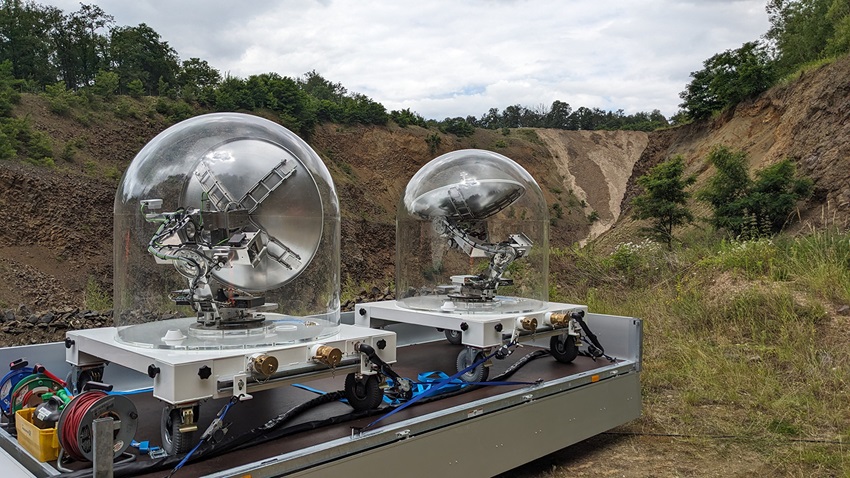
Using topographic data from a mountain, Dr Cristallini and his team developed a simulation environment that allowed them to simulate avalanches and analyse whether they could be detected using the Starlink signals. To test the promising simulation results in practice, the researchers also used their passive radar system to detect small and controlled landslides in a former basalt mine on the Rhine near the German town of Remagen. These landslides occur when an excavator plunges its load into the still-gaping hole. "Both simulations and field testing have shown that a passive radar with signals from satellite megaconstellations is suitable for avalanche detection," Dr Cristallini summarises.
Opening photo: Field tests in a former basalt mine: The passive radar’s right-hand antenna is aimed at a Starlink satellite, whilst the left-hand antenna is aimed at the controlled landslide. (photo: Fraunhofer FHR/Diego Cristallini)
You may also be interested in: Toyota invests millions in space technology firm Interstellar Technologies











