
High energy costs, declining economic forecasts and the difficult global market situation have characterised the discourse in recent months. Congestion in the supply chain has not been a major topic. Has the situation for suppliers recovered by 2024? The figures in reichelt elektronik's latest supply chain report show that the supply chain is still far from normal.
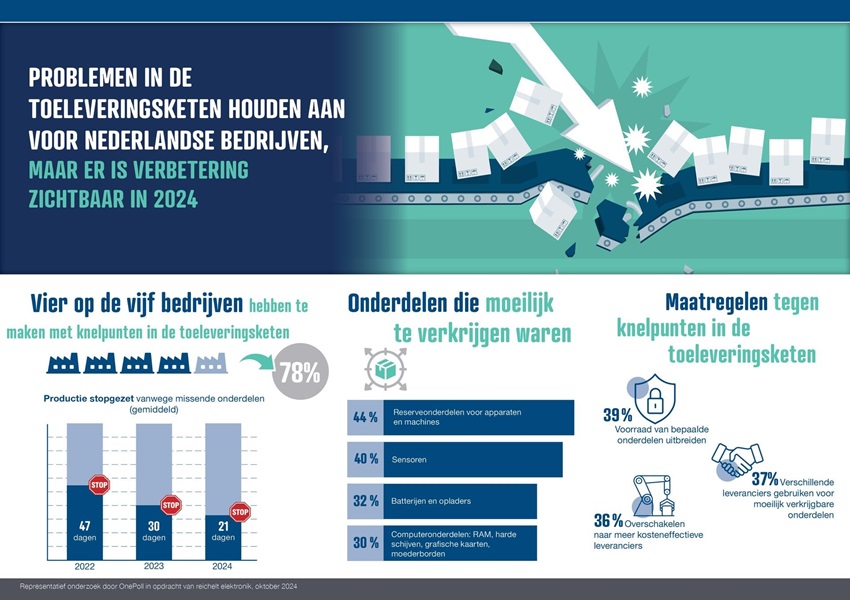
Problems in the supply chain are still widespread among Dutch companies. This year, around four in five companies (78%) reported major or moderate disruptions due to supply chain bottlenecks. A third (34%) had to shut down production for at least 20 days due to missing components. This is a huge loss for the affected companies. But it is an improvement over last year. Back then, 49 per cent had to shut down production for at least 20 days. The average number of production days lost also fell. While machines were down for 47 days in 2022, it was down to 30 days in 2023. This year, in 2024, that figure was around 21 days. So states the report by reichelt elektronik. The survey has now been carried out for three years in a row by the independent research institute OnePoll. 250 industrial companies from the Netherlands participate in it.
Spare parts
Spare parts for appliances and machines (44%) and sensors (40%) were the most difficult to obtain in 2024, as they were last year. Batteries were also difficult to obtain this year (32%), while they were still readily available in 2023 (16%). The biggest challenge this year for companies was high energy costs (67%) and stricter environmental regulations (66%). Price increases for hard-to-get components were also a challenge in 2024 (63%). Like last year, 45% of participating companies still think the situation will not change much in the next 12 months either.
How product design affects
It is also interesting to see how strongly product availability affects product range and product design. For example, 32 per cent of respondents said they are paying even more attention to long-term component availability when developing new products. Also, 30 per cent of companies have removed a product from the range because certain components are no longer (properly) available. To still get the parts needed, more than a third (41%) have found alternative suppliers for all or almost all components.
More stock
To better protect themselves against material shortages, most companies have opted for both long-term and short-term solutions. For instance, 39 per cent of companies have significantly increased their inventory of certain parts. Another 44 per cent plan to do so by 2025.
Regionalise and diversify
The long-term plan to regionalise and diversify supply chains is also already being implemented by some companies. For example, almost a third (28%) have already switched to regional suppliers to reduce their dependence on international influences, while another 43% plan to deploy this in the coming year. Many companies (38%) have already expanded their supplier network and another 47 per cent plan to do so in the coming year.
Drivers
However, global market events or political events are not the only drivers for companies to change their supply chains. One in three companies (34%) have taken measures this year to increase the security of their supply chains to protect themselves from attacks. Almost half of companies (44%) plan to take this step in the coming year. The impact of the Supply Chain Duty of Care Act is also evident: 29 per cent of the companies surveyed have changed suppliers this year to comply with the law. And 48 per cent plan to do so within the next 12 months.
International challenges
Rising component costs (63%) are not the only factor increasing price pressure in Dutch manufacturing companies. Respondents see high energy costs (67%) as the biggest obstacle. The challenging economic situation worldwide (56%) and at home (52%) is also a problem for many companies. The war in Ukraine (49%) and possible or intensified trade conflicts between China and the EU (40%) were mentioned as particularly negative influences, closely followed by a possible escalating conflict in the Middle East (40%).
What the Dutch government can do
A glance inside reveals that more than half of companies (61%) agree that the current government provides them with a solid basis for trade in an international context. What they would like to see from the government to be even more successful is more unity within the current government around EU decision-making (36%). They also want more protection from foreign competitors, especially when supported by government subsidies, as is the case in China (32%). They also want to be able to have more free trade with countries outside the EU (31%). Many companies also think it is important to have fewer internal conflicts within the current government (29%).
See also: Supply chain disruptions continue
Infographic: Reichelt Elektronik











