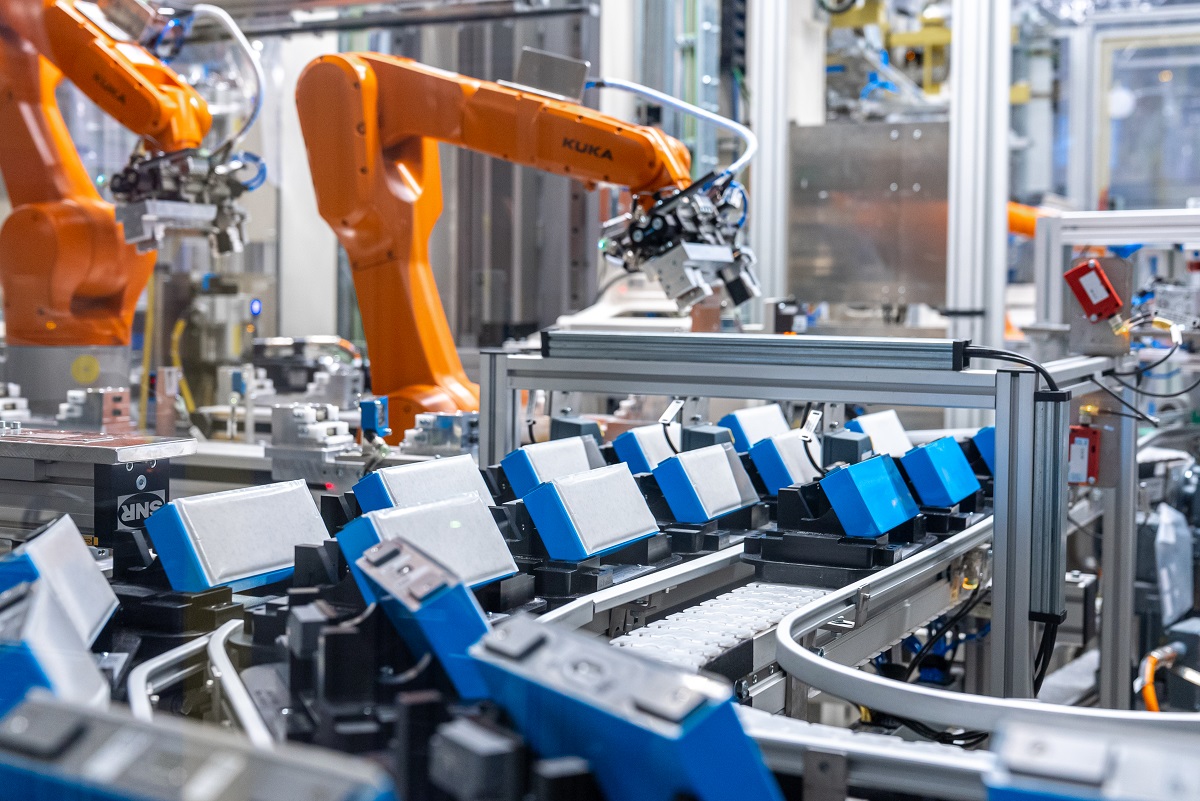

BMW Group in Leipzig is expanding production of battery modules. It is doing so with the official commissioning of a second battery module production line. It produces the modules for the all-electric BMW i4. The first battery module production line the Leipzig plant commissioned in May 2021. It supplies battery modules for the BMW iX.
“The second production line for battery modules in Leipzig is crucial for supplying the battery components needed to manufacture a growing number of electrified vehicles,” says Markus Fallböhmer, Head of Engine and E-Drive Production at the BMW Group. The gradual expansion of e-component production is bringing the BMW Group ever closer to its 2030 target. By then, fully electric models are expected to account for at least half of the BMW Group’s sales.
Investment
The new production line for battery modules will cost around 70 million euros. The expansion of e-component production will also lead to new jobs. Some 250 people will work on the new line by the end of 2022. This number is in addition to the more than 700 people already working in e-component production in Leipzig.
196 production stations
The new production line covers an area of about 4,250 m². The line uses BMW i production areas that are now empty following the phasing out of the BMW i3 on 30 June. Each battery module passes a total of 196 production stations before it is complete and ready for further processing.
Securing jobs
"The Leipzig plant remains electrified," says an elated Petra Peterhänsel, Plant Director. "Now that BMW i3 production has ceased, we can use the skills and experience of our employees elsewhere. We can offer them secure long-term jobs," she noted. She added that this would continue to ensure the future viability of the plant.
Milestone
To prepare for the steady increase in electric vehicles, the production of e-drives in Leipzig will become even more extensive and flexible next year. The upcoming stages of the expansion programme will create even more new jobs. Another important milestone is the production of the successor to the MINI Countryman. It will roll off production lines from 2023. The crossover model will be available with combustion engines and all-electric drive.
From battery cell to high-voltage battery
The production of high-voltage batteries can be divided into two phases. On the one hand, there is module production and, on the other, the assembly of high-voltage batteries. Module production is a highly automated process. First, the lithium-ion cells undergo plasma cleaning. This is followed by coating by a specially developed system to ensure optimal insulation. They are then combined to form larger units known as modules. The BMW Group sources its battery cells from partners who produce them to the company's exact specifications.
Completed battery modules
The completed battery modules then enter an aluminium housing together with connectors and control and cooling units. The size and shape of the enclosure and the number of battery modules used vary depending on the vehicle variant. This makes it possible to optimally adapt each high-voltage battery to the car it will power.
Production network for e-drives
To meet rising demand for production capacity for e-drive components, the BMW Group is using a global production network. At the company's own battery facilities. production of the high-voltage batteries and battery components for the full range of electrified BMW and MINI vehicles takes place. This takes place in Dingolfing, Leipzig and Regensburg in Germany, as well as in Spartanburg (US) and Shenyang (China). There is also local production of high-voltage batteries in Thailand, for the Rayong plant.
Competence Centre
In Munich, the BMW Group operates an e-drive pilot plant and a Battery Cell Competence Centre. There, analysis of the value creation processes of battery cells takes place as well as refinement of the technologies for the production processes. Just outside Munich, the BMW Group will soon open a Cell Manufacturing Competence Centre. This new facility is located in Parsdorf, just east of the city. It will be a pilot plant for the production of battery cells. It will model series production of lithium-ion battery cells and validate the feasibility of their large-scale production, especially with regard to quality, time and cost.
Electric motors
In Dingolfing and at BMW Group Plant Landshut, the BMW Group produces electric motors at the Competence Centre for E-Drive Production. The housing for the highly integrated fifth-generation e-drive is made at BMW Group Plant Steyr.
Photo: BMW
Read also: Daimler and BMW explore cooperation for development of autonomous vehicles -.











