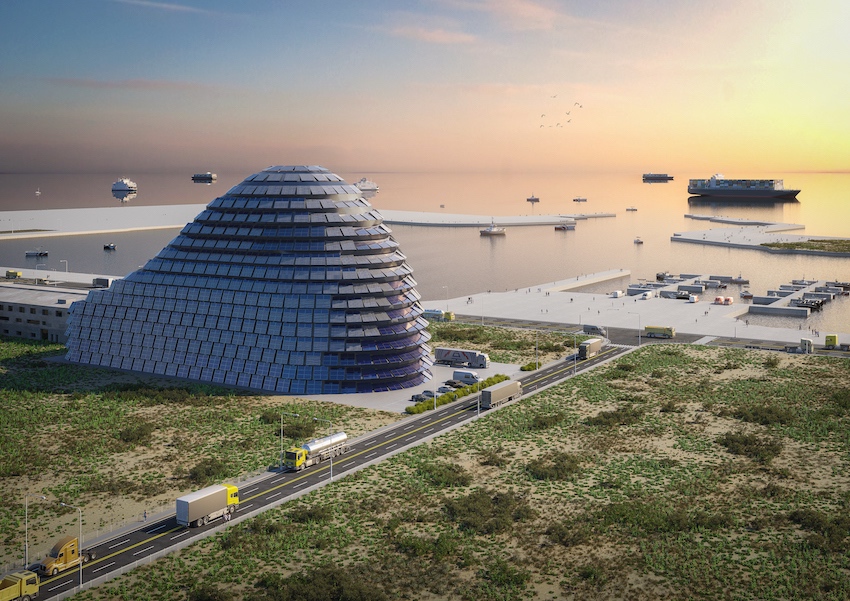

Dutch architecture firm MVDRV introduces Sun Rock, a new building for Taiwanese energy company Taipower. With an eye on the energy transition Taiwan is going through, sustainability is central to the building. Thus, the building is covered with solar panels to generate as much solar energy as possible.
This is an unusual building. The name Sun Rock literally translates into sun rocks and refers to the building's appearance. The building is completely covered with solar panels from top to bottom. The property stands at the Changhua Coastal Industrial Park, near Taiwan's Taichung. The main purpose of the site is to store and maintain renewable energy equipment.
Optimising solar energy production
The design of the building has been optimised to generate the maximum amount of solar energy. Thus, the building is built in a location that captures a lot of sunlight. The round shape of the Sun Rock maximises the amount of sunlight falling on the solar panels. For example, the building slopes down on the south side. This creates a large area directly in the sun at noon. On the north side, the building is designed as a kind of large sphere. This shape maximises the amount of sunlight that can be captured during the mornings and evenings.
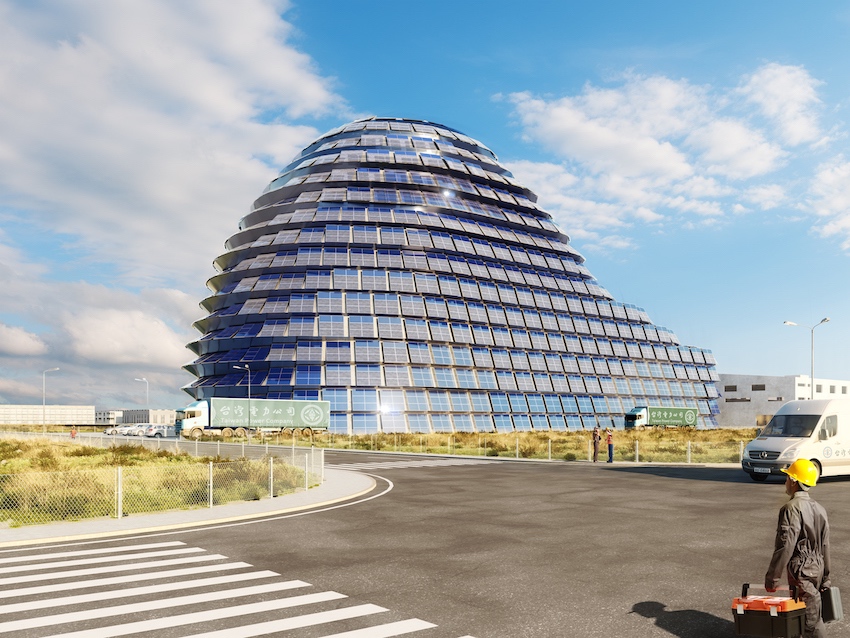
The building is fitted with solar panels on the outside. These are placed in a kind of folds. Adjusting the angle of these folds helps maximise the amount of solar energy generated. Thus, the building accommodates as much as 4,000 square metres of solar panels. This is enough to generate one million kilowatt hours of renewable energy on an annual basis.
Self-sufficient
MVDRV reports that the solar panels generate as much energy as burning 85 tonnes of crude oil would produce. The building is completely self-sufficient thanks to the solar panels. The Dutch architectural firm reports that other design choices are also being considered to provide more space for solar panels. The building could theoretically generate up to 1.7 million kilowatt hours of energy as a result.
"Of course, we try to make all our projects as sustainable as possible. However, we see that projects can go beyond just being sustainable themselves. This project has a unique and fascinating potential," says Winy Maas, founding partner of MVRDV. "The user is an energy company, which allowed us to do more than usual. We clad the entire façade with solar panels and maximise the energy yield. This makes the building not only self-sufficient for its own use, but also an energy production tool that exports electricity to the rest of the grid. This is achieved through maximally efficient positioning of the panels. Our design is therefore completely data-driven. It is always nice to see the results if you let analytics be the determining factor in the design."
Author: Wouter Hoeffnagel