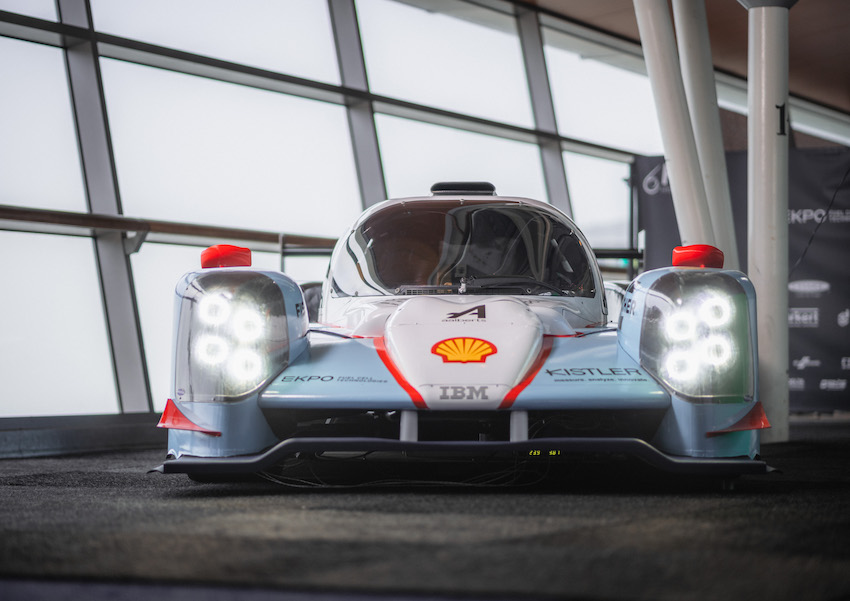

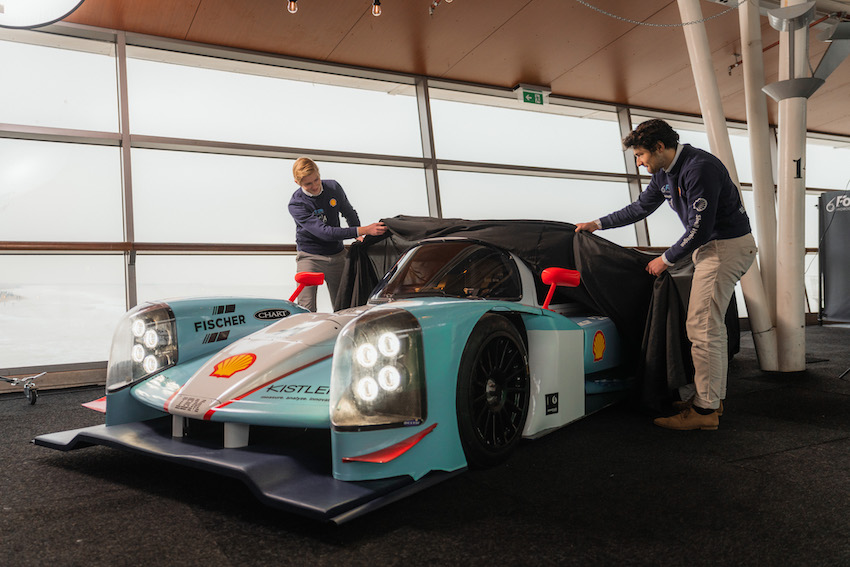
The Forze Hydrogen Racing team launches their hydrogen-based race car Forze IX. The vehicle - which should eventually compete in the Supercar Challenge and Le Mans - has a peak power output of no less than 800 hp, realising maximum speeds of 300 km per hour.
The Forze IX is a racing car the team has been working on for three years. The team talks about a "revolutionary racing car" and a breakthrough in sustainable racing. The Forze IX features a dual fuel cell and electric motors. Here, the fuel cells bring hydrogen from the vehicle's tanks into a chemical reaction with oxygen, creating water and electricity. The electric motors of the Forze IX are powered using this generated electricity.
Pushing the boundaries of technology
"We want to keep challenging ourselves and pushing the boundaries of technology," said Forze team manager Coen Tonnaer. "The Forze IX has a peak power output of more than 800 hp converted, partly due to a dual fuel cell and a super battery that can give a big 'adrenaline shot'."
"That's ultimately what it's all about," says Tonnaer: "We want to inspire people to embrace hydrogen as an alternative to fossil fuels and show that it is not inferior to mainstream racing cars on the track."
Supercar Challenge
The team sets itself the goal of competing in the GT Class of the Supercar Challenge. The Supercar Challenge is a racing class established in 1997. The class is open to both GT cars and touring cars. The competition consists of a dozen races. These are spread over six events at the circuits of Assen in the Netherlands, Zolder and Spa-Francorchamps in Belgium and the Hockenheimring in Germany.
"A future of racing without emissions is our dream," says team manager Coen Tonnaer on the team's website. "We want to promote hydrogen as a sustainable alternative to fossil fuels by demonstrating that it can compete with conventional petrol-based cars on the track. We have already proved that this is possible by building eight competitive zero-emission race cars. The ninth vehicle is on its way!"
Years in development
The development of the vehicle has taken years. "It is a huge challenge for us. Our team has worked incredibly hard and put their heart and soul into this project. Seeing the results now come to life in this car makes me very proud and excited about what is to come," Tonnaer said.
In the video below, the team presents the Forze IX on De Pier in Scheveningen.
Specifications
Some specifications of the Forze IX at a glance:
- Acceleration from 0 to 100 km/h: less than three seconds
- Top speed: 300 km/h
- Fuel cells: Twice 240 kW (327 hp) of power
- peak power: 600 kW (805 hp)
- Weight: less than 1,600 kg
- Dimensions: 519 x 190 cm
- Drive: four-wheel drive with torque vectoring
- Energy recovery: a unique kinetic energy recovery system
The Forze Hydrogen Racing team is supported by a wide range of partners and sponsors. The main sponsor is Shell, whilst ElringKlinger and Kistler are domain partners. ElringKlinger specialises in lightweight solutions, e-mobility, sealing and shielding technology, tooling and technical services. This company supplies the fuel cells for the vehicle. Kistler is a global supplier of modular solutions for dynamic measurement technology. These solutions enable the measurement of, amongst other things, pressure, force, torque, acceleration and temperature. An overview of all partners is available here.
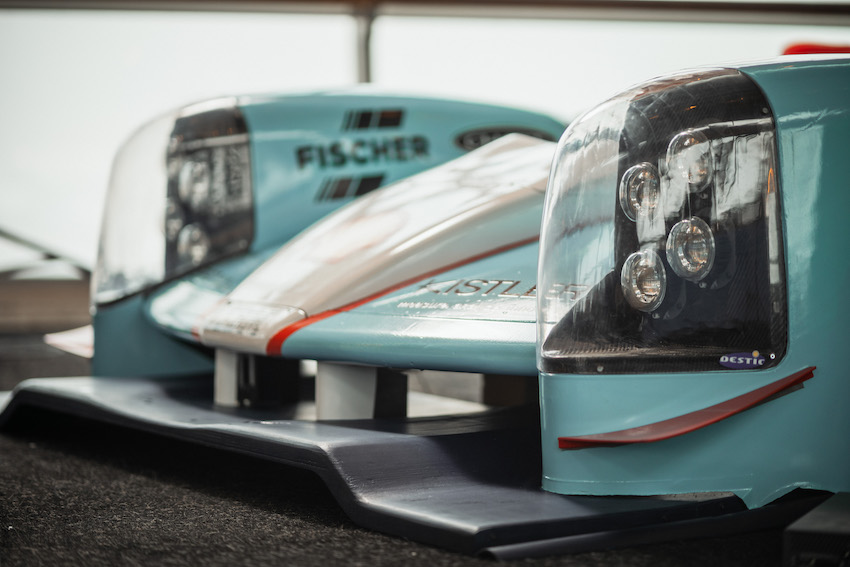
Over the next few years, the team plans to further develop its cars to achieve the speed and reliability needed to participate in the Le Mans Prototype endurance races.
Author: Wouter Hoeffnagel











