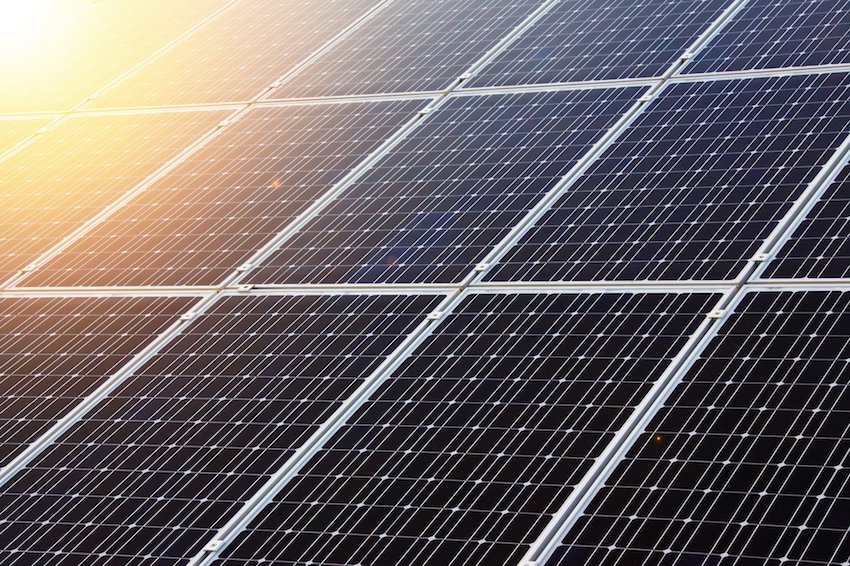

A new material enables the production of highly efficient solar panels. It involves so-called semiconductor nanowires. If placed on top of a traditional silicon-based solar panel, it has the potential to cheaply double the efficiency of these solar panels.
The material was developed by researchers at the Norwegian University of Science and Technology. "We have a new method for highly effective use of gallium arsenide (GaAs) material via nanostructuring, allowing us to make solar panels much more efficient using only a fraction of the material normally used," explains Anjan Mukherjee, PhD student in the Department of Electronic Systems at the Norwegian University.
Increasing efficiency
Mukherjee is the lead developer of the new technique. The researchers call GaAs the best material for increasing the efficiency of solar cells. This in view of its exceptional ability to absorb light and electrical properties. The material has long been in use for producing solar panels intended for use in space.
That the material has so far not been widely incorporated into solar panels on Earth is partly due to cost. Producing GaAs components for high-quality solar cells is relatively expensive. The demand for techniques that reduce the amount of GaAs material required is therefore high, the researchers report.
Ten times more efficient
Such a technique now seems to be available. "Our research group discovered a new way to produce solar cells with a very high power-to-weight ratio that is over 10 times more efficient than any other solar cell by using GaAs in a nanowire structure," explains Helge Weman, professor in the Department of Electronic Systems at NTNU. A research paper by the group has been published in ACS Photonics.
A major cost in traditional production of GaAs solar cells is the fact that they usually 'grow' on a thick and therefore relatively expensive GaAs substructure. The researchers depart from this. "Our method uses a vertically standing matrix structure of nanowires on a cheap and industry-focused silicon platform for growing nanowires," Weman said.
Minimising production costs
According to researchers, the most cost-effective and efficient solution is to grow so-called dual tandem cells with a GaAs nanowire cell on top of a silicon solar cell. This eliminates the need to use an expensive GaAs substrate. "We have worked on minimising the cost of growing the top GaAs nanowire cell, as the production cost of GaAs is one of the biggest challenges currently holding back the technology."
Bjorn-Ove Fimland, professor in the Department of Electronic Systems at NTNU: "The small footprint of the nanowire structure offers additional advantages, as it enables high quality in the crystals of the nanowires and the interface with the silicon. This improves the performance of the solar cell."
Molecular beam epitaxy
The researchers deploy a method called molecular beam epitaxy (MBE) to produce the nanowires. This method is less suitable for producing material in large volumes. Mukherjee: "However, it is possible to produce these nanowire-based solar cells on a large scale using industry-level tools such as metal organic vapour deposition (MOCVD)."
Integrating it on top of a silicon solar cell can increase efficiency by up to 40%. Compared to silicon solar cells available on the market today, the approach can be expected to double efficiency.
More applications
The researchers foresee more applications of their nanowires. Adapting the method is expected to make it possible to grow nanowires on other substrates. This, according to the researchers, opens the door to more applications. "We are exploring growing these kinds of lightweight nanowire structures on atomically-thin two-dimensional substrates such as graphene. This could open up huge opportunities for producing lightweight and flexible solar cells that can be used in self-propelled drones, microsatellites and other r applications in space," Mukherjee concludes.
Further information is available here.
Author: Wouter Hoeffnagel