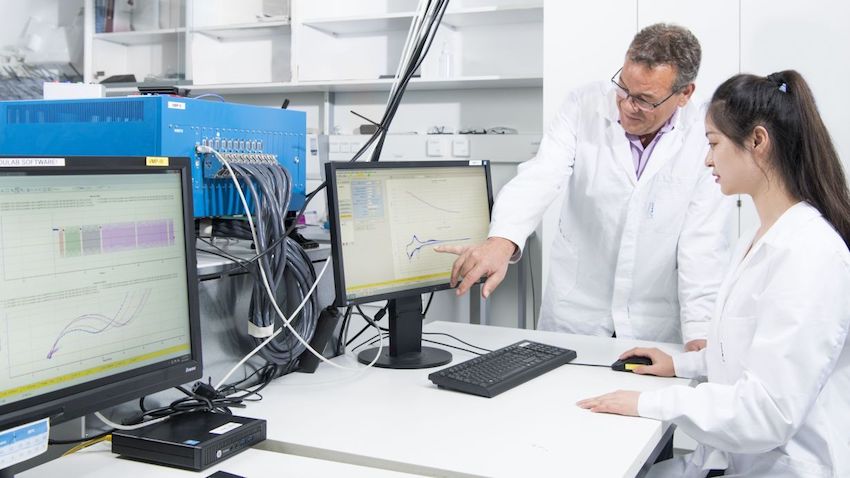

A new lithium-metal battery developed by the Karlsruhe Institute of Technology (KIT) and the Helmholtz Institute Ulm (HIU) is breaking records in terms of energy density. The battery offers a very high density of 560 watt-hours per kilogram - based on the total weight of the active materials - with high stability.
The new battery was developed by researchers at the Helmholtz Institute Ulm (HIU). This institute was founded by the Karlsruhe Institute of Technology (KIT) in collaboration with the University of Ulm. The researchers combine a nickel-rich cathode with an ionic liquid as an electrolyte. The cathode enables the storage of a large amount of energy per mass. The electrolyte maintains this capacity over a large number of charge cycles.
Alternative to lithium-ion batteries
Lithium-ion batteries are currently the most common choice in the field of batteries. However, according to KIT and HIU, this technology is at the top of its potential when it comes to certain applications. These include electric mobility. This is where there is demand for lightweight compact vehicles with a long range.
Lithium-metal batteries represent an alternative. They offer high energy density. This allows the storage of relatively large amounts of energy per mass or volume. At the same time, however, there are challenges. For instance, their stability poses a challenge as the electrode materials can react with common electrolytes.
Li|ILE|NCM88 cells
Researchers at KIT and HIU are now offering a solution to this. In Joule magazine, they describe how a new combination of materials offers a solution. The researchers deploy a layered nickel-rich cathode containing a minimal amount of cobalt. This is called NCM88. The cathode offers a high energy density. However, if the researchers combine this cathode with the common electrolyte LP30, it yields low stability. Thus, the storage capacity quickly decreases as the number of charge cycles increases.
Stefano Passerini, director of HIU and head of battery electrochemistry at the researcher group, says: "The LP30 electrolyte creates cracks in the cathode. The electrolyte reacts in these cracks and destroys the structure. In addition, a thick, mossy lithium-containing layer forms on the anode."
The researchers therefore deployed a stable and non-combustible ionic liquid electrolyte (ILE) with two anions. An anion is a negatively charged ion that is attracted to the positive cathode. The battery cells created by this combination are also called Li|ILE|NCM88 cells. "Using ILE, the structural changes in the nickel-rich cathode can be significantly reduced," said Dr Guk-Tae Kim of HIU's Battery Electrochemistry Research Group.
Promising results
Tests with the new battery yield promising results. For example, an energy density of 560 watt-hours per kilogram appears possible based on the total weight of the active materials. The battery initially offers a storage capacity of 214 milli-amp-hours per gram. The battery offers around 88% of its initial capacity after 1,000 charge cycles. The so-called Coulomb efficiency, which gives an indication of the ratio of absorbed to dispensed capacity, comes out to an average of 99.94%. The researchers also stress the safety of the battery they present. They speak of an important step towards CO2-neutral mobility.
More information is available in the researchers' article in the scientific magazine Joule.
Author: Wouter Hoeffnagel











