It won't be long before we 3D-print our own food. At least, if it's up to Eindhoven-based company byFlow, a frontrunner in the field.
Pasta, a meatball or a biscuit from your own printer? It's closer than you think. In about ten years' time, every kitchen will have a 3D printer next to the espresso machine. Food printing is the future Nina Hoff, director of ByFlow, thinks. In an article in the Eindhovens Dagblad, the reporter gets a peek into the company's printing hall of fame.
ByFlow develops, builds and sells 3D food printers. "To demonstrate how the printer works, she places a cartridge in the print head of the device," the reporter writes. "For this occasion, she entered the logo of the Eindhovens Dagblad into the computer. The letters ED are printed by the printer layer by layer on the glass base, resulting in an edible picture that tastes amazing. No chocolate or puree, but a surprising flavour in which I at least detect beetroot."
Hoff knows that 3D-printing food has countless possibilities, but also believes that people need to be able to taste it first to be convinced. This is therefore a key focus of her company: marketing it. In any case, she has the experience: she ran the world's first 3D-printed restaurant, worked from Australia to Dubai with the most famous master chefs and she signed a contract with Callebaut, the world's largest chocolate manufacturer. This year, Hoff was also named Tech-entrepreneur 2018 at the presentation of the first Techionista Award.
Award
Nina Hoff's career has taken a surprising turn. In late 2015, she quit her job in healthcare to head up byFlow, the technology company of her visionary father Frits and technical brother Floris, who together had developed the world's first foldable 3D printer. "Under her inspired leadership, money came from investors that was used for accessible software, simple operation and slick design of the 3D printer," the Eindhovens Dagblad reported. "The result is a device that master chefs love to show off. Not for nothing is Jan Smink, chef of three-star restaurant De Librije, ambassador of the 3D printer Focus. Just like Hidde de Brabander, the television chef who shines at 24-Kitchen and Koffietijd."
The Belgian king was also impressed when he was handed a chocolate portrait of himself during a visit to the High Tech Campus. After a demonstration, King Willem-Alexander also said he hoped to have his own printer in his kitchen soon.
Stunt
More than a hundred of its Focus printers have now been sold. Not bad for a printer that costs three thousand euros. "While the food printing was actually meant as a marketing stunt to raise awareness of the printer," Hoff reveals. "Because the Focus has two easy-to-change print heads, you can immediately print a wide range of materials with it. Apart from plastic, for example, biorubber, silicones, ceramics, bronze clay, glass clay and food. But it was soon clear that food in particular caught the imagination. Chocolate makers and restaurateurs were particularly keen to use it. Because you can use it to make shapes you can't achieve any other way. And in the cartridges you can combine ingredients, giving you special flavours."
It has been researching 3D printing food since 2015. In collaboration with chefs, chocolatiers, pastry chefs, designers, industry and universities, a database of beautiful 3D designs and special recipes has been created. Those collaborations led to optimisation of Focus as a 3D printer for food.
"TNO has been working on it for seven years, but we really had to open up the market. We now mainly focus on awareness, we show that we are there. Until now, we are there more for the exclusive events: printing is not yet fast enough for large groups." But in the future, Hoff sees other possibilities. "3D printing food has great social benefits. Take malnutrition in the elderly. Elderly people with chewing and swallowing problems are usually given pureed food. With a 3D printer, you can give the pureed food back the shape of the original product. For example, a carrot looks like a carrot again, with the advantage that the substance remains soft and easy to chew. Another great social benefit is that you are not left with food residues, as you can basically use anything. So it's a very sustainable way of preparing food."
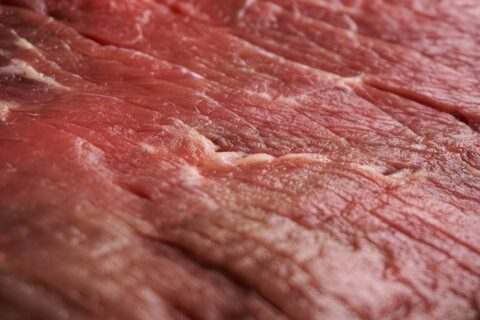
Will that also apply to meat from the printer? Hoff has to laugh a little about it. "Everyone talks about that, but that was an experiment. We were invited last year by the Australian organisation MLA to come and work with meat. The trigger was the fact that there is a lot of leftover meat and they didn't know what to do with it. People only want steaks of a certain size and even a chicken breast has to look like a chicken breast. So people were left with leftover meat that had to be under or just at cost How do we give meat a second life. We took up that invitation and made a kind of mince from that meat and printed beautiful, special snacks from it. That was an eye-opener though, because chefs turned out to be willing to pay ten times the price for meat from a cartridge." So the problem became a revenue model. It was so well received that byFlow was recently invited to Dubai to do the same there. "It definitely has potential, you can also do something with it for food waste, but it's not really what we are focusing on right now."
With the current price tag, for now the food printer is only for caterers, exclusive pop-up restaurants in world cities and fancy Michelin-starred restaurants where perfect creations are printed on beautiful plates. "But within ten years it will become an activity in every household," Hoff expects, foreseeing that one day everyone will have a 3D food printer in their kitchen. "Ease of use is very important. Now 3D printing is still far too laborious for the average consumer. But I hope that soon boxes of cartridges in different flavours will be on sale in supermarkets. Something like Nespresso. Then the printers would have to be a lot cheaper; around four hundred euros. But I can see that happening."
Growth
3D printing is rapidly gaining ground. Aircraft parts, medicine, furniture and houses; it's all being printed. Now food is making its appearance. Scientific organisations like TNO have been researching the quality and possibilities of printed food for years. Because you can determine the composition, colour, taste, shape, texture and nutritional value yourself when printing food, you can provide everyone with exactly the nutrients they need. Someone with a calcium deficiency gets more calcium, the vegetarian gets more vitamin B12. How hard or soft food comes out of the printer can also be influenced. That can be a godsend for people with swallowing problems.
But you can also think of fun shapes, such as cauliflower in the shape of a snowman or broccoli in the shape of a cartoon hero for children who eat badly or recognisable shapes for the demented elderly. You can create new flavours, because you can put any ingredients you can think of into the mixture you fill the cartridge with. There is also unprecedented freedom of shape because you can build up dishes layer by layer. Food printing is sustainable because ingredients are used efficiently.
Source: Brabants Dagblad
Photo: byFlow