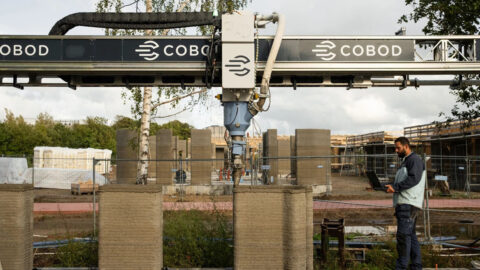
3D printing is increasingly going to find its way into the construction industry. There are several initiatives worldwide that make it possible to print entire houses or buildings. MIT in the US recently introduced a robot that can put up the basic structure of a house within 14 hours.
Globally, several companies have been working on 3D printing houses and buildings for several years. For instance, Chinese company Winsun already realised a number of small 3D printed houses in 2014. In 2015, it added a five-storey apartment complex and a villa.
Mobile 3D printer
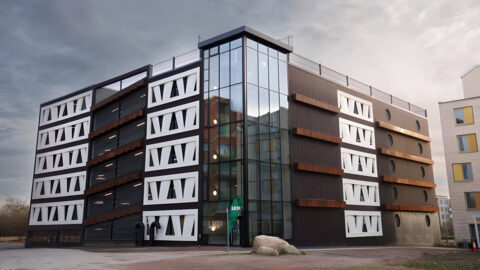
A feat was also presented in Dubai in 2016, namely a 3D-printed unusually designed office complex. The printer took a total of 17 days to do so. Dubai then announced its intention to be the global leader in 3D printing by 2030.
In Russia, the companies Apis Cor and PIK embarked on a similar project and in March this year they presented a 3D-printed house in the city of Stupino. The parts for the shell construction had been printed within a day by a mobile 3D printer. The printer was then lifted out of the house with a crane. The house is made of different materials, including a special concrete mix.
Tailor-made
Last week, the Massachusetts Institute of Technology (MIT) also introduced a system that makes it possible to print a building in a short period of time. This approach would open up more possibilities for the design and construction of new buildings. For example, a building can be completely customised to the creator's wishes and the needs that a particular building site requires. The internal structure can also be modified in new ways; different materials can be added during the process and the material density can be varied to achieve the optimal strength, insulation and other important properties.
The system consists of a tracked vehicle on which a long, industrial robot arm is attached. This in turn has a small precision robot arm at the end. This easy-to-operate arm can be used to control any conventional or non-conventional construction nozzle, such as one used to pour concrete or spray insulation material.
14 hours
Unlike typical 3D systems, MIT's free-moving system can construct an object of any size. As a proof of concept, the researchers used a prototype to build the walls of a dome 15 metres in diameter and over 3.5 metres high. Printing the walls was completed in less than 14 hours.
For these initial tests, the system made the foam insulation framework used to form a finished concrete structure, explained lead researcher Steven Keating. This construction method, in which polyurethane foam moulds are filled with concrete, is similar to traditional commercial insulation-concrete formwork techniques. Following this approach for their initial work, it was found that the system can be easily adapted to existing construction sites and equipment, and that it conforms to existing building codes without requiring new evaluations.
To Mars
Eventually, the aim is to make the system self-sufficient. It features a shovel that can be used to work the building surface and collect locally available materials, such as dirt, for the construction itself. The whole system can operate electrically and be powered by solar panels, among other things.
The system could be a good solution for remote areas but also to quickly provide residents of an area affected by a natural disaster with new shelter.
"We envision a future where we can send a completely autonomous system to the Moon or Antartica and build buildings with the material available there. At the same time, we also wanted to show that we can build something in a very short time that is immediately usable and can be integrated on any construction site in this form."
By: Kelly Bakker
Source: MIT