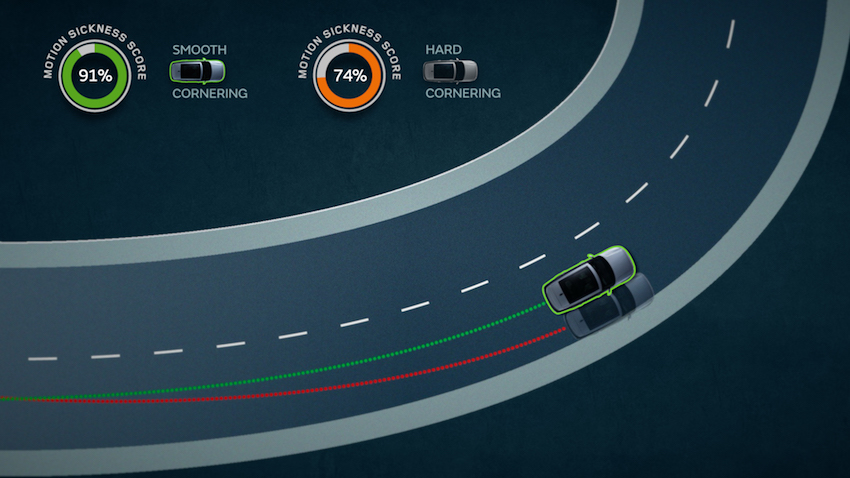

Self-driving cars have the potential to significantly change the way humans travel by road. For instance, such vehicles could eventually allow occupants to perform other activities and tasks, such as reading notes, writing texts and going through documents. However, the important thing here is that our bodies allow it. Jaguar Land Rover is working on a system to help with this by optimising the driving behaviour of autonomous vehicles. With the aim of preventing or minimising car sickness-related complaints.
Research published by the University of Michigan last year showed that a good proportion of people in the car suffer from car sickness if they are busy doing other things. During the University of Michigan test, participants were asked to perform 13 simple cognitive tests on a tablet. More than one in 10 experienced carsickness-related symptoms such as nausea during the test as a result, so much so that they asked for the vehicle to be stopped. Four per cent even had to vomit as a result.
The percentage of people experiencing car sickness in self-driving cars is expected to increase. Motion scientist Jelte Bos TNO expects that around 60% of occupants of fully autonomous vehicles will experience this. 30% may even experience vomiting, Bos reported to De Telegraaf back in 2018. The main reason for this is that - in time - occupants will no longer have to pay attention to the road and will therefore look more at the screen of, for example, their smartphone.
Adjust driving behaviour to prevent car sickness
Jaguar Land Rover is working on a solution. The company is developing a technology that allows autonomous vehicles to learn to adjust their driving behaviour to avoid carsickness. The system optimises acceleration, braking and lane position to prevent nausea in its passengers. These settings are adjusted every 10 milliseconds to combine driving behaviour, comfort and nausea prevention.
The software is based on 20,000 simulations, both virtual and in the physical world. Using these simulations, a set of metrics has been collected that functions as a baseline for the driving behaviour of autonomous vehicles. Machine learning then allows the vehicle to adjust its driving behaviour while driving. This algorithm continues to learn using data collected by other Land Rover Jaguar autonomous vehicles during real-world use.
Standardised test method
Based on the University of Michigan experiment described earlier, last year the university developed a standardised testing method to identify car sickness in self-driving cars. This testing method is mainly intended to help manufacturers of such vehicles take car sickness into account in the design of their systems and eliminate it as much as possible. The method also enables a good comparison of different algorithms and concepts being developed for this purpose.
The method includes:
- A 20-minute drive that includes 25 braking, 45 left turns and 30 right turns. The test is conducted at both speeds of about 16 to 25 km/h (10 to 15 mph) and 32 to 40 km/h. (15 to 25 mph)
- A range of tasks users perform on a tablet. At both speeds, users make the journey once without performing these tasks and once while performing the tasks. Among other things, this tests their ability to read comprehensively, search for visual objects, enter text and recognise patterns.
- An array of sensors that measure the vehicle's acceleration and geographical location. The sensors also measure users' bodily responses, such as their sweating behaviour, skin temperature and heart rate. Cameras and sensors additionally record participants' head movements and posture.
- A scale of 0-10 to indicate the degree of car sickness. At 0, participants experience no car sickness, while at 10 they want the vehicle to stop immediately.
- An end-of-ride conversation, where participants describe their feelings in their own words every two minutes or as soon as they experience a change.
Further information on the test method and the research carried out by the University of Michigan can be found in the white paper‘Queasy Passengers: A Testbed for Motion Sickness in Driverless Vehicles’by researcher Monica L. H. Jones of the University of Michigan Transportation Research Institute.
Author: Wouter Hoeffnagel








