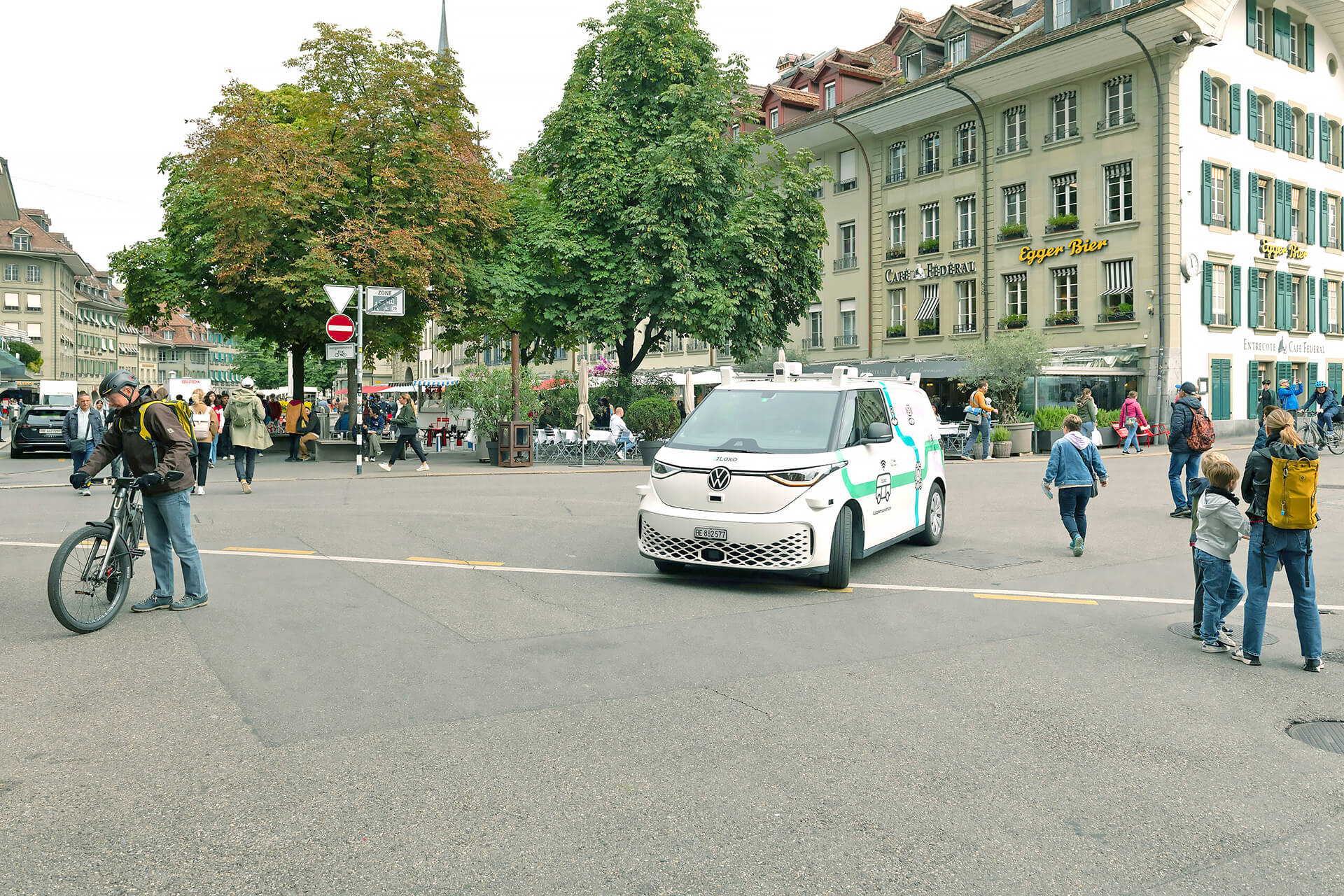

In Bern, Switzerland, an autonomous vehicle is going to deliver parcels over the next two years. It is a vehicle with Level 4 autonomy, which means that the vehicle is allowed to travel on the road without a driver.
The trial is part of a pilot project by Swiss tech startup LOXO and the also Swiss logistics company Planzer. The parties are deploying a Volkswagen ID. Buzz Cargo Van, which can be fitted with two KYBURZ custom-made cargo boxes. The vehicle has been named 'Mathilde' by Planzer. The project is called 'Planzer - Dynamic Micro-Hub w LOXO'.
The vehicle features technology from LOXO, specifically the LOXO Digital Driver navigation software. This software combines artificial intelligence (AI) with a range of sensors, enabling vehicles to find their way around environments autonomously. The software is vehicle-agnostic and is therefore applicable to all vehicles.
LOXO Alpha and LOXO R1
Two vehicles using the technology have been developed by LOXO. One is the LOXO Alpha, a vehicle developed specifically for driverless last-mile applications. It is a compact electric vehicle, which LOXO presents as the first generation of LOXO vehicles.
LOXO also developed the LOXO R1, a vehicle aimed at delivering goods. It involves a VW ID. Cargo Van equipped with the company's technology. LOXO presents this as its first generation of retrofitted delivery vehicles. The LOXO R1 is aimed at medium-distance deliveries.
Level 4 autonomy
So LOXO is now joining forces with logistics company Planzer. The parties will test LOXO's technology on public roads in Bern, Switzerland. They are referring to the Automated Vehicles Act, which is expected to come into force in spring 2025 and will allow autonomous vehicles with level 4 autonomy to be deployed on public roads. LOXO and Planzer report great opportunities in this for the delivery of goods and parcels.
Level 4 autonomy refers to a level of automation for vehicles based on a Society of Automotive Engineers (SAE) standard. Level 4 automation means, among other things, that vehicles can drive fully autonomously and perform driving tasks in specific environments, such as city traffic or on highways. This no longer requires a human driver to be able to intervene, something that is the case with lower levels of automation.
However, there are some limitations with Level 4 autonomy; for example, the driving conditions must meet specific requirements. Therefore, if these requirements are not met, autonomous vehicles with Level 4 autonomy do not operate.

Environmentally friendly and better suited to cities
Planzer - Dynamic Micro-Hub w LOXO aims to demonstrate how automated driving and the concept of microhubs can make commercial traffic more environmentally friendly and better suited to cities. In this context, the term microhubs refers to small-scale parcel handling stations, which can be either fixed or mobile.
The number of daily parcel deliveries in Bern is rising rapidly. Whereas around 20,000 parcels were delivered daily in 2019, this number is expected to rise to 60,000 by 2040. With the project, the city of Bern wants to gain experience with autonomous delivery vehicles. Bern city councillor Reto Nause says: "We can benefit enormously from these findings and thus set the right course for the future at an early stage," says city president Alec von Graffenried.
Fixed route
The autonomous vehicle deployed during the project will transport parcels from a Planzer location near Weyermannshaus train station to a number of processing points in the city. In doing so, the vehicle will follow a fixed route. At these processing points, Planzer transfers the parcels into other electric vehicles, which then deliver the parcels.
Further information about the project is available here.








