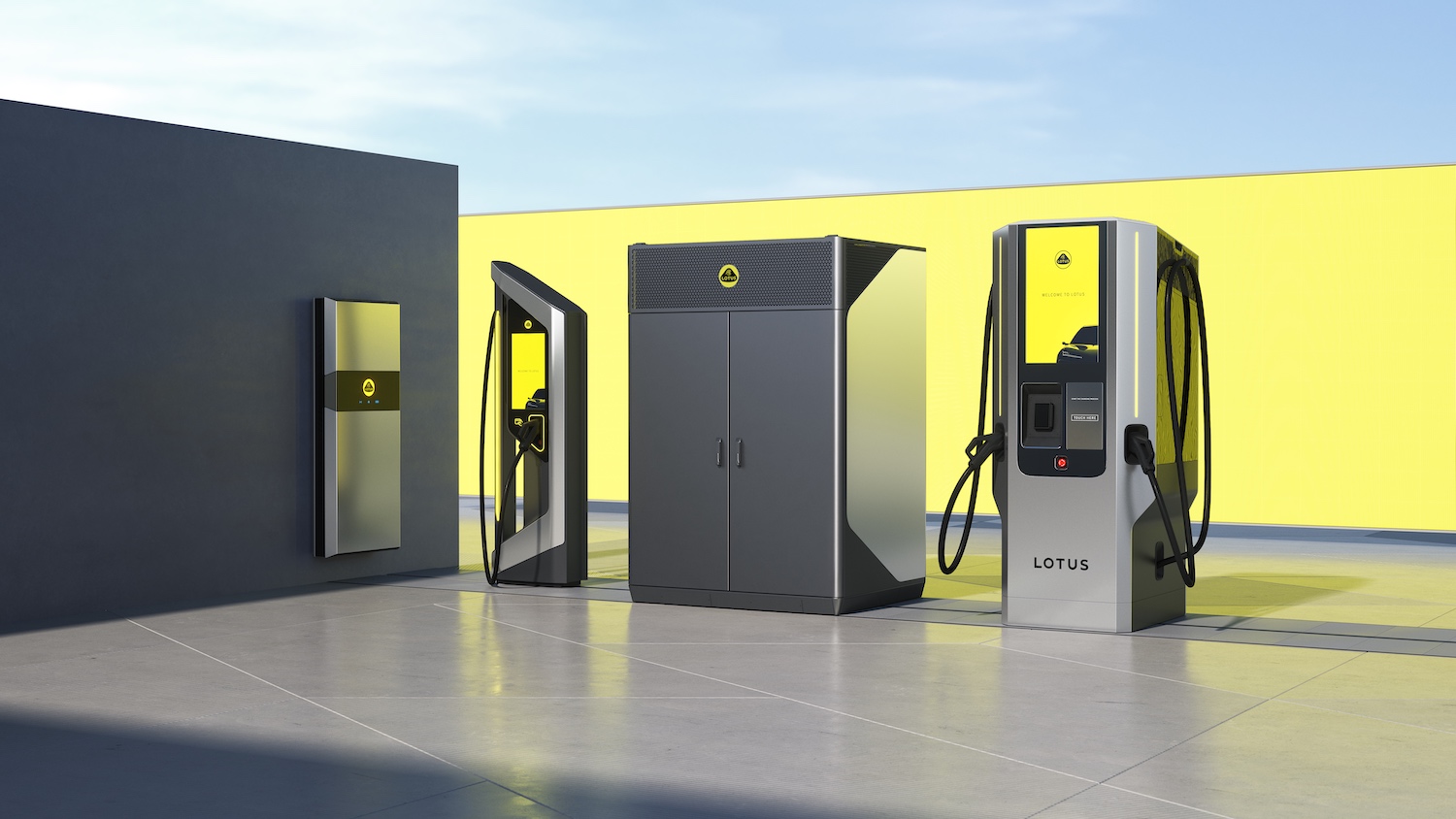

Lotus is rolling out its own fast-charging network in the European Union (EU) and elsewhere. The charging network should be available in the majority of EU member states by the second quarter of 2024. The company is also presenting its own charging stations.
The British car manufacturer plans to roll out a network of charging stations worldwide, which should include 450 kW DC fast chargers. Four vehicles per station should be able to charge simultaneously. Lotus is rolling out the charging network globally. The network is available immediately in China, and is expected to be available in most EU member states and the Middle East from the second quarter.
Preventing charging stress
With the network, Lotus aims, among other things, to strengthen the availability of charging stations. In doing so, it points to charging stress, which describes the fear of EV drivers of not finding a charging station in time and getting stranded as a result.
The lack of adequate charging infrastructure is one of the main reasons for customers to refrain from buying an EV, according to research by the US Energy Policy Institute. Lotus hopes to address these concerns with its new charging network.
Focus on electric driving
Not surprisingly, as the British carmaker has been strongly committed to electric driving for some time. The car brand currently offers four models: the Emeyra, Eletre, Emira and Evija. Only the Emira is available with a combustion engine; the other models are available exclusively with an electric drive.
Both the Eletre and Emeya can fast charge. For instance, Lotus promises that the Eletre can be charged enough in 20 minutes to achieve a range of 400 kilometres. The maximum range is around 600 kilometres. The Emeya can also fast charge, charging from 10 to 80% battery capacity in 18 minutes. The range of the Emeya has not yet been announced, but Lotus says it is similar to that of the Eletre.
Various charging stations available
In addition to a global network, Lotus is also introducing several charging stations aimed at parties looking to offer charging spots. These include the Liquid-Cooled All-in-One DC Charge, which enables fast charging with a capacity of up to 450 kW. Lotus reports that this allows the Lotus Eletre R to charge in just five minutes to a range of 142 kilometres.
In addition, Lotus is introducing the Liquid-Cooled Power Cabinet. That is a modular power cabinet suitable for locations where high power is needed to reduce charging times, such as petrol stations along motorways. This solution features up to 480 kW of power.
Also new is the Liquid-Cooled Charging Unit. This is a charging station that, in combination with the Liquid-Cooled Power Cabinet, allows for simultaneous charging of up to four vehicles. The unit offers a maximum capacity of 600 amps.
More and more charging stations in the EU
The number of charging stations in the EU is rising rapidly, by the way. For example, figures from the European charging station providers association ChargeUp show that the number of charging stations in the EU has increased by 44% in one year. In total, over 475,000 charging stations can be found in the EU. This number stood at 330,000 a year ago. Together with Germany and France, the Netherlands accounts for 50% of public charging points in the EU.
However, the amount of public charging infrastructure appears to have declined in the Netherlands, Luxembourg, Lithuania and Estonia. This is because some of the charging points previously designated as public turn out to be private in reality.
Author: Wouter Hoeffnagel
Photo: Lotus








