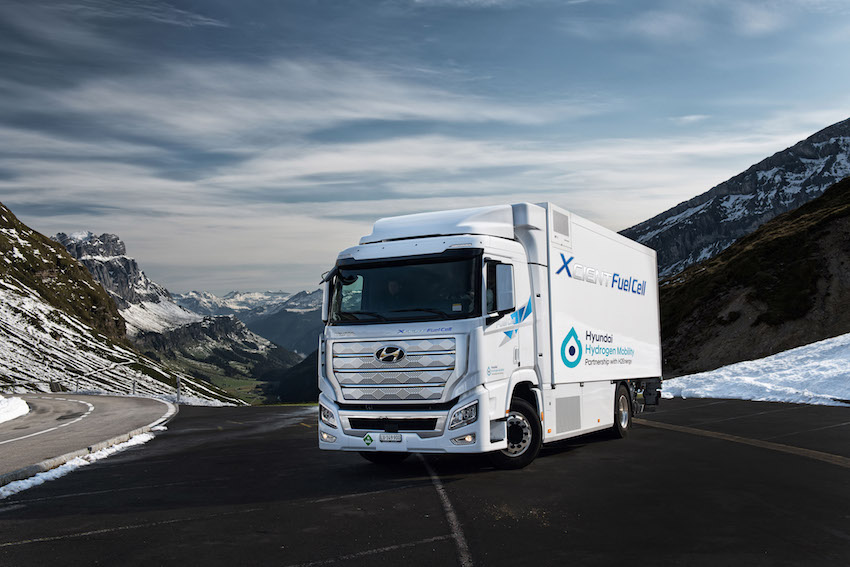

The first seven units of Hyundai's XCIENT Fuel Cell truck have been delivered to customers in Switzerland. They are the first units of this heavy duty fuel cell truck to be put into service worldwide. In total, Hyundai plans to deliver 50 units this year.
Hyundai is a newcomer to the European truck market; the XCIENT Fuel Cell truck is the first truck Hyundai offers in Europe. The company aims to have delivered some 1,600 units of the truck to the Swiss market by 2025. For instance, Coop, Migros, Traveco, Galliker Logistics, Camion Transport, F. Murpf AG and G. Leclerc Transport AG have already placed orders for the XCIENT Fuel Cell truck. These companies plan to deploy the trucks across Europe.
Hydrogen
The vehicle features a hydrogen-based fuel cell. Switzerland already has a hydrogen ecosystem to support such trucks. For instance, the country has over 100 hydrogen refuelling stations, suitable for both trucks and passenger vehicles.
The XCIENT Fuel Cell truck is powered by a 350 kW electric motor and a dual fuel cell totalling 190 kW. It also features a 73.2 kWh battery pack, which supports the hydrogen system by storing or releasing electricity. For example, energy is recovered during braking, which is stored in these batteries.
Range of 400 km
The new hydrogen truck has a maximum train weight of 36 tonnes and kerb weight of around 9.8 tonnes. The vehicle has a total of seven hydrogen tanks, with a total capacity of 32 kg. This gives a range of 400 km if towing an 18-tonne trailer. According to Hyundai, this balances the needs of users with the capabilities of the Swiss infrastructure. Users can refuel the vehicle in 8 to 20 minutes.
With the fuel cell truck, Hyundai delivers a 100% emission-free (well-to-wheel) truck. The hydrogen on which the vehicle runs is produced from renewable energy.
Interest from other parts of Europe too
There is also interest in the hydrogen trucks from other parts of Europe. To make full use of the trucks, an ecosystem including hydrogen refuelling stations, such as those available in Switzerland, is needed. Hyundai invites other parties to participate in this hydrogen ecosystem. Together with partner companies, Hyundai wants to roll out a similar ecosystem in other markets, including the Netherlands. Germany, Norway and Austria are also planned.
Hyundai is not only targeting the European market with its hydrogen trucks, but also the US and Chinese markets. 2,000 units of the XCIENT Fuel Cell truck may be produced annually by Hyundai for the European, North American and Chinese markets. The company invested $1.3 billion in the truck's development, which is separate from Hyundai's previously announced development of a hydrogen ecosystem. The company is working with North American and Chinese parties on hydrogen production, refuelling stations, service and maintenance.
"The delivery of these trucks is just the beginning of the hydrogen breakthrough," said In Cheol Lee, Executive Vice President and Head Commercial Vehicle Division of Hyundai Motor. "We plan to also enter the North American and Chinese truck market and promote the use of hydrogen as a clean energy carrier worldwide. Because hydrogen offers endless possibilities."
More variants on the way
Development of a new version of the XCIENT Fuel Cell truck is planned over the next few years. This includes two fuel cells, each with an output of 200 kW. Besides a two-axle model, other models are planned, including 4×2 trucks, 6×4 trucks and 4×2 tractors with a train weight of 44 tonnes and range of 1,000 kilometres.
Author: Wouter Hoeffnagel








