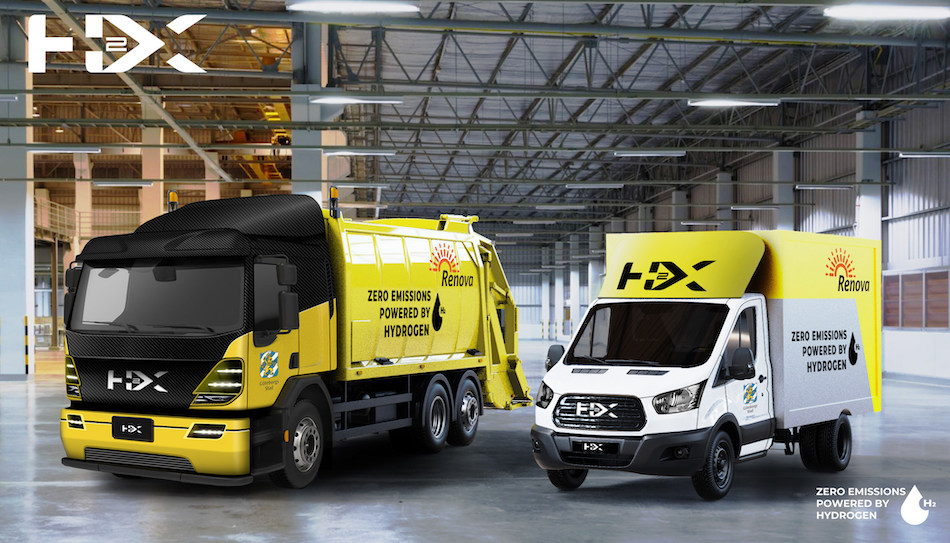

Australia's H2X Global is to supply hydrogen-powered trucks and vans to Renova, a waste company that handles waste collection in several Swedish municipalities in the Gothenburg region. The company will supply an 18-tonne truck, a 28-tonne one with swap body and a 3-tonne van with load lift.
H2X Global is a company focused specifically on developing hydrogen-powered vehicles. The company currently offers a limited number of models: a pick-up truck called Warrego and the van 'Darling', which is available as a taxi MPV and van/passenger bus. The vehicles it supplies to Renova are developed specifically for this waste processor.
Ambitious sustainability targets
Sweden has been firmly committed to sustainability for some time. For instance, the country aims to become the first welfare state worldwide to stop using fossil fuels. Sweden wants to be carbon-neutral by 2045, while by 2030 emissions must be reduced by 70% compared to 2010.
Gothenburg has even more ambitious targets. The city wants its own fleet to no longer include vehicles consuming fossil fuels by 2023. By 2030, the city aims to reduce CO2 emissions from the entire transport system in Gothenburg by 90%. Within the so-called Gothenburg Green City Zone, the city even wants to allow only completely emission-free transport by 2030. This specifically involves means of transport based on electricity or hydrogen.
H2X's supply of the vehicles will contribute to achieving these targets. Hydrogen vehicles have no direct CO2 emissions. However, hydrogen production can produce CO2 emissions. Green hydrogen offers a solution; this hydrogen is produced with green electricity generated by windmills or solar energy. As a result, the production of green hydrogen has no CO2 emissions.
Warrego
Earlier, we pointed out the Warrego and the two variants of the Darling offered by H2X Global. The Warrego is a hydrogen-based vehicle based on the Ford Ranger. The vehicle offers a range of 500km and can be fully refuelled in three to five minutes, according to the manufacturer. H2X Global says it wants to prove with the Warrego that hydrogen is a worthy alternative to diesel as a fuel.
The Warego is available in three configurations. The Warego 66 offers an engine output of 200KW, while the fuel cell provides a peak output of 66kW. The vehicle is equipped with a 60kW battery. This combination yields a range of 500km and a top speed capped at 110km/h. The vehicle accelerates from 0 to 100 km/h in 11 seconds. The electric pick-up truck is available with 2WD and AWD.
The Warrego 90 is the bigger brother of the Warrego 66. The model offers an engine power of 220kW, while the fuel cell provides a peak power of 90kW. The battery offers 100kW of capacity. Like the Warrego 66, the Warrego 90 offers a range of 500km. At 150km/h, the vehicle offers a higher limited top speed than its smaller brother. The Warrego 90 accelerates from 0 to 100 km/h in 8 seconds. The vehicle is available as AWD only.
The Warrego 90 XR is similar to the Warrego 90 in terms of engine, fuel cell and battery. The difference is in the range, which in the XR model is 750km compared to the 500km range offered by the Warrego 90.
More information on the Warrego is available here.
Darling
The Darling cannot be reserved at this time; interested parties can only leave their contact details. This model will be available in two versions: a delivery/passenger van and a taxi van. The van will be available in three lengths: compact, standard and long. H2X Global stresses that the cargo space of the vans is comparable to that of competing fuel-engine vans. It is also possible to equip the Darling with various superstructures, including a tipper, a refrigerated cargo area, a fold-out camper roof and a cargo lift.
The Darling can also be fitted with raised suspension for off-road use. Users can switch between 2×4 or 4×4 propulsion depending on their application. This allows them, among other things, to increase the vehicle's towing capacity.
Some specifications of the Darling at a glance:
- Available as a van or 11-passenger van
- 500km range
- Maximum payload weight of 1,500 to 1,950 kg (depending on configuration)
- Maximum towing weight of 1,000 to 2,550 kg (depending on configuration)
- Lower TCO compared to fuel vehicles due to cheaper maintenance. This is possible because a fuel cell includes fewer moving parts than a fuel engine.
- Focused on urban logistics and distribution, mobility around airports and goods transport with a range of 500km. Think courier services, delivery services and small businesses.
The taxi version of the Darling is based on the passenger variant and specifically tailored to the needs of taxi companies.
More information on the van and passenger variant of the Darling is available here. More information on the taxi variant is available here.
Author: Wouter Hoeffnagel








