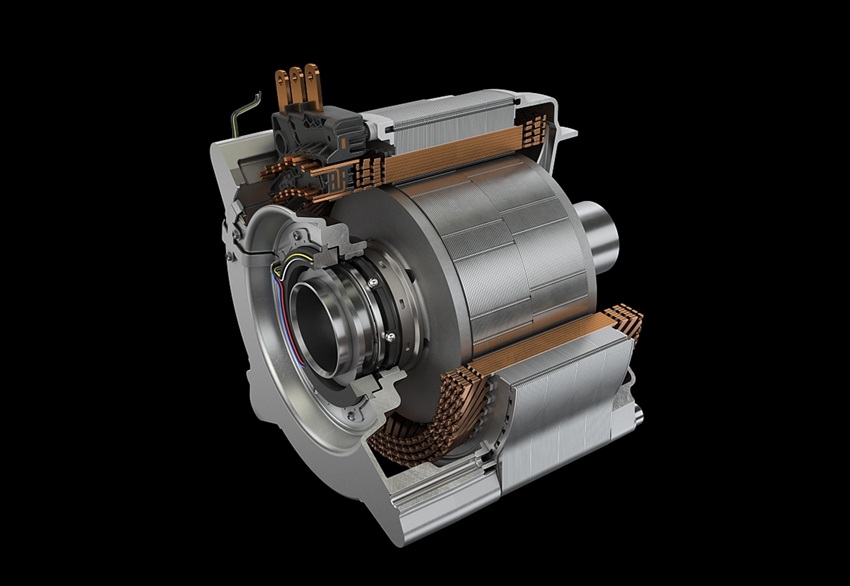

Sales of electric cars are increasing. Consequently, the amount of electric motors produced is also increasing. At the end of their lifetime, these electric motors are shredded and then recycled. Reuse and assembly of the individual parts is not possible. Sustainable strategies to refurbish and recycle electric motors as part of a modern circular economy have so far been lacking. This is now changing.
In the REASSERT project, researchers from the Fraunhofer Institute for Manufacturing Engineering and Automation IPA are working with partners from industry on various concepts for repairing, refurbishing and reusing electric motors (Reuse/Repair/Remanufacturing). They are also working on new designs for the circular economy.
Valuable raw materials
Used electric motors contain valuable raw materials such as copper and rare earth metals like neodymium, of which China has a quasi-monopoly. With current recycling methods, recovering these raw materials is not possible. Moreover, the raw materials used have a larger CO2 footprint compared to a combustion engine. It is therefore crucial to extend the use phase of these engines.
Maintaining value
"Innovative value retention strategies offer significant potential for emission reduction in terms of sustainability," says Julian Große Erdmann. He is a scientist at the Fraunhofer Institute for Manufacturing Engineering and Automation IPA in Bayreuth. In the REASSERT project, researchers are working with partners to develop innovative methods for refurbishing and reusing electric motors in vehicles. Partners include Schaeffler (consortium leader), the Karlsruhe Institute of Technology, BRIGHT Testing GmbH, iFAKT GmbH and Riebesam GmbH & Co. KG.
Circular economy
More specifically, the parties are focusing on value retention strategies through reuse, repair, remanufacturing (Reuse/Repair/Remanufacturing) and recycling of raw materials. These are key elements for a circular economy. The project partners define Reuse as repurposing the entire engine for secondary use. By Repair, they mean replacing defective parts and assemblies. In Remanufacturing, all parts are disassembled, cleaned, reconditioned and reassembled. "With these strategies, fewer raw materials such as rare earths and copper are needed, perhaps only for spare parts," explains the researcher.
Reference motors
To recycle raw materials, the project partners plan to take apart the motor and sort the individual materials before shredding them. The project partners use reference engines from the passenger car sector to analyse and select which value retention strategies should be used in a given application.
From inspection to test phase
The project involves setting up a complete process, each step of which has its own demonstrator and test rig. From incoming inspection for motor classification to disassembly, demagnetisation, cleaning, component diagnosis and remanufacturing, all the way to reassembly and testing at the end of the production line, assessing the functionality of the motor. "During this process, an engine casing with light wear, for example, can be classified for reuse and, if necessary, remanufactured using machining processes to ensure functionality.
Non-destructive disassembly methods
Depending on the chosen strategy, various process steps and chains are involved. “So the effort required to prepare the electric motor for a second life can vary,” explains the engineer. One example of the challenges is dismantling and reusing the magnetic materials from motors. “A rotor with permanent magnets is difficult to dismantle, even in a manual dismantling process. This is due to the coating and the adhesion of the magnets. The aim is to develop non-destructive dismantling methods.”
AI decision tool
An AI tool has been developed as part of the project. It helps select the best value retention strategy for a given application. The tool accesses the electric motor's product and process data, which are stored in a digital twin.
Prototype
The knowledge gathered in the project is intended to be used for the design of new electric motors. The aim is to develop a prototype motor for the circular economy that can be easily dismantled and to which the aforementioned value retention strategies can be applied effortlessly.
Source: Fraunhofer. Featured image: The REASSERT project aims to develop a prototype electric motor for the circular economy. (photo: Schaeffler)
See also: Almost one in six newly registered vehicles in the EU is electric








