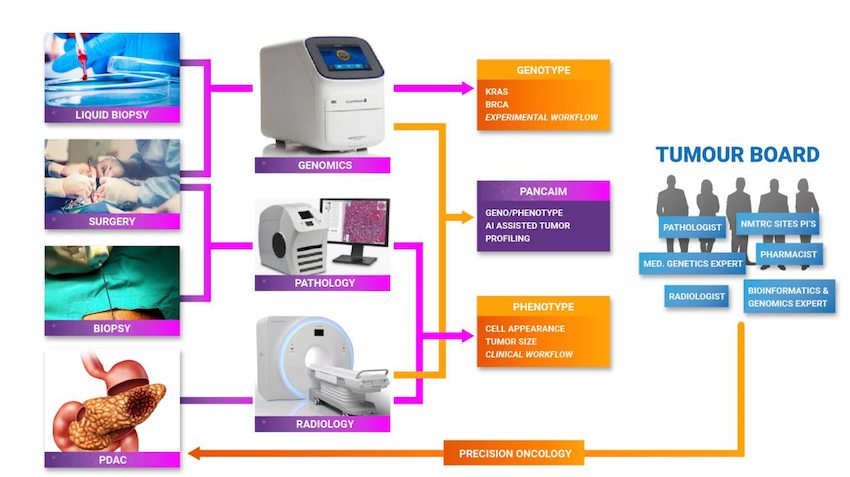

The European PANCAIM consortium is deploying artificial intelligence (AI) to generate new knowledge from existing genetic, pathological and radiological information from thousands of patients. This should lead to earlier diagnosis, better prognosis and longer survival for patients with pancreatic cancer. The project receives €8 million funding as part of the European Horizon 2020 programme. The consortium is led by the Radboudumc.
PANCAIM is an international project aimed at greatly improving the diagnosis and treatment of pancreatic cancer. This is necessary because the management of pancreatic cancer shows little improvement compared to, for example, breast, colon and prostate cancer. In part, this is because in many cases pancreatic cancer is diagnosed too late, making cure impossible. However, there are also important steps to be made in genetic research and medication, according to stakeholders.
Tailor-made treatment
"Too often the patient still gets a standard treatment - one size fits all - whereas we really need to move towards tailor-made treatment, towards personalised medicine," says Henkjan Huisman, AI specialist at Radboudumc and coordinator of PANCAIM.
The consortium aims to use AI techniques to gather new information. Among other things, deep learning is being used to analyse to database of data from over five thousand patients with pancreatic cancer. This should speed up the diagnosis of this cancer and offer a clearer prognosis. "We want to use this to better predict who will benefit from chemotherapy," says radiologist John Hermans, "but also to more accurately predict who will benefit from surgery and who will not. This way, we avoid unnecessary operations and treatments. Precisely on the basis of more and better information, it is possible to make such decisions in consultation with the patient. Thus, in this project, we also immediately bring the new knowledge to applications in the clinic."
Mutations
Previous research from the University of Glasgow shows that pancreatic cancer can arise from various mutations that can occur in at least 10 to 15 genetic signalling pathways. A personalised treatment requires detection of the mutations involved in each tumour. These mutations then form the basis for targeted therapy.
Over the past decade, many new drugs have already become available that precisely target mutations that cause cancer. These are mainly about genetic mutations and less about the type of cancer. In some cases, a particular mutation that is especially common in breast cancer also turns up in colon or lung cancer. In such cases, the drug for breast cancer can also be used for patients with colon or lung cancer with the same mutation. Hermans: "Therefore, we expect that the AI-based approach we are now rolling out for combined analysis of imaging, pathology and genetics can not only improve diagnosis, but certainly also therapy. This is really unique worldwide."
Contributing to 'impact on healthcare'
Huisman: "The primary goal is to contribute to 'impact on healthcare' through scientific research. We ultimately want to arrive at an AI-based tumour profile of each individual patient. This tumour profile forms the basis for patient discussion in a Tumour Board. That is the Precision Oncology we want to achieve with this PANCAIM consortium."
The project has eight participants:
- Swedish medical university Karolinska Institutet
- Norwegian University Hospital of Oslo
- Spanish national oncology research centre Carlos III
- Glasgow University of Ireland
- Swedish provider of cloud-based healthcare collaboration tools Collective Minds Radiology
- Dutch developer The Hyve
- Czech consulting company AMIRES
The project is coordinated by the Radboudumc.
Author: Wouter Hoeffnagel
Image: Radboudumc










