
Maastricht UMC+ announces to have successfully treated for the first time a patient with a large bone defect after a severe lower leg fracture using a combination of biodegradable 3D-printed implant, endogenous stem cells and bone tissue. This prevented amputation of the patient's lower leg.
Several dozen times a year, Dutch patients suffer such a bone fracture of the lower leg that amputation is the only option. This is due to the size of the missing piece of bone, which cannot be bridged. Maastricht UMC+ points out the impact such an amputation has on patients in many cases. This includes not only a physical impact, but also negative impact on psychological states. For example, an amputation can be perceived by patients as a traumatic experience.
Personalised 3D frame
The new treatment technique recently deployed by the hospital offers a solution. This involves first making a CT scan of the patient's lower leg, visualising the fracture. Based on this scan, a personalised 3D frame is produced using a 3D printer. This frame is based on the same piece of bone in the patient's other leg, which is still intact.
The frame is inserted into the fracture via a surgical procedure. The implant consists of two components: a base of a polymer called polycaprolactone with a layer of tricalcium phosphate on top, which is also naturally present in bone tissue and stimulates bone growth. The implant was developed by Australian company Osteopore in collaboration with Maastricht UMC+ and the Maastricht research institute MERLN.
Too great a distance to cover
Scientist Martijn van Griensven is closely involved in the development of the frame. Van Griensven explains in an article on the Maastricht UMC+ website: “Compare it to the distance between Katwijk and England. You know there’s land on the other side of that water, but you can’t see it. It’s the same with such a large bone fracture; bridging that gap seems like an impossible task. We started to ask ourselves: is there something we can create in the lab – outside the body, that is – which we can then place in the gap, allowing the fracture to heal and the patient to put weight on the bone again?”
Bones consist largely of calcium and contain very small holes. Bone cells are present in these holes. Van Griensven: "Think of it as the caves you find in certain regions in Spain. Caves in the mountains in which people have made cave houses. That's how you can see a bone with bone cells in our body." The scientists tried to make exactly such a material from lime with holes. "It worked," Van Griensven explains. "We made a soluble plastic with cavities and overlaid it with lime, very similar to our bones."
Stem cells
Stem cells are taken from the patient's bone marrow during surgery. These stem cells are applied in a high concentration together with body's own bone tissue to the surgically placed 3D frame. This eventually causes new bone tissue to start growing on the frame. The 3D frame is made of biodegradable material and therefore completely degrades over time. This is a significant advantage that eliminates the need for a second surgery to remove the frame.
Trauma surgeons Martijn Poeze and Taco Blokhuis are enthusiastic about the new technique: "If we can spare people the physical and mental suffering of an amputation, that's obviously worth a lot. You prevent patients from having to wear a prosthesis for the rest of their lives with all the discomforts that go with it. We can therefore offer a much better future perspective this way."
Accurate and sterile production
Van Griensven emphasises the accuracy with which the implant is made. "It requires special precision to make an implant exactly tailored to the individual patient. In addition, this must also be done in an extremely sterile way to prevent infections after the frame is inserted in the patient," says the scientist.
In the production of the 3D implanted frame, sterility is of great importance to minimise the risk of infection. The frame is therefore 3D printed in Singapore, where this process can be carried out with a "very clean printer".
Author: Wouter Hoeffnagel
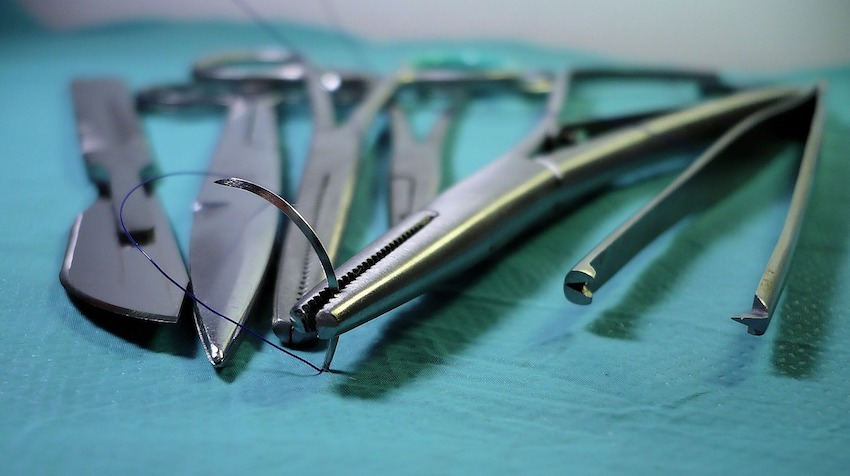
Image: Dominik Karch via Pixabay