
Italian architect Stefano Boeri, together with a team of consultants, conceived and developed the architectural and communicative concept for the Italian Covid-19 vaccination campaign free of charge. The integrated proposal includes three elements: a campaign logo in different forms; the design for the temporary pavilions for administering the vaccine in the main Italian squares; and a mobile information column to be set up in public places.
Boeri's proposal associates the vaccination campaign with a primrose blooming after the long winter, heralding the revival of nature and the arrival of spring. In doing so, the flower symbolises the vast biodiversity found throughout Italy, but at the same time also the natural cycle of life and constant renewal.
The flower is the element that will connect every aspect of the campaign, as it has the same circular pattern as the layout of the pavilions that will be erected in Italian squares and public spaces. It will be clearly visible from above, as large versions of it will be printed on the roofs of the pavilions, on the side walls and on the information columns.
Pavilions
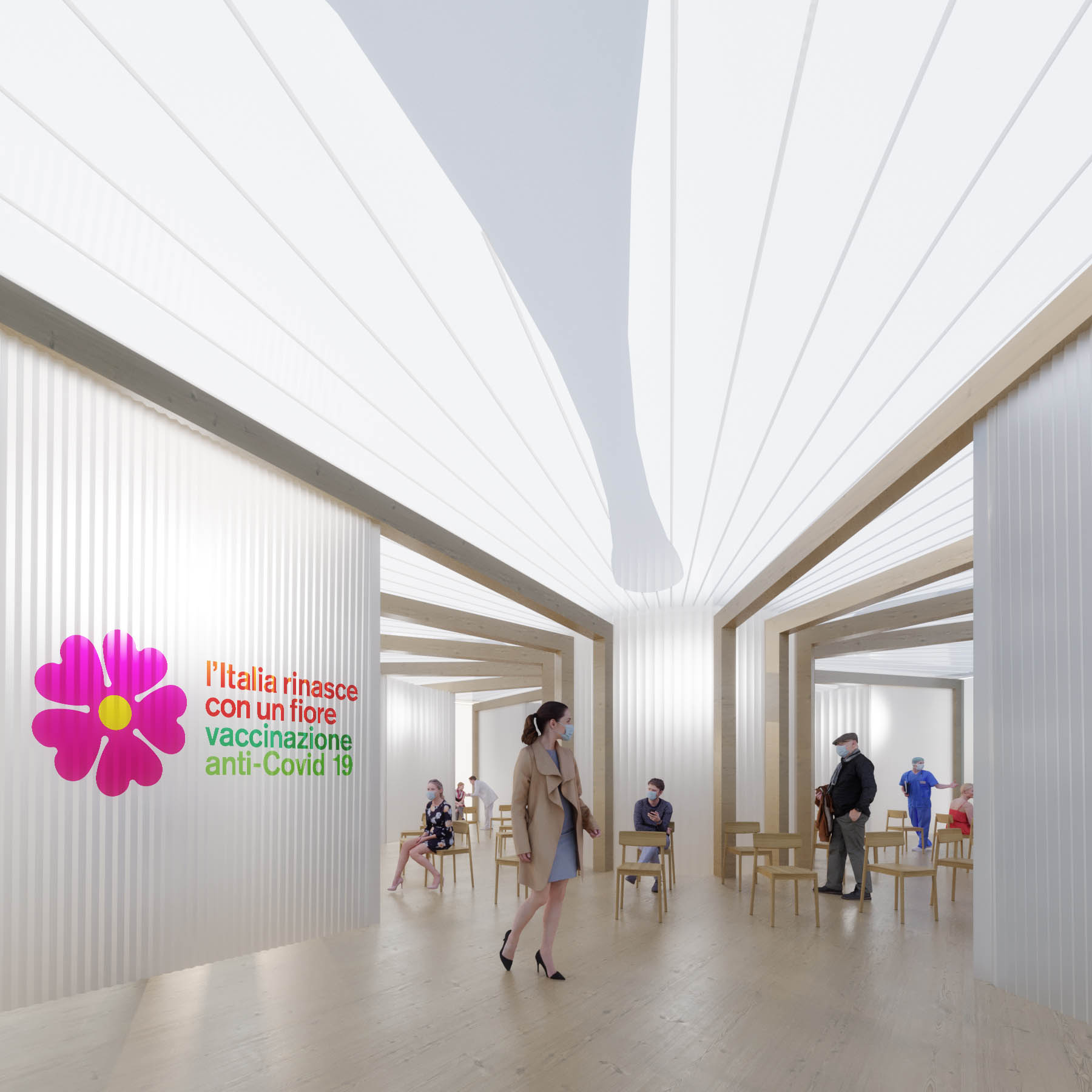
The circular structure of the vaccination pavilions is easy to assemble and disassemble. The pavilion rests on a prefabricated wooden base that will also be used to support the various systems in the internal spaces. The supporting frame will be made of wood. The external cladding will be made of textile with a combination of various recyclable and naturally degradable water-resistant materials. The roof will house a system of solar panels and is designed to generate enough electricity to meet the needs of the entire pavilion.
The partitions for the interior spaces will be made with prefabricated textile systems known for their light weight, flexibility, sound absorption and transparency. Inside the pavilion are the spaces needed for the administration of the vaccine as well as those needed for the reception and waiting after vaccination. The central core of the circle is designed for service areas for the operators (administration, storage, changing rooms, special toilets, etc).