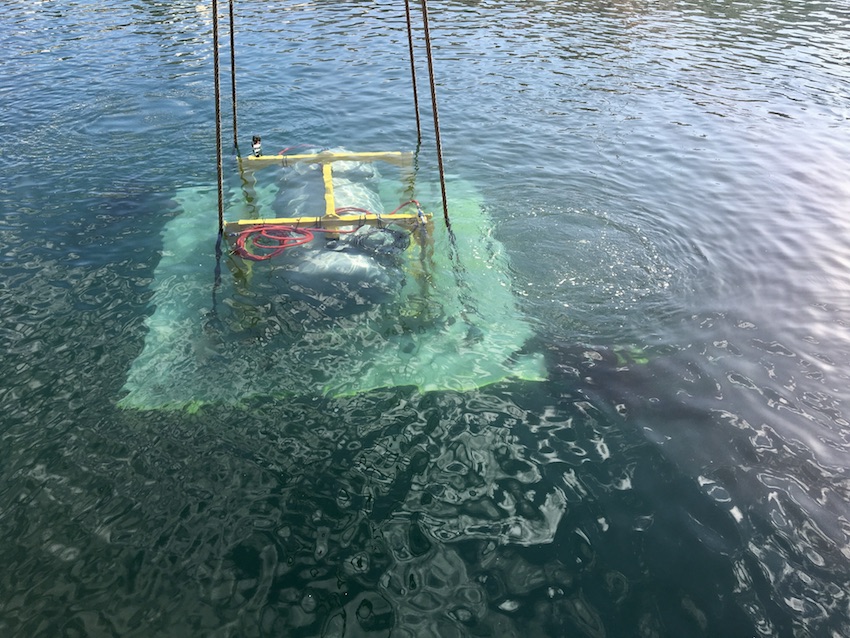

Startup FLASC, which is developing a battery-free energy storage system for the offshore industry, is partnering with Subsea 7. This company focuses on offshore projects and services for the energy sector. Together, the parties intend to market FLASC's energy storage system.
FLASC is a spin-off from the University of the Malta and based in Delft. The startup is working on an energy storage system that does not use batteries, but combines compressed seawater and compressed air into an energy storage system. Here, energy is stored using a hydro-pneumatic fluid-driven piston driven by a pump turbine, also known as a peripheral pump.
Storing water under pressure
Energy storage uses electricity to pump water into a closed chamber with compressed air. While releasing electricity, this pressurised stored water is released through a hydraulic turbine to generate energy. Targeted at the offshore industry, the energy storage system is placed in seawater. In doing so, the water serves as a heat sink and dissipates excess heat.
The animation below demonstrates how FLASC works.
Prototype
The company tested a prototype of its storage system at a port in Malta in late 2017. This used FLASC to store energy generated by an array of solar panels. This stored energy was released in a controlled manner to measure the performance and efficiency of the system. The prototype was built by the startup in collaboration with industry partner Medserv and with funding from the Malta Council for Science and Technology.
In the video below, FLASC explains its prototype.
Various advantages
On its website, FLASC sets out various advantages of its energy storage system:
- Safe: The technology uses compressed seawater and compressed air. None of the materials and subcomponents used are considered hazardous or flammable during their life cycle.
- Longevity: After installation, FLASC can operate for 25 years in demanding conditions, according to the startup.
- Scalable: The system is scalable and can therefore easily grow with growing energy needs. FLASC is particularly interesting for applications requiring more than 10 MWh of storage capacity.
- Suitable for shallow water: Even in shallow water, FLASC can achieve a high energy density, which improves storage capacity. In addition, the storage capacity can be adjusted as required and does not depend on external hydrostatic pressure.
- Uses existing supplier chain: Although the storage technology is new, the underlying technology is based on widely available components widely used in the offshore industry.
Applications
The startup foresees several applications for its storage technology. For instance, many renewable energy sources do not generate energy in a constant manner; the capacity generated varies. However, energy networks are not designed to handle this and can only cope with limited variations. FLASC's technology can be used to temporarily store energy and release it to the energy grid in a controlled manner.
Natural conditions can also significantly affect the power generated from energy sources. If conditions change, this can lead to a sudden increase or decrease in the amount of energy generated, for example. FLASC technology can be used to accommodate these sudden changes, allowing these changes to be spread out over a longer period of time, thus slowing them down.
However, FLASC technology can also be used for applications where large quantities of cold compressed seawater are needed. These include liquefaction of natural gas, offshore production of hydrogen gas, liquefaction of CO2 for its capture and storage and desalination of seawater.
More information about FLASC can be found here.
Author: Wouter Hoeffnagel