Robotisation at a miniscule level. That's what TU Eindhoven researchers have done with the development of a small plastic robot made of responsive materials. It moves under the influence of light and magnetism. In the future, this 'wireless aquatic polyp' could extract pollutant particles from the surrounding water, or pick up and transport cells for analysis in diagnostic systems.
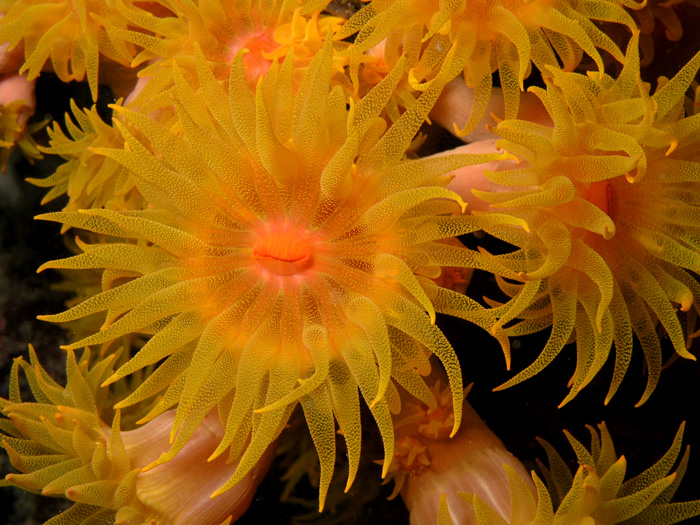
The mini-robot is inspired by a coral polyp; a small, soft-bodied animal with tentacles that form the basis of coral in the ocean. PhD student Marina Pilz Da Cuncha says in a press release on the Eindhoven University of Technology website: “I was inspired by the movement of these coral polyps, particularly by the water current they generate themselves, which allows them to truly interact with their environment.” The body of the living polyp makes a specific movement that generates a water current which attracts food particles. The tentacles then grab the food particles as they drift past.
Movement on light
The wireless-controlled artificial polyp developed measures 1 by 1 cm, has light-controlled tentacles and a stem that responds to magnetism. “Combining these two stimuli has not been done very often because it requires delicate manufacturing and assembly processes. But it’s very interesting for robot design, as it enables complex movements and tasks,” explains Pilz Da Cunha. The tentacles move when illuminated by light. Different wavelengths produce different results. For example, the tentacles ‘grip’ under the influence of UV light, whilst they ‘release’ under blue light. This video shows how the artificial polyp attracts the floating oil droplet and then grips it firmly. The stem rotates around its axis under the influence of magnetism. The polyp thereby creates a current in the water. This current draws the oil droplets towards the tentacles. The tentacles then close around the oil droplet under the influence of UV light. Blue light can open the tentacles again, releasing the droplet.
From land to water
The device now unveiled can grasp and release objects underwater. This is a new feature of the light-powered mini parcel delivery robot unveiled earlier this year. This land-based robot proved unable to operate underwater, as the polymers from which it is constructed rely on photothermal signals. It was the heat generated by the light, rather than the light itself, that powered the robot. Pilz Da Cunha: “And heat is quickly dissipated in water, so it wasn’t possible to control the robot underwater.” She therefore developed a photomechanical material – a material that moves only when exposed to light, without the need for heat.
And that's not the only advantage of the new material. Besides working under water, it can also hold its shape after light-activation. While the photothermal material immediately returns to its original shape after the stimulus is removed, the molecules in the photomechanical material assume a new state. This allows for different stable shapes. "This helps control the gripping arm; once something is caught, the robot continues to hold on to its loot until you re-shine it," says Pilz Da Cunha.
Rotating magnet
By placing a rotating magnet under the robot, the trunk circles its axis, so to speak, as shown in the video. Pilz Da Cunha: "This made it possible to actually move the floating objects in the water, in our case oil droplets, towards the polyp."
The position of the tentacles (open, closed or something in between), was found to affect the flow. "Computer simulations, with different tentacle positions, eventually helped us understand the movement of the stem and therefore get it just right. And to thus 'lure' the oil droplets to the tentacles," explains Pilz Da Cunha.
The beauty is that the robot operates independently of the composition of the surrounding liquid. This is unique because most of the stimuli-responsive materials used in underwater applications, hydrogels, are actually sensitive to their environment. Hydrogels therefore behave differently in contaminated water. Pilz Da Cunha: "On the contrary, our robot works exactly the same in salt water, or in water with pollutants. Indeed, the polyp may in future be able to filter pollutants from the water, by catching them with its tentacles."
Swimming robot?
PhD student Pilz Da Cunha is now working on the next step: an array of polyps that can work together. With this, she hopes to achieve transport of particles, with one polyp passing a 'package' to the other. A swimming robot is also still on her wish list. Applications for this include biomedical things like drug transport or trapping specific cells.
Before that, the researchers still need to work on the wavelengths to which the material reacts. "UV light affects cells, and the penetration depth in the human body is limited. Moreover, the UV light could possibly damage the robot, reducing its lifespan. Therefore, we will work on a robot that does not need UV light as a stimulus."
Source: TU Eindhoven
Video: Pilz Da Cunha.










